
Performance management is a structured, ongoing process. It sets expectations, measures results, gives feedback, and helps employees improve over time. In practice, performance management aligns individual work with business priorities. It also helps employees understand goals, develop skills, and perform better.
What is Performance Management?
Performance management is a continuous process that includes planning, monitoring, evaluating, and improving employee performance. The goal is to ensure individual effort supports team and organizational success. It is not a single annual review. Rather, it is a broader management approach that uses goal setting, feedback, coaching, measurement, and development.
What makes this different from simple supervision? The answer is continuity and alignment. Supervision may focus on day-to-day oversight, but performance management connects daily work to longer-term expectations, business priorities, and employee growth. It encourages managers and employees to regularly discuss priorities, track progress, and identify areas for improvement.
What are the core attributes of performance management?
The core attributes of performance management are key features that make it effective as an ongoing system. They improve employee performance and align work with organizational goals. Performance management is more than just evaluating employees. It creates a clear, fair, and continuous process to help people understand expectations, improve work, and contribute more over time.
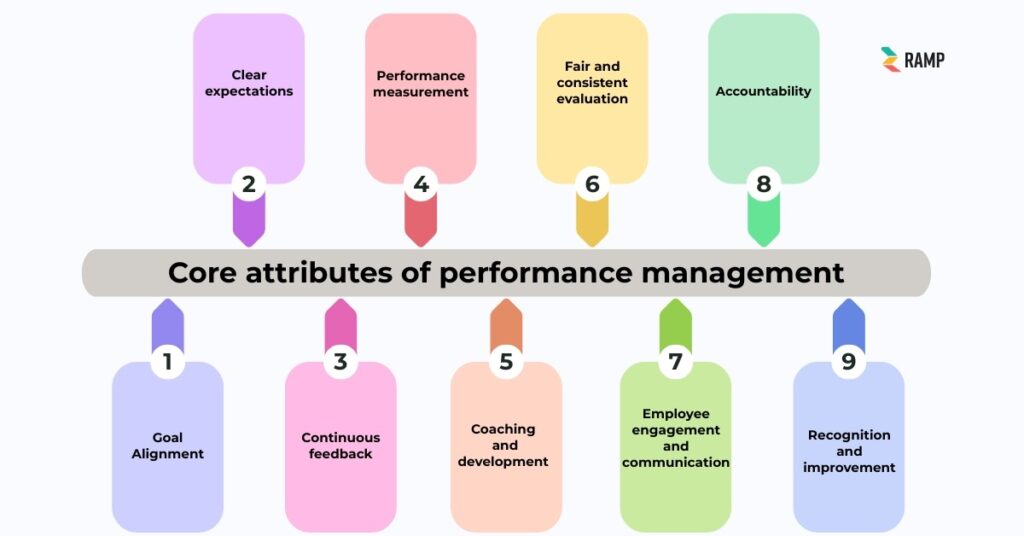
The diagram below shows the core attributes of performance management.
Here are the main core attributes in detail:
- Goal alignment: This ensures each employee's objectives support the larger team and organizational goals. It helps people see how their daily work connects to business success.
- Clear expectations: Employees must clearly understand their duties, expected performance levels, and the outcomes that define success in their roles.
- Continuous feedback: Through frequent feedback, employees receive up-to-date information on their performance, understand which actions are effective, and know where and how to make improvements promptly.
- Performance measurement: Performance measurement involves consistently tracking both behaviors and outcomes using clear benchmarks, ensuring that performance reviews are based on objective data, not subjective impressions.
- Coaching and development: In addition to judging past performance, it focuses on helping employees grow through guidance, support, training, and skill-building.
- Fair and consistent: A strong performance management system uses the same standards for all employees. Structured reviews and documented discussions help reduce bias.
- Employee engagement and communication: Employee engagement relies on open, two-way discussions so managers and employees can regularly share achievements, express concerns, and identify development needs.
- Accountability: Employees are responsible for achieving results and making improvements, while managers are responsible for offering guidance, maintaining fairness, and helping employees succeed.
- Recognition and improvement: Good performance management recognizes strong performance and addresses gaps for improvement. This may mean taking corrective action or creating improvement plans.
The core attributes of performance management are alignment, clarity, feedback, measurement, development, fairness, communication, accountability, and improvement. Together, these attributes make performance management a continuous and practical process rather than a one-time review activity.
What is the Performance Management Process?
The performance management process is the structured, ongoing method organizations use to plan, monitor, review, and improve employee performance. It helps ensure that employees understand their goals, receive feedback on their work, get support for improvement, and stay aligned with organizational objectives. It is a continuous cycle, not a one-time event. This is where a well-designed performance management system plays a crucial role.
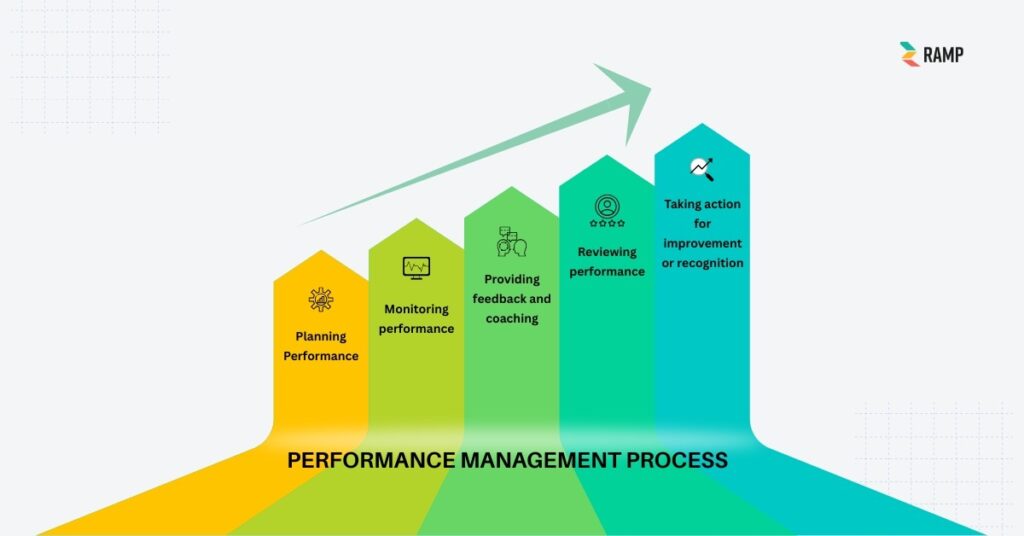
The diagram below shows the 5 processes of Performance Management.
The main steps in the performance management process are:
- Planning performance: Managers and employees first set clear goals, job expectations, responsibilities, and performance standards. This stage defines the goals to achieve and the criteria for measuring success.
- Monitoring performance: Managers track performance over time through regular check-ins, work tracking, and progress discussions. This process helps identify whether the employee is meeting expectations or facing challenges.
- Providing feedback and coaching: Managers provide ongoing feedback on strengths, weaknesses, and areas for improvement. Coaching, guidance, and support are provided so employees can improve their performance and develop their skills.
- Reviewing performance: Managers formally review employee performance quarterly or annually and compare actual results with previously set goals and standards to assess overall contribution.
- Taking action for improvement or recognition: Based on the review, the organization may reward strong performance, plan employee development, offer training, adjust goals, or create improvement plans where needed.
In short, the performance management process is a continuous cycle of setting goals, tracking work, giving feedback, evaluating results, and helping employees improve. Its purpose is not only to measure performance but also to strengthen it over time.
What are the benefits of performance management?
The main benefits of performance management are:
- Clear expectations: Employees understand their roles, goals, and the standards they are expected to meet.
- Better goal alignment: Individual performance is connected to team and organizational objectives, which helps to improve focus and direction.
- Continuous feedback: Regular feedback helps employees correct mistakes early, build on strengths, and improve performance over time.
- Employee development: It identifies skill gaps and training needs, which support the learning, growth, and career development of the employees.
- Higher motivation and engagement: Employees often perform better when they receive guidance, recognition, and support.
- Improved decision-making: It provides a structured basis for decisions about promotions, rewards, transfers, and performance improvement plans.
- Greater accountability: Both managers and employees become more responsible for setting goals, tracking progress, and achieving results.
A research paper titled "Harnessing the Power of Performance Management" by Sabrin Chowdhury, Elizabeth Hioe, and Bill Schaninger shows the strong business outcomes framing for why good performance management matters, and also points out three key practices of effective performance management.
In short, the benefits of performance management include clarity, feedback, development, motivation, and organizational alignment. Good performance management helps employees understand expectations, improve their work, and stay aligned with organizational goals. That's why the manager's role in performance management is crucial.
What are the limitations of performance management?
The main limitations of performance management are:
- Risk of bias: Personal opinions, favoritism, or inconsistent judgment can affect evaluations.
- Time-consuming process: If the system is too complex, regular reviews, meetings, and documentations can take significant time.
- Overemphasis on measurement: Some systems focus too much on ratings and numbers instead of actual growth and meaningful contribution.
- Employee stress or fear: It can reduce confidence and trust of the employees if the process feels punitive rather than supportive.
- Inconsistent implementation: The system may fail if managers do not give useful feedback or apply standards fairly.
- Limited effectiveness without follow-up: Performance management loses value when feedback is not followed by coaching, development, or action.
If managed poorly, performance management becomes a paperwork exercise. It can create stress, bias, and confusion instead of improvement.