
Performance management systems are structured frameworks that organizations implement to plan, monitor, evaluate, and enhance employee performance over time. These systems align individual contributions with organizational objectives through goal setting, feedback, assessments, metrics, and development, thereby promoting consistency, transparency, and actionable outcomes across the organization.
What Are Performance Management Systems?
A performance management system encompasses more than a review form or annual appraisal. It represents the comprehensive structure through which performance is defined, discussed, monitored, and improved. An effective system provides managers with a consistent process for setting goals, evaluating results, delivering feedback, and facilitating employee development.
Performance management refers to the broader practice of improving performance, whereas performance management systems are the organized frameworks designed to implement this practice consistently.
Why Performance Management Systems Matter?
Performance management systems matter because employee performance does not improve by accident. Organizations need a reliable way to define success, monitor contribution, address gaps, and recognize strong work. Without a system, performance decisions often become inconsistent, subjective, or reactive.
An effective system clarifies expectations for employees and demonstrates how their work aligns with team and organizational priorities. It enables managers to move beyond subjective impressions by utilizing clear standards, evidence, and regular communication. This approach enhances fairness and increases the utility of performance discussions.
At the organizational level, performance management systems facilitate alignment, accountability, and talent development. These systems assist leaders in identifying high performers, detecting capability gaps, planning succession, and making informed decisions regarding compensation and advancement. Well-designed systems also enhance communication and minimize unexpected outcomes during formal reviews.
What Performance Management Systems Include?
Performance management systems encompass a range of tools and processes. They typically integrate several interconnected components that function collaboratively throughout the year.
Most systems include these core elements:
- Goal setting and expectation alignment
- Role definitions and performance standards
- Ongoing check-ins and manager feedback
- Performance reviews or formal appraisal cycles
- Metrics, KPIs, or scorecards
- Self-assessments and manager evaluations
- Development planning and coaching
- Documentation for rewards, promotions, or corrective action
Each component serves a specific function: goals establish targets, feedback facilitates improvement, reviews summarize results over a defined period, and development planning translates insights into growth opportunities. The system achieves maximum effectiveness when these elements are integrated rather than functioning as isolated human resources tasks.
What are the types of Performance Management Systems?
The primary types of performance management systems are traditional appraisal systems, continuous performance systems, competency-based systems, goal-based systems, and development-focused systems. Each type addresses performance according to the specific values and priorities of the organization.
The following diagram illustrates the various types of performance management systems.
A detailed explanation of each type of performance management system is provided below.
Traditional Appraisal Systems
These systems rely on annual or semiannual performance reviews, often with manager ratings and fixed evaluation forms. They are prevalent in large organizations with formal review cycles.
Continuous Performance Systems
These systems emphasize frequent check-ins, continuous feedback, and shorter review cycles. They are particularly suitable for dynamic work environments in which priorities change regularly.
Competency-Based Systems
These systems measure employees against specific skills, behaviors, and capabilities critical for the role. They are often used for leadership assessment, professional development, and promotion planning.
Goal-Based Systems
These systems focus primarily on measurable objectives, such as SMART goals or OKRs. Performance is evaluated based on progress toward established outcomes.
Development-Focused Systems
These systems place greater emphasis on coaching, skill development, growth-oriented discussions, and future potential, rather than focusing solely on past performance.
Traditional systems emphasize periodic evaluation, whereas continuous systems prioritize regular coaching and ongoing adjustment.
How Performance Management Systems Work?
Performance management systems operate by establishing a repeatable cycle that connects expectations, observation, evaluation, and improvement. This cycle typically begins with goal setting and continues through regular performance discussions, culminating in a formal review or summary.
A typical system works in this sequence:
- Set performance goals and clarify responsibilities
- Define standards, measures, or competencies
- Track progress throughout the work period
- Hold check-ins and provide ongoing feedback
- Document key outcomes, behaviors, and issues
- Conduct formal performance reviews
- Link results to development, rewards, or corrective action
- Reset goals for the next cycle
This structure ensures that performance management remains proactive rather than reactive. Rather than postponing the discussion of issues or achievements until year-end, the system facilitates real-time conversations. This approach increases the process's actionability, precision, and capacity for meaningful improvement.
Key Benefits of Performance Management Systems
Organizations implement performance management systems because well-designed systems generate value for both employees and the business. These systems enhance organizational structure, clarify priorities, and render performance discussions more actionable.
The diagram shows the key benefits of performance management systems.
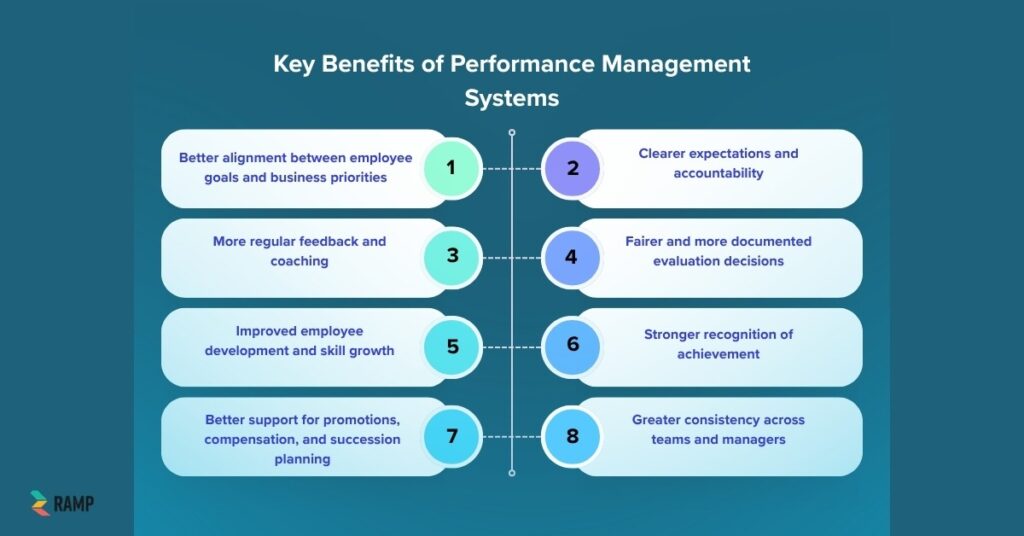
The main benefits of performance management systems include:
- Better alignment between employee goals and business priorities
- Clearer expectations and accountability
- More regular feedback and coaching
- Fairer and more documented evaluation decisions
- Improved employee development and skill growth
- Stronger recognition of achievement
- Better support for promotions, compensation, and succession planning
- Greater consistency across teams and managers
A robust system also reduces uncertainty. When feedback is ongoing, employees are less likely to be taken by surprise during reviews. Managers make better decisions with structured discussions and documented data. In this way, the system elevates both performance and the quality of related decisions.
Common Problems and Limitations of Performance Management Systems
Although performance management systems can be effective, their impact varies significantly. Ineffectively designed systems frequently result in frustration rather than progress. Problems occur when the system is inflexible, excessively complex, subjective, or overly focused on administrative tasks. Thus, it is important to know the common performance management mistakes in order to avoid them.
The diagram shows the limitations of performance management systems.
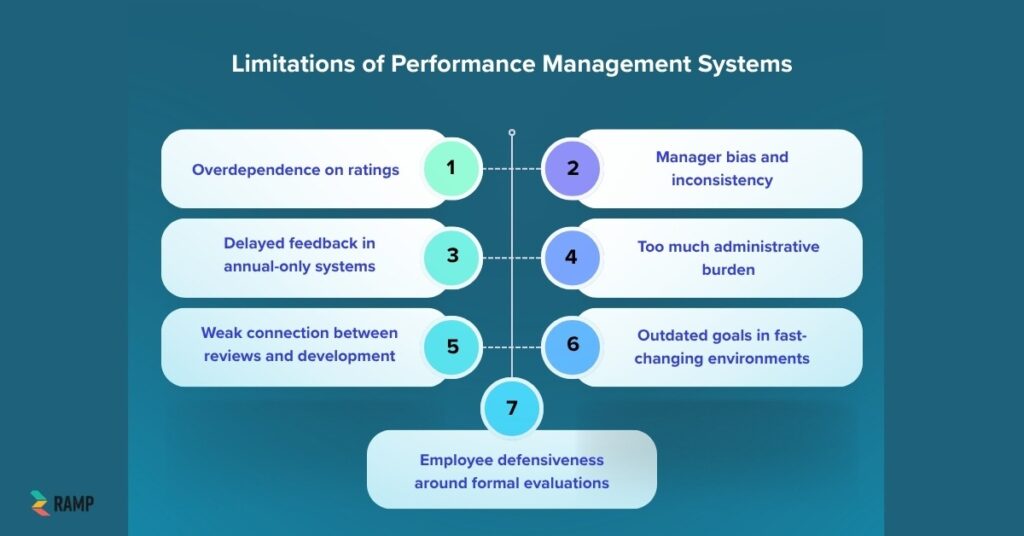
Common limitations include:
- Overdependence on ratings
- Manager bias and inconsistency
- Delayed feedback in annual-only systems
- Too much administrative burden
- Weak connection between reviews and development
- Outdated goals in fast-changing environments
- Employee defensiveness around formal evaluations
A system also fails when managers regard it solely as a human resources obligation rather than a leadership responsibility. Thus, it is vital to understand the manager’s role in performance management. In such cases, forms may be completed, but substantive coaching is often neglected. The distinction between system design and effectiveness lies in the fact that design addresses system intent, whereas effectiveness depends on consistent and skillful implementation.
Examples of Performance Management Systems in Practice
Performance management systems may differ by organization, but their purpose remains the same. The goal is to keep performance visible, manageable, and improvable.
Here are common examples:
- A company uses quarterly goal setting, monthly check-ins, and annual review summaries.
- A sales organization measures quota attainment, pipeline quality, and coaching progress.
- A technology team uses project delivery, peer input, and skill development plans.
- A service team tracks response quality, resolution time, and customer feedback.
- A leadership program evaluates business outcomes, team engagement, and succession readiness.
In addition to these, a white paper titled "Encouraging Effective Performance Management Systems" by Society for Industrial and Organizational Psychology (SIOP) mentions the effective systems of performance management and outlines the critical role of aligning individual goals with company strategy.
These examples show that systems do not need to be identical to be effective. They need to fit the nature of the work while keeping the principles of clarity, fairness, and continuous improvement.