
Modern performance management is a flexible, ongoing approach that aligns employee goals, feedback, development, and business priorities in real time rather than relying solely on annual reviews. This approach enhances clarity, agility, accountability, and organizational growth through regular check-ins, well-defined goals, data-driven insights, coaching, and equitable evaluation.
What Is the Modern Performance Management Framework?
Modern performance refers to a current approach to managing employee performance through continuous feedback, adaptive goals, coaching, and evidence-based evaluation. Unlike older systems built around once-a-year ratings, the modern performance management framework is designed for faster business cycles, changing priorities, and more collaborative work.
When should you use it? It works best when goals shift often, teams collaborate across functions, managers coach regularly, and organizations use performance conversations to improve results. The difference between modern performance and traditional performance is that modern performance emphasizes ongoing improvement, while traditional performance emphasizes periodic judgment.
A research paper titled "Employee Performance Management" by Julie Duda, Jason Flynn, Sue Cantrell, Nicole Scoble-Williams, and Amy Sanford of Deloitte focuses on continuous employee performance management.
This framework is particularly beneficial for growth-oriented companies, knowledge-based roles, hybrid teams, and organizations aiming to enhance engagement, retention, and execution quality.
What are the Core Components of a modern performance management framework?
The modern performance management framework depends on a small set of root attributes. These are the building blocks that make the system practical rather than theoretical.
First, it needs goal alignment. Employees should understand how individual work supports team and business outcomes.
Second, it needs continuous feedback. Performance improves faster when guidance happens during the work, not months later.
Third, it needs regular coaching. Managers should help employees solve problems, develop skills, and remove blockers.
Other core components include:
- Clear expectations and role standards
- Flexible goals that can be updated
- Frequent check-ins
- Evidence-based evaluation
- Employee self-reflection
- Development planning
- Recognition and accountability
- Fair calibration across teams
Why do these components matter together? Because a framework fails when one part is missing. Feedback without clear goals becomes vague. Goals without coaching become mechanical. Evaluation without development becomes punitive.
How is the Modern Performance Management Framework implemented?
Implementation works best when the framework is introduced as a management practice, not just a new HR form.
The first move is to define what success looks like in the organization. That means to clarify goals, performance standards, manager responsibilities, and the cadence of conversations.
The second move is to redesign the rhythm. Annual reviews alone are not enough. Weekly, biweekly, monthly, and quarterly touchpoints should each have a purpose. Managers also need training in coaching, expectation-setting, bias awareness, and documentation.
A simple implementation path looks like this:
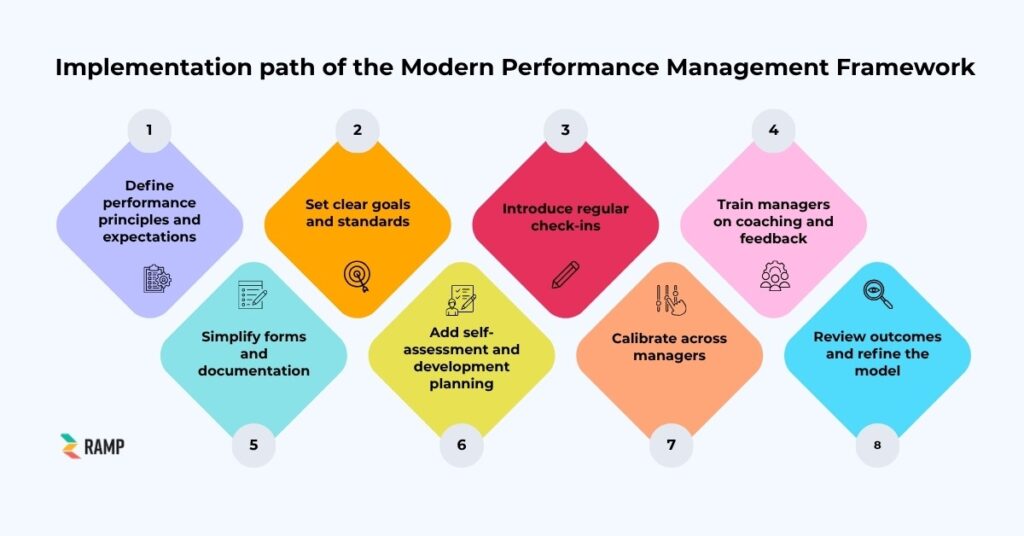
A simple implementation path includes the following:
- Define performance principles and expectations
- Set clear goals and standards
- Introduce regular check-ins
- Train managers on coaching and feedback
- Simplify forms and documentation
- Add self-assessment and development planning
- Calibrate across managers
- Review outcomes and refine the model
Why do many implementations fail? Because organizations change the form but not the behaviour. The framework only works when managers consistently use it.
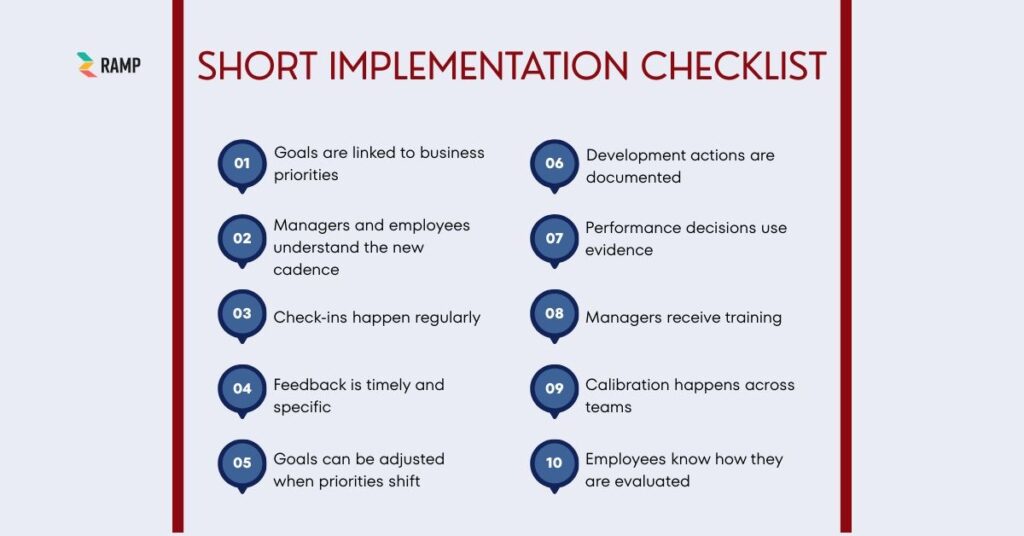
Short Implementation Checklist
The following section provides an implementation checklist. Follow each step during rollout and use the list to self-audit your progress. Ensure each action is completed in sequence for effective adoption.
What Metrics Show Effectiveness?
A modern framework should be evaluated by whether it improves performance quality, not just whether meetings happened. That means measuring both process quality and business impact.
Useful effectiveness metrics include:
- Check-in completion rate: percentage of scheduled check-ins completed in a month
- Goal update rate: percentage of employee goals reviewed or revised in a quarter
- Feedback timeliness: average number of days between a key event and feedback delivery
- Development plan completion: percentage of agreed development actions completed in a quarter
- Internal promotion rate: percentage of roles filled internally over a year
- Regrettable attrition rate: percentage of high-value employees lost during a year
- Engagement score: average employee survey rating over a survey cycle
The difference between activity metrics and outcome metrics is that activity metrics show whether the process happened, while outcome metrics show whether the process worked. A good framework tracks both.
What Are the Pros?
The biggest advantage of the modern framework is that it makes performance management more useful. Feedback becomes faster, goals stay relevant, and employees get more support while work is still in motion. That improves both execution and learning.
Another strength is better alignment. Because goals are reviewed more often, people are less likely to spend months pursuing outdated priorities. The framework also supports stronger engagement because employees get more clarity, more recognition, and fewer surprises during formal evaluations.
The diagram includes the benefits of the Modern Performance Management Framework.
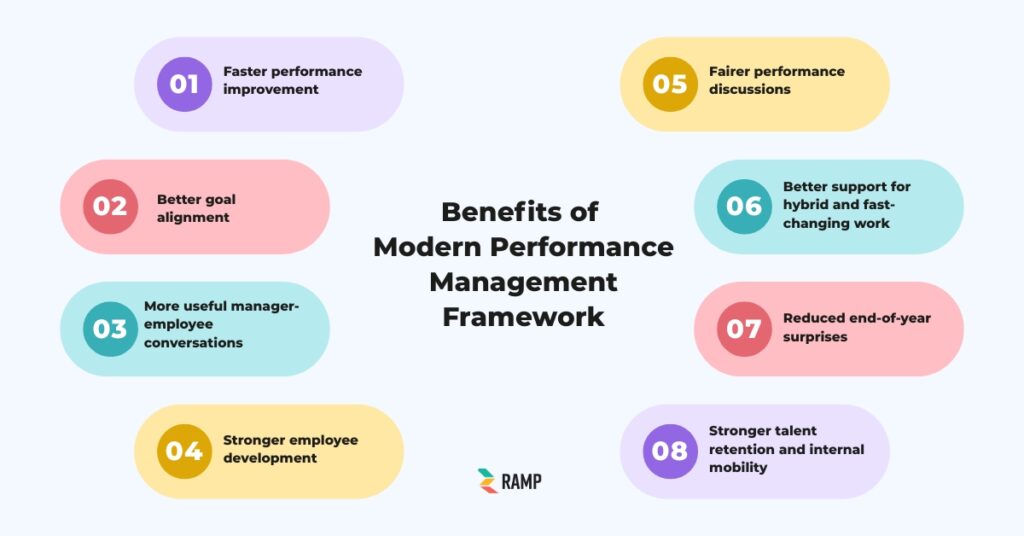
Key benefits in the diagram include:
- Faster performance improvement
- Better goal alignment
- More useful manager-employee conversations
- Stronger employee development
- Fairer performance discussions
- Better support for hybrid and fast-changing work
- Reduced end-of-year surprises
- Stronger talent retention and internal mobility
Why are these benefits meaningful? Because performance systems fail when they are too delayed or too disconnected from real work. Modern frameworks reduce both problems.
What Are the Cons and Limitations?
The modern framework is not automatically better in every environment. It is important to keep the common performance management mistakes in mind. It can fail when managers are poorly trained, when the organization adds too many touchpoints, or when the process becomes frequent but still vague. More conversations do not help if the conversations are weak.
Another limitation is inconsistency. Some managers coach well, others do not. Without standards and calibration, a modern framework can still feel unfair. It can also create fatigue if every check-in becomes another administrative task.
The diagram shows the common limitations of the Modern Performance Management Framework.
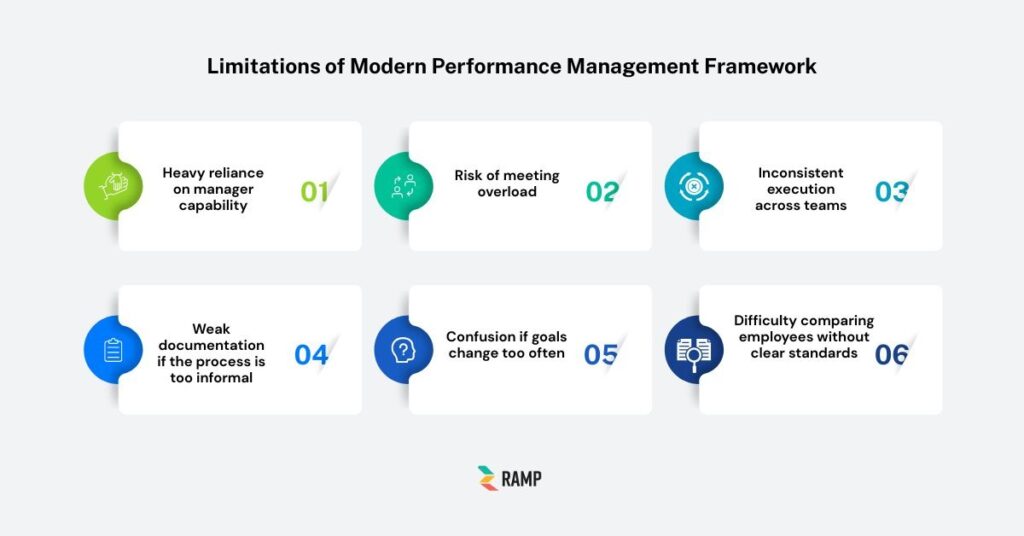
Common limitations include:
- Heavy reliance on the manager's capability
- Risk of meeting overload
- Inconsistent execution across teams
- Weak documentation if the process is too informal
- Confusion if goals change too often
- Difficulty comparing employees without clear standards
The difference between flexibility and lack of structure is important. A modern system should be adaptable, but it still needs defined expectations, evidence, and discipline.
When Not to Use It?
There are cases where a fully modern framework may not be the best fit. Highly stable environments with routine work and limited change may not need frequent goal revisions or constant coaching cycles. In those settings, a lighter process may be enough.
It is also a poor fit when managers have not been trained, and leadership is not committed to regular follow-through. Without those foundations, the framework can become confusing, inconsistent, and overly time-consuming. A company should not adopt a modern model only because it sounds current.
The best answer is often not to reject the framework entirely, but to scale it properly. Some organizations need a full continuous model. Others need only a simpler version with quarterly check-ins, clearer goals, and better feedback.
How HeyRamp Supports Modern Performance Management?
HeyRamp supports modern performance management by bringing goals, feedback, 1:1s, performance reviews, DISC-based behavioral insights, and team analytics into one structured system. Instead of treating performance as a once-a-year review, HeyRamp positions it as a continuous operating rhythm built around communication, accountability, development, and measurable progress. Public product descriptions consistently highlight HeyRamp's clear goals, structured 1:1s, meaningful feedback, DISC assessments, performance reviews, and team analytics.