
Performance management mistakes are the common errors that make performance systems unclear, unfair, inconsistent, or ineffective at improving employee results. Performance management mistakes reduce accountability, weaken engagement, and hurt business outcomes when organizations rely on poor design, weak manager habits, biased evaluation, and outdated workplace assumptions.
What Are the Performance Management Mistakes?
Performance management mistakes are flaws in strategy, process, behavior, communication, and culture that prevent performance management from working as intended. A strong system should clarify expectations, improve performance, support development, and align employee effort with business goals. Mistakes do the opposite. They create confusion rather than clarity, defensiveness rather than growth, and administration rather than improvement.
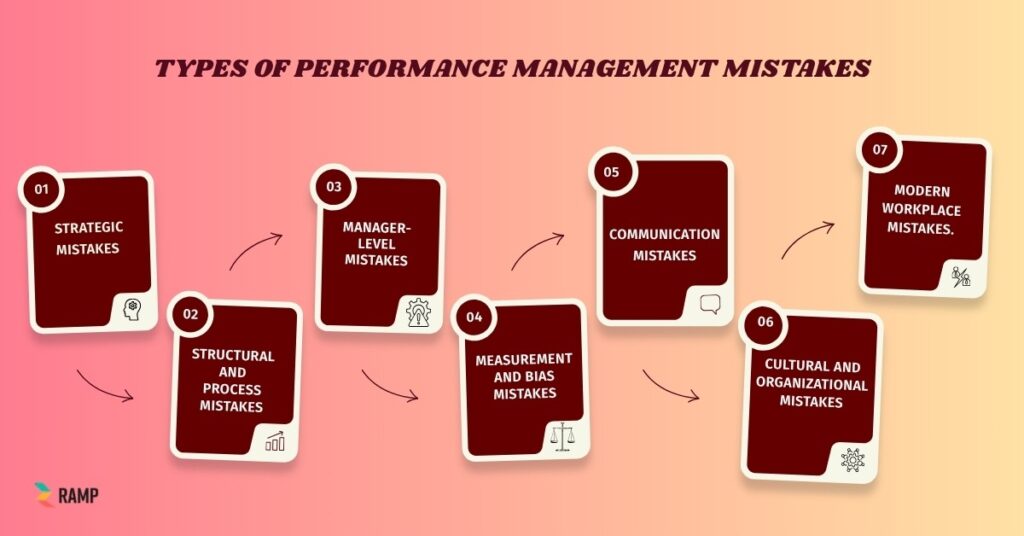
Common types of performance management mistakes include strategic, structural, and process, manager-level, measurement and bias, communication, cultural and organizational, and modern workplace mistakes.
The diagram shows the types of performance management mistakes below.
Strategic Mistakes
Strategic mistakes occur when performance management is not aligned with the business's actual direction. Many organizations treat the process as an HR requirement rather than a management tool that supports execution, capability building, and accountability. When this happens, employees may complete reviews and forms without understanding how their work contributes to team or company priorities.
Another strategic mistake is using performance management primarily to judge past performance rather than to improve future performance. A system built solely for ratings, promotions, or compensation decisions often becomes defensive and narrow. Employees focus on protecting their image rather than improving their work.
The difference between strategic alignment and administrative completion is that strategic alignment makes performance management useful for achieving business results, while administrative completion only shows that the process was completed. A strong system connects goals, feedback, development, and performance outcomes to the organization's real priorities.
Structural and Process Mistakes
Structural and process mistakes refer to the design flaws that make performance management rigid, slow, or overly complicated. One common mistake is relying too heavily on annual reviews. When performance discussions happen only once or twice a year, feedback comes too late to help employees improve while the work is still in progress.
Another mistake is building a process that is too bureaucratic. Long forms, excessive rating fields, and complex approval layers often lead managers to focus on compliance rather than coaching. Employees then experience the system as paperwork rather than support.
A further process mistake is failing to update goals during the performance cycle. In many workplaces, priorities shift quickly, but the official goals remain frozen. This creates a gap between what employees are evaluated on and what the business actually needs.
The difference between a structured process and a rigid process is that a structured process supports consistency, while a rigid process prevents adaptation. Good design makes performance conversations simple, regular, and relevant.
Manager-Level Mistakes
Manager-level mistakes are among the most damaging because managers are the main link between the system and the employee experience. A common mistake is avoiding feedback until the formal review. When managers delay difficult conversations, performance issues grow, trust weakens, and employees lose the opportunity to correct problems early.
Another mistake is being unclear about expectations. Employees cannot perform well when managers use vague language, shifting standards, or incomplete instructions. Thus, establishing a communication framework is necessary. Statements like "do better" or "be more proactive" do not help unless the manager explains what behavior needs to change.
Some managers also make the mistake of focusing only on problems and ignoring recognition. Performance management should include both corrective and reinforcing measures. Employees need to know what to improve, but they also need to know what strong performance looks like.
The difference between managing performance and reacting to performance is that managing performance involves ongoing guidance, while reacting to performance means stepping in only after something goes wrong.
Measurement and Bias Mistakes
Measurement and bias mistakes happen when organizations or managers use flawed standards to assess performance. One common mistake is relying too heavily on ratings without enough supporting evidence. A number or label may be simple to record, but it rarely captures the full value of someone's work, especially in roles that depend on judgment, teamwork, or problem-solving.
A research paper titled "Toward Fairer Data-Driven Performance Management" by Harvard Business Review, which focuses on fairer data-driven performance management and addresses fairness, bias, and data quality in performance management.
Bias is another major issue. Managers may be influenced by recent events, first impressions, personal preferences, or one standout trait. This can distort evaluations and make the process seem unfair. Employees quickly lose confidence in performance management when they believe decisions are subjective or inconsistent.
Another mistake is measuring only what is easy to count. Output numbers may matter, but performance often includes quality, collaboration, initiative, reliability, and adaptability. If measurement is too narrow, employees may optimize for visible metrics while neglecting broader value.
The difference between evidence-based evaluation and impression-based evaluation is that the former uses examples and patterns, while the latter relies too much on opinion.
Communication Mistakes
Communication mistakes occur when performance management fails because expectations, feedback, and decisions are not clearly explained. One frequent mistake is giving feedback that is too general. Employees cannot act on comments like "improve your attitude" unless the manager explains the specific behavior, context, and impact involved.
Another communication mistake is making performance conversations one-sided. When managers speak only to deliver judgment, employees become passive, defensive, or disengaged. Better conversations allow employees to reflect, ask questions, explain obstacles, and participate in next-step planning.
Timing also matters. Feedback that comes too late loses much of its value. Praise delivered months after the result feels weak, and corrective feedback delivered after the opportunity to improve has passed creates frustration instead of progress. Thus, real-time feedback is crucial.
The difference between feedback and criticism is that feedback is meant to guide improvement, while criticism often focuses only on what is wrong. Good communication in performance management is timely, specific, respectful, and actionable. That's why it's important for managers to know how to give constructive feedback to employees.
Cultural and Organizational Mistakes
Cultural and organizational mistakes occur when the wider workplace environment undermines the purpose of performance management. A common mistake is creating a culture where feedback feels threatening. In such environments, employees hide mistakes, managers avoid honesty, and review conversations become political rather than productive.
Another mistake is rewarding outcomes without paying attention to behavior or values. If an organization says collaboration matters but rewards only individual results, employees receive mixed signals. This weakens trust in both the system and leadership.
Some organizations also make the mistake of treating performance management as an isolated HR process rather than a daily management responsibility. When leaders do not model feedback, goal clarity, and accountability, the process becomes superficial.
The difference between a performance culture and a review culture is that a performance culture supports continuous improvement through everyday habits, while a review culture depends mostly on formal evaluation cycles. Culture shapes whether performance management feels useful or performative.
Modern Workplace Mistakes
Modern workplace mistakes refer to the ways traditional performance practices fail in fast-changing, collaborative, and flexible work environments. One common mistake is using old models designed for stable, individual work in settings where goals shift frequently, and success depends on cross-functional teamwork. In these cases, fixed annual goals and manager-only assessments often miss the reality of how work gets done.
Another mistake is failing to adapt performance management for remote or hybrid work. Some managers confuse visibility with performance and give more credit to employees they see more often. This creates unfairness and can disadvantage remote team members.
Organizations also make mistakes when they overlook employee development in fast-evolving roles. Skills can become outdated quickly, so performance management needs to support learning and adaptation, not just task completion.
The difference between traditional control and modern performance support is that the former focuses on monitoring and judging, while the latter focuses on clarity, flexibility, collaboration, and growth.
By recognizing where performance management often breaks down, organizations can create a stronger foundation for fairer evaluation, better feedback, and more meaningful development. That naturally leads to the next question: how performance should actually be assessed in a practical, consistent, and results-focused way across different roles and situations.