
Traditional performance management is a formal, periodic system that evaluates employees through annual or semiannual reviews, fixed goals, and manager-led ratings. It often fails because it is too slow for modern work, too subjective for fair decisions, and too disconnected from daily performance improvement.
Why is this important? Performance gets better when people have clear goals, regular coaching, and quick feedback, not when they get a summary months after the work is finished. In many companies, reviews become a one-time event instead of an ongoing process. Employees wait too long for helpful feedback, managers depend on memory, and ratings take over real conversations.
Traditional performance management typically involves annual appraisals, rating systems, forced rankings, and manager-led reviews. The key difference is that traditional systems focus on fixed review periods, while continuous performance management emphasizes ongoing improvement and support. That's where the modern performance management framework comes in.
Common Symptoms and Warning Signs
The symptoms usually appear before leaders admit the system is broken. The diagram below highlights three types of symptoms.
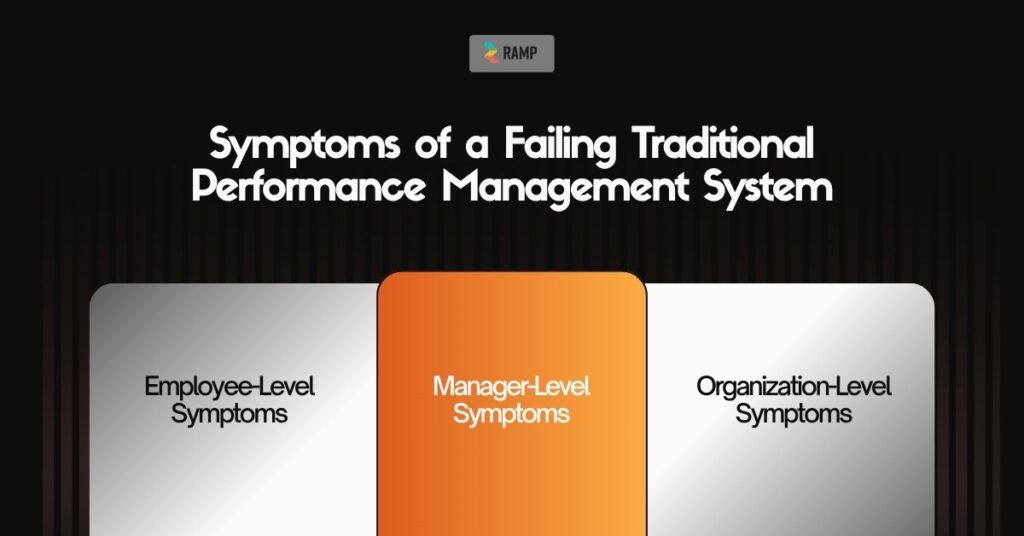
Here is a closer look at each type of symptom:
Employee-Level Symptoms
These signs often show up first in employee behavior and sentiment:
- Review conversations feel tense, defensive, or performative.
- Employees say feedback is too vague to act on.
- Strong performers feel invisible between review cycles.
- Lower performers hear problems too late to recover.
- Employees see reviews as unfair or politically driven.
- People focus on pleasing managers rather than improving work.
- Motivation drops after ratings are announced.
Manager-Level Symptoms
Managers also reveal system weaknesses through their behavior :
- They postpone feedback until formal review time.
- They struggle to justify ratings with specific examples.
- They use generic phrases instead of concrete coaching.
- They treat reviews as HR tasks, not leadership work.
- They feel uncomfortable discussing performance regularly.
Organization-Level Symptoms
At the business level, the failure becomes visible in broader patterns:
- Engagement scores stay low despite formal review completion.
- Top performers leave for places with better growth culture.
- Promotions trigger complaints about fairness.
- Goal alignment weakens across departments.
- Performance discussions do not improve execution quality.
- HR processes are completed, but behavior does not change.
What are the root causes of the failure?
The real problem starts with the root causes, not just the symptoms. Traditional performance management fails because managers delay feedback, overemphasize ratings, apply subjective judgments, keep goals too rigid, and provide limited development support. The diagram shows these root causes.
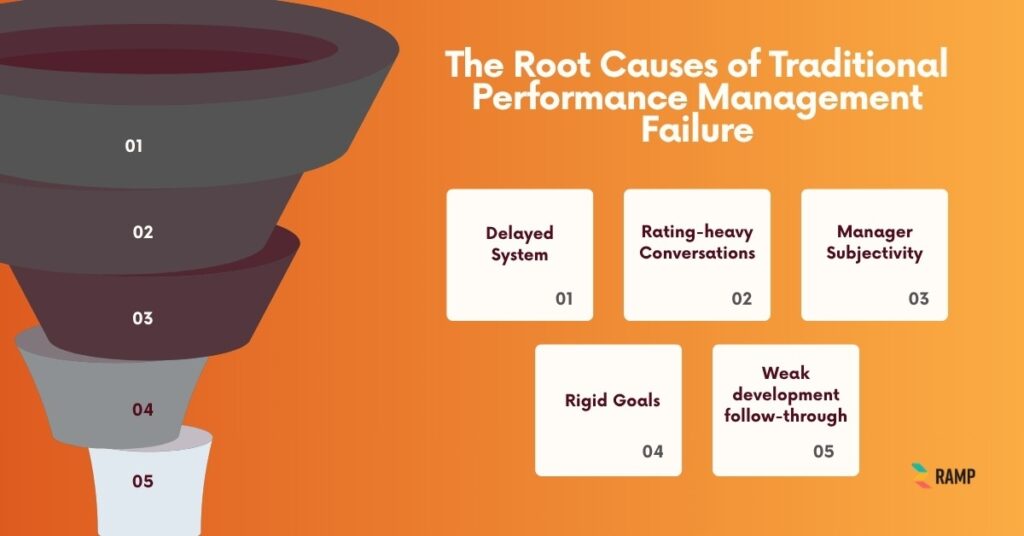
First, traditional performance management refers to a delayed system. Feedback often arrives long after the work is completed, which reduces learning value and makes improvement harder. Employees need guidance while they can still adjust performance, not after the fact.
Second, the system often depends too heavily on ratings. Once a single score becomes the focus, the discussion shifts from improvement to self-defense. Employees argue about numbers instead of understanding what to change.
Third, the manager's subjectivity weakens fairness. Bias, memory gaps, favoritism, and inconsistent standards can distort evaluation. When employees do not trust the process, the process loses credibility.
Fourth, goals are often too rigid. Work priorities change, but annual objectives may remain unchanged. Employees can end up judged against outdated targets.
Fifth, development is usually underbuilt. Many traditional systems identify gaps without turning them into clear coaching, practice opportunities, or support.
Research from the University of Alabama at Birmingham (UAB) also highlights the weaknesses of traditional performance management. It notes that infrequent evaluations, rigid rating criteria, and top-down processes can reduce employee engagement and make feedback feel punitive. UAB recommends replacing this approach with continuous, two-way feedback, regular coaching, and adaptable goals that support employee growth and stronger performance.
What is the best way to improve the system?
The best way to improve is to match each problem with a practical solution.
- Delayed feedback → replace annual-only reviews with regular monthly or quarterly check-ins
- Rating-heavy conversations → reduce score dominance and use evidence-based narrative feedback
- Manager subjectivity → define standards clearly and use calibration across managers
- Rigid goals → review and update goals as business priorities shift
- Weak development follow-through → requires action plans, coaching, and skill-building steps after reviews
- Administrative overload → simplify forms and focus on conversation quality
- Top-down control → add self-assessment and shared discussion so employees participate actively
This approach matters because the right fix depends on the actual cause. A company that only adds software or extra forms without solving the root problem usually keeps the same failure pattern.
Common Mistakes When Trying to Fix It
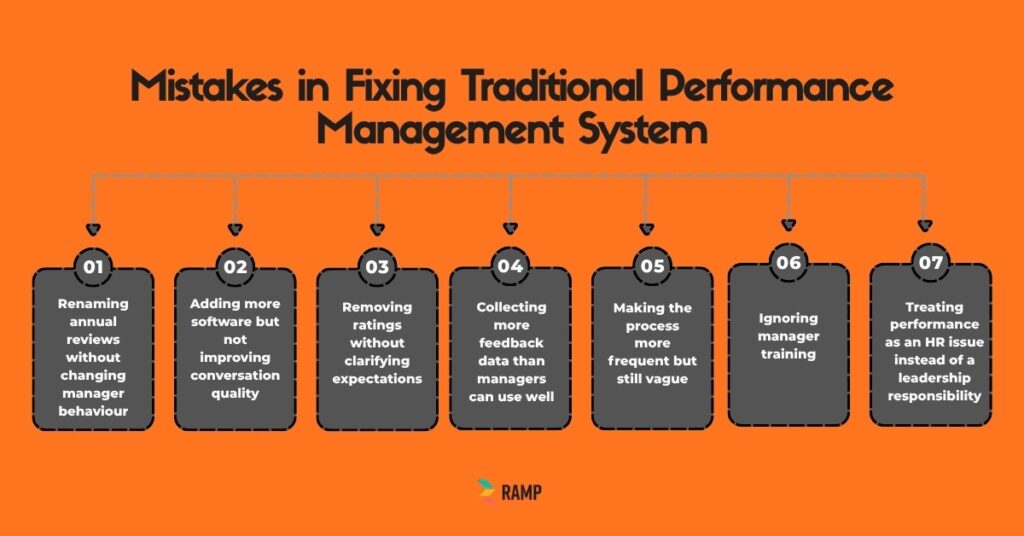
Some organizations realize the old system is not working, but still end up redesigning it poorly. The diagram shows the most common mistakes.
Quick Diagnostic Checklist
Use this quick checklist to identify the failure pattern quickly.
- Feedback is mainly given during annual or semiannual reviews.
- Employees are surprised by criticism in formal reviews.
- Goals stay fixed even after priorities change.
- Ratings dominate the conversation.
- Managers use vague feedback such as “be more strategic.”
- Different managers apply different standards.
- HR tracks forms more than coaching quality.
- Employees feel the process is unfair or political.
- Top performers feel unnoticed between review cycles.
- Lower performers hear concerns too late to improve.
If several of these signs are present, traditional performance management is likely failing in practice.
Impact on Employees and Business Outcomes
The impact goes beyond a weak review experience.
For employees, traditional performance management can reduce motivation, clarity, and confidence. Traditional performance management fails when managers delay feedback, focus too heavily on ratings, rely on subjective judgment, keep goals unchanged, and neglect employee development. When the process feels unfair, trust in the manager and the organization declines. This can slow development and reduce engagement.
For managers, the system creates pressure at the wrong time. Instead of coaching continuously, managers are expected to reconstruct months of performance during review season. That weakens accuracy and makes conversations more difficult.
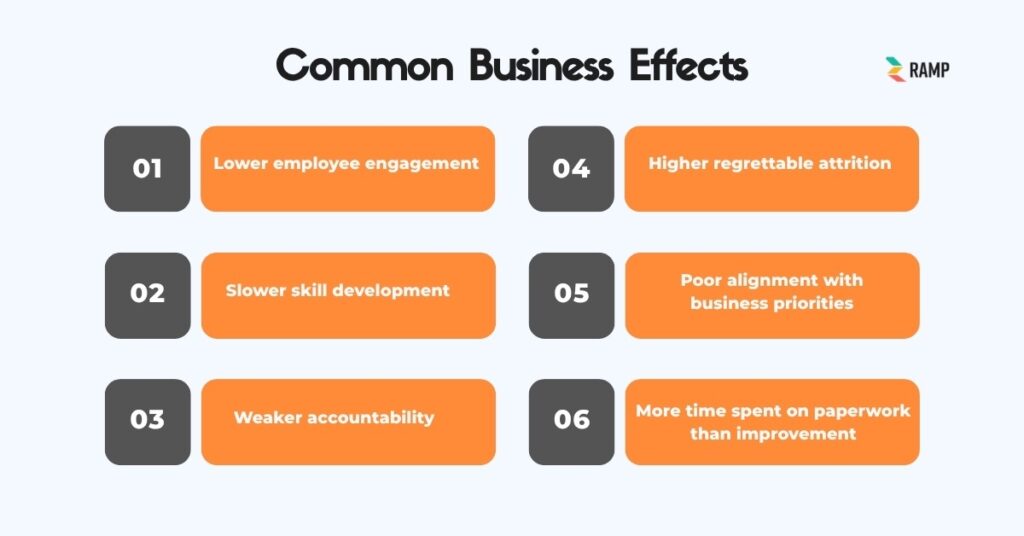
For the business, the costs are operational and cultural. Teams lose alignment when outdated goals no longer reflect current priorities. Talent retention suffers when high performers feel unseen. Promotions and rewards become less credible when standards are inconsistent.
The picture includes the common business effects:
Best Practices
Performance management works best when a few key practices are used regularly. Here are some of the most effective ones:
- Hold regular one-on-ones instead of saving issues for review season.
- Use role-relevant goals and update them when priorities shift.
- Separate coaching conversations from compensation-heavy discussions where possible.
- Ask employees for self-reflection before formal reviews.
- Document examples throughout the cycle, not only at the end.
- Train managers to give specific, evidence-based feedback.
- Use calibration sessions to reduce inconsistency across teams.
- Keep the process simple enough to be used well.
These practices are important because what makes a system effective is how it is used every day. A good system helps people improve all year, not just during review time.