

Coaching feedback is a developmental form of feedback that helps individuals improve skills, performance, confidence, and professional growth through guidance, support, and constructive conversation. Instead of only pointing out mistakes, coaching feedback aims to help people learn, reflect, and perform better over time.
It is commonly used by managers, mentors, trainers, coaches, and team leaders to encourage long-term improvement rather than short-term correction alone.
Why Does It Matter?
Coaching feedback matters because it helps individuals grow in a supportive and structured way. Rather than simply evaluating performance, it encourages learning, problem-solving, and self-awareness.
It matters because it:
- Builds employee confidence and capability
- Encourages continuous improvement
- Strengthens communication and trust
- Helps individuals develop new skills
- Improves motivation and engagement
- Supports leadership and career development
- Encourages accountability and ownership
Organizations that use coaching feedback effectively often create stronger teams and healthier workplace relationships.
Research on feedback in coaching and technology-enabled coaching processes explains that feedback plays a central role in helping coaching conversations become more effective and development-focused. The article highlights key success factors such as constructive feedback, the coach and coachee’s openness to feedback, the quality of the coaching relationship, and a supportive feedback environment. This supports the value of coaching feedback as a structured, collaborative process that builds skills, confidence, reflection, and long-term professional growth.
Core Structure of Coaching Feedback Using the SBI Framework
A practical way to deliver coaching feedback is through the SBI Framework, which stands for:
- Situation — Describe the specific context or event.
- Behavior — Explain the observable action.
- Impact — Describe the result of that behavior.
This framework keeps feedback focused on actions and outcomes rather than personal judgment.
Short Example
"In the project update meeting, I observed that you explained the technical issues very clearly and answered questions patiently. The impact was that the team understood the challenges better and was able to make faster decisions."
The SBI method makes coaching feedback more structured, objective, and actionable.
Characteristics of Coaching Feedback
Coaching feedback has several important characteristics that make it effective for guiding improvement, building confidence, and supporting long-term professional development. The diagram below shows the characteristics of coaching feedback.
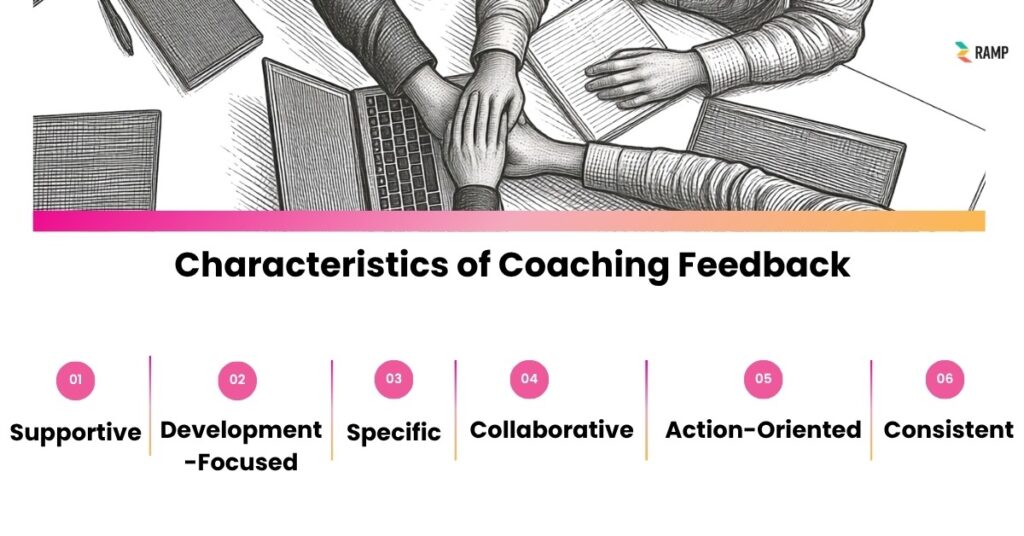
Effective coaching feedback usually includes the following characteristics:
- Supportive: The feedback is designed to encourage growth rather than criticize.
- Development-Focused: The goal is long-term improvement and skill building.
- Specific: It focuses on concrete actions and behaviors rather than vague comments.
- Collaborative: Coaching feedback encourages two-way discussion and reflection.
- Action-Oriented: It includes practical suggestions for improvement.
- Consistent: Regular coaching conversations help reinforce progress over time.
When to Use It?
Coaching feedback is most effective in situations such as:
- When employees are learning new skills or responsibilities
- During leadership and career development
- After presentations, meetings, or project work
- When improving communication or teamwork
- During employee onboarding and training
- When supporting performance improvement
- While preparing employees for future roles or promotions
It is especially valuable when organizations want to build long-term capability and team confidence.
When Not to Use It?
Coaching feedback may be less effective in certain situations, including:
- During highly emotional conflicts or stressful situations
- When immediate disciplinary action is required
- If the individual is unwilling to listen or participate
- When feedback is unclear or unsupported by facts
- If there is no trust between the coach and employee
- During urgent operational situations requiring immediate decisions
In these situations, coaching feedback may lose effectiveness and fail to create meaningful improvement.
The chart below highlights situations where coaching feedback is most effective, as well as scenarios where it may be less productive or fail to achieve meaningful improvement.
| When to Use It? | When Not to Use It? |
| When employees are learning new skills or responsibilities | During highly emotional conflicts or stressful situations |
| During leadership and career development | When immediate disciplinary action is required |
| After presentations, meetings, or project work | If the individual is unwilling to listen or participate |
| When improving communication or teamwork | When feedback is unclear or unsupported by facts |
| During employee onboarding and training | If there is no trust between the coach and employee |
| When supporting performance improvement | During urgent operational situations requiring immediate decisions |
| While preparing employees for future roles or promotions | - |
| It is especially valuable when organizations want to build long-term capability and team confidence. | In these situations, coaching feedback may lose effectiveness and fail to create meaningful improvement. |
Sentence Starters for Effective Coaching Feedback
The following sentence starters help make coaching feedback clearer and more professional:
- "In [situation], I observed…"
- "The impact was…"
Example
"In the customer support call, I observed that you stayed calm while handling a frustrated client and explained the solution step by step. The impact was that the customer became more cooperative and the issue was resolved smoothly."
These sentence starters help maintain clarity, structure, and professionalism during coaching discussions.
Common Mistakes to Avoid
Many managers and leaders make avoidable mistakes while giving coaching feedback.
The diagram below shows the common mistakes to avoid while giving coaching feedback.
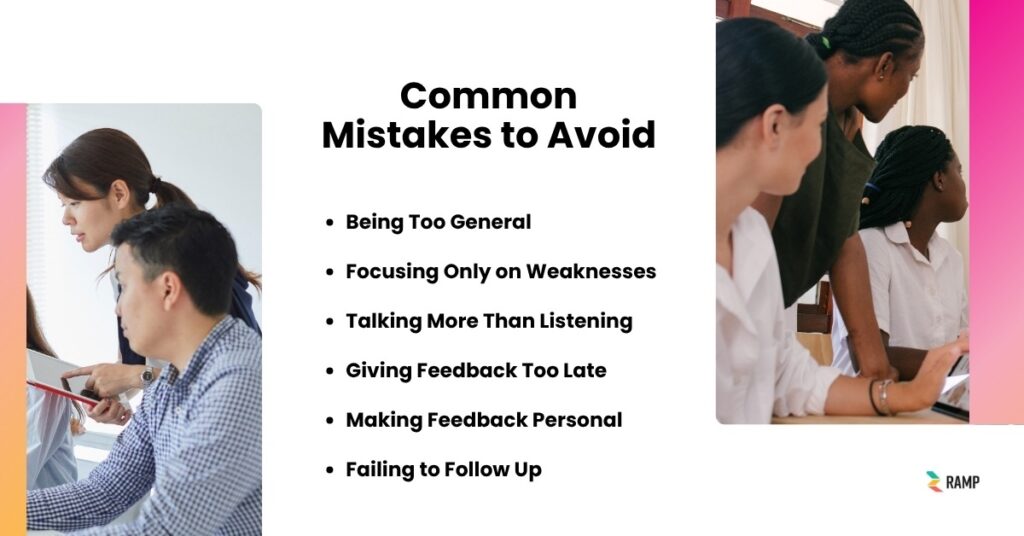
The details of the common mistakes include:
- Being Too General: Vague comments make it difficult for employees to understand what needs improvement.
- Focusing Only on Weaknesses: Ignoring strengths can reduce confidence and motivation.
- Talking More Than Listening: Coaching should involve discussion, not one-sided lectures.
- Giving Feedback Too Late: Delayed coaching reduces relevance and learning opportunities.
- Making Feedback Personal: The focus should remain on behaviors and performance, not personality.
- Failing to Follow Up: Without follow-up conversations, improvement becomes difficult to measure.
Coaching feedback is an important tool for developing skills, improving performance, and building stronger professional relationships. Unlike traditional criticism, it focuses on guidance, support, and continuous growth.
When delivered clearly and consistently, it helps individuals gain confidence, improve communication, and develop long-term professional capability. Using structured approaches, such as the SBI framework, makes coaching feedback more effective, practical, and easier to apply in everyday workplace situations.