
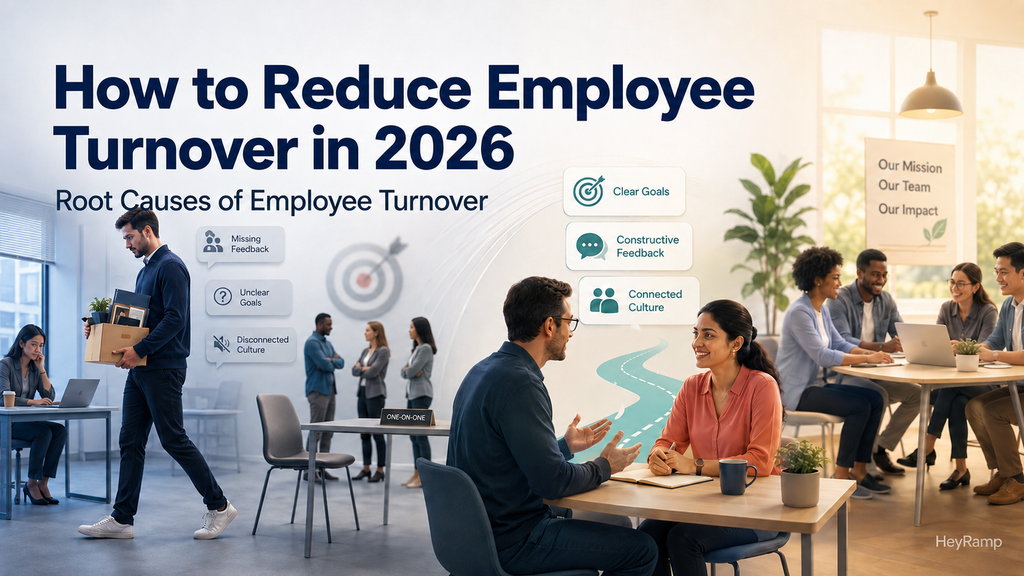
Employee turnover rarely begins with a resignation letter.
In most cases, employees leave after months of unresolved frustration. A manager repeatedly cancels one-on-one meetings. Feedback only appears when something goes wrong. Priorities change without explanation. Career conversations never happen. Team members work together but rarely feel connected.
Each issue may appear manageable on its own. Over time, however, these experiences create a workplace where employees feel overlooked, uncertain, or disconnected.
Compensation can influence an employee's decision to leave, but salary is only part of the picture. People also consider the quality of management, opportunities for growth, clarity of expectations, team relationships, workload, recognition, and whether their work feels meaningful.
For HR leaders and people managers, reducing turnover requires more than improving benefits or conducting exit interviews. It requires identifying the everyday friction points that gradually push employees out.
This guide examines four major causes of employee turnover:
- Poor management
- Lack of feedback and recognition
- Unclear goals and expectations
- A disconnected team culture
It also explains how organizations can address these problems through practical, repeatable retention strategies.
What Is Employee Turnover?
Employee turnover refers to the number or percentage of employees who leave an organization during a particular period.
Turnover generally falls into two categories:
Voluntary turnover
Voluntary turnover occurs when an employee chooses to leave. Common reasons include:
- Poor relationships with managers
- Better career opportunities elsewhere
- Limited development opportunities
- Unmanageable workloads
- Lack of recognition
- Misalignment with company culture
- Compensation concerns
- Personal circumstances
Involuntary turnover
Involuntary turnover happens when the organization ends the employment relationship. This may result from performance issues, misconduct, restructuring, redundancy, or changes in business needs.
Some turnover is natural and even necessary. The real concern is preventable turnover, especially when capable employees leave because persistent workplace problems were ignored.
Why Employee Turnover Matters
When an employee leaves, the cost extends beyond recruitment.
The organization may lose role-specific knowledge, customer relationships, project continuity, and team stability. Remaining employees often absorb additional work while the position is vacant. Managers must spend time recruiting, interviewing, onboarding, and training a replacement.
Frequent departures can also affect morale. Employees may begin questioning why their colleagues are leaving and whether they should explore other opportunities.
The wider effects may include:
- Lower productivity
- Increased recruitment and onboarding costs
- Loss of institutional knowledge
- Greater pressure on remaining employees
- Delayed projects
- Reduced customer service quality
- Lower employee confidence
- Weaker employer reputation
- Managerial time spent replacing people instead of developing them
High turnover is therefore not just an HR concern. It can become an operational and financial problem across the entire organization.
Why Employees Really Leave
Employees rarely leave because of one isolated incident. Turnover is usually the result of a pattern.
A talented employee may tolerate one difficult week. They are less likely to tolerate months of unclear priorities, inconsistent management, limited recognition, and a lack of a visible path forward.
The final reason given during an exit interview may be a better salary or a new opportunity. That explanation does not always reveal why the employee was willing to look elsewhere in the first place.
To understand turnover, organizations need to examine employees' daily experiences. That is where many retention problems begin.
1. Poor Management
The relationship between an employee and their manager shapes much of the employee experience.
Managers influence workload, priorities, recognition, communication, development opportunities, psychological safety, and access to information. Even when company policies are strong, poor management can make the workplace feel unsupportive.
What poor management looks like
Poor management is not limited to aggressive or openly disrespectful behavior. It can also manifest as inconsistency, avoidance, poor communication, or a lack of support.
Common warning signs include:
- Frequently canceling one-on-one meetings
- Micromanaging routine work
- Providing little direction
- Changing expectations without explanation
- Taking credit for employees' contributions
- Avoiding difficult conversations
- Treating employees inconsistently
- Failing to address team conflict
- Ignoring excessive workloads
- Showing little interest in employee development
- Making important decisions without context
- Communicating only when something goes wrong
Employees may begin to feel that their manager does not trust, support, or understand them. Once that belief develops, engagement often declines.
How poor management drives turnover
Employees want a reasonable level of autonomy, but autonomy is not the same as abandonment. They need to know what success looks like, where to go for support, and whether their manager will remove obstacles when necessary.
Micromanagement creates a different problem. When every decision is questioned or controlled, capable employees may feel that their judgment is not respected.
Both extremes can lead to the same outcome: employees stop taking ownership because they no longer feel trusted or supported.
Retention strategies for HR leaders
HR leaders should treat people management as a skill that requires training, expectations, and accountability.
Practical actions include:
- Define clear expectations for managers.
- Train managers in coaching, feedback, delegation, and conflict resolution.
- Track whether one-on-one meetings happen consistently.
- Use employee surveys to assess management quality.
- Review turnover patterns by manager and team.
- Include employee development and team health in manager evaluations.
- Provide new managers with structured guidance.
- Intervene when repeated concerns appear.
Promoting a strong individual contributor to management does not automatically make that person ready to lead others. Organizations should provide support before poor habits become part of the team culture.
Retention strategies for people managers
Managers can strengthen retention by becoming more dependable and attentive.
They should:
- Hold regular one-on-one meetings.
- Keep commitments or reschedule quickly when conflicts arise.
- Ask about obstacles before assuming poor performance.
- Explain the context behind changing priorities.
- Give employees appropriate decision-making authority.
- Adjust communication based on individual needs.
- Discuss career development before employees ask.
- Recognize effort, improvement, and results.
- Follow up on concerns instead of merely acknowledging them.
Consistency matters more than occasional grand gestures. Employees are more likely to trust a manager who provides reliable support throughout the year.
2. Lack of Feedback and Recognition
Employees need information about how they are doing. Without it, they are left to interpret silence.
Some assume that silence means their work is satisfactory. Others begin to worry that their contribution is not valued. Both reactions can become harmful when expectations remain unspoken.
The problem with annual-only feedback
An annual performance review cannot replace regular conversation.
If feedback is delayed for months, employees have fewer opportunities to correct problems, build useful skills, or understand how their work is perceived. Negative feedback can also feel unfair when it refers to issues that were never discussed earlier.
Regular feedback makes performance conversations less intimidating because they become part of the normal flow of work rather than isolated judgment events.
Why recognition matters
Recognition tells employees that their work has been noticed and that it contributes to something meaningful.
Recognition does not need to be public, expensive, or elaborate. In fact, generic praise can feel less meaningful than a specific private comment.
Compare these two statements:
"Good job."
"Your preparation helped the client meeting stay focused, and your explanation made the next steps much clearer."
The second statement tells the employee what they did well and why it mattered.
How missing feedback contributes to turnover
When employees receive little feedback, several problems can develop:
- Strong performers may feel invisible.
- Struggling employees may not know how to improve.
- Employees may misunderstand their manager's expectations.
- Development needs may remain hidden.
- Promotions and performance decisions may feel unexpected.
- Employees may seek external validation through another job.
People are more likely to stay when they can see that their work is understood, their progress is recognized, and their growth matters.
Retention strategies for HR leaders
HR teams can make continuous feedback easier by establishing simple and consistent practices.
These may include:
- Encouraging managers to discuss feedback during one-on-ones
- Training managers to give specific, behavior-based feedback
- Separating development conversations from formal evaluation
- Creating fair recognition practices
- Monitoring whether employees understand performance expectations
- Providing channels for upward and peer feedback
- Making career conversations part of the employee experience
- Reviewing whether recognition is distributed fairly across teams
HR should also examine whether certain employees are less visible due to their location, personality, work schedule, or communication style. Remote employees and quieter team members can easily be overlooked in recognition systems that favor visibility.
Retention strategies for people managers
Managers should provide feedback in a timely, specific, and useful manner.
A simple feedback structure is:
- Describe the situation.
- Explain the behavior you observed.
- Clarify the impact.
- Agree on the next step.
For example:
"In yesterday’s client meeting, several technical terms were introduced without explanation. The client appeared unsure about the recommendation. In the next meeting, please explain each term in plain language and pause to check understanding."
Positive feedback should be equally specific:
"The summary you sent before the meeting helped everyone arrive prepared. It shortened the discussion and allowed us to make a decision quickly."
Managers should also ask employees how they prefer to receive feedback. One employee may value a direct conversation. Another may want time to process written notes first. Adapting the delivery can make feedback easier to understand without changing the message itself.
3. Unclear Goals and Expectations
Employees cannot perform confidently when success is poorly defined.
Goal confusion occurs when employees receive broad instructions, conflicting priorities, or constantly changing requests without adequate context. They may work hard while remaining unsure whether they are working on the right things.
Common signs of unclear goals
Employees may experience unclear expectations when:
- Priorities change frequently.
- Different leaders give conflicting instructions.
- Goals are not documented.
- Deadlines are missing or unrealistic.
- Responsibilities overlap between roles.
- Employees do not know how performance is measured.
- Individual tasks are disconnected from company objectives.
- Projects begin without clear ownership.
- Managers assume expectations are obvious.
This confusion creates avoidable rework, frustration, and tension between colleagues.
How unclear goals lead to turnover
Employees generally want to make progress. When priorities remain unclear, progress becomes difficult to recognize.
They may begin asking:
- What should I focus on first?
- Who owns this decision?
- Is this still a priority?
- How will my work be evaluated?
- Why am I doing this?
- Does my contribution matter?
If those questions remain unanswered, employees can lose confidence in both their role and the organization.
Unclear goals may also create unfair performance discussions. An employee cannot reasonably be held accountable for an outcome that was never clearly defined or supported.
Retention strategies for HR leaders
HR can support better goal management by helping teams establish a shared approach.
Effective practices include:
- Connecting company objectives to team and individual goals
- Defining ownership for major outcomes
- Creating a consistent goal-setting rhythm
- Making goals visible to relevant team members
- Encouraging managers to review goals regularly
- Distinguishing between urgent requests and strategic priorities
- Documenting changes in scope, ownership, or deadlines
- Ensuring performance criteria reflect actual responsibilities
Goal-setting should not be treated as a form completed at the beginning of the year and forgotten. Goals need to remain visible and adaptable as business conditions change.
Retention strategies for people managers
Managers should translate broad business priorities into clear expectations for each employee.
Every meaningful goal should clarify:
- What needs to be achieved
- Why it matters
- Who is responsible
- How success will be measured
- What resources are available
- When the work is due
- What dependencies or risks exist
- How progress will be reviewed
When priorities change, managers should explain what has changed and what employees should stop doing. Adding a new priority without removing or adjusting existing work creates overload rather than clarity.
Managers should also use one-on-one meetings to review progress, surface blockers, and confirm whether the employee still understands the expected outcome.
4. A Disconnected Team Culture
Employees can be busy, productive, and constantly communicating while still feeling disconnected.
A healthy team culture is not defined by social events alone. It is built through trust, inclusion, mutual respect, shared purpose, and the ability to speak honestly.
What a disconnected culture looks like
Signs may include:
- Communication is mostly transactional.
- Employees do not understand one another's responsibilities.
- Remote employees feel excluded.
- Conflict is avoided rather than resolved.
- Information is shared unevenly.
- Certain voices dominate meetings.
- Employees hesitate to ask for help.
- Collaboration depends on personal relationships.
- Team achievements receive little recognition.
- People feel they must hide mistakes or concerns.
- Employees do not see how their work connects to the team's purpose.
Team disconnection can develop gradually, especially during rapid growth, restructuring, leadership changes, or remote and hybrid work.
How cultural disconnection drives employees away
People do not need close personal friendships with every colleague. They do need to feel respected, included, and able to contribute without unnecessary social or political barriers.
When employees feel disconnected, they may:
- Participate less in meetings.
- Avoid sharing ideas.
- Stop asking for support.
- Communicate only when necessary.
- Feel less accountable to the group.
- Become more open to outside opportunities.
A disconnected culture can be particularly difficult for new employees. Without intentional support, they may struggle to build relationships, understand unwritten norms, or find the information they need.
Retention strategies for HR leaders
HR should focus on the conditions that create belonging, not only on events intended to create engagement.
Useful actions include:
- Strengthening onboarding and role integration
- Creating fair access to information and opportunities
- Measuring inclusion and psychological safety
- Supporting employee resource or interest groups where appropriate
- Training managers to lead remote and hybrid teams
- Establishing clear standards for respectful behavior
- Reviewing promotion and recognition patterns
- Creating safe channels for raising concerns
- Encouraging cross-functional collaboration
- Acting on employee feedback and reporting progress
A survey has little value if employees repeatedly share concerns but see no response. Closing the feedback loop is essential for credibility.
Retention strategies for people managers
Managers shape team culture through everyday behavior.
They can improve the connection by:
- Giving every team member room to contribute
- Sharing decisions and context transparently
- Addressing conflict early
- Recognizing collaborative behavior
- Creating space for questions and disagreement
- Helping employees understand each other’s roles
- Checking in with remote and quieter employees
- Establishing clear communication norms
- Encouraging help-seeking without embarrassment
- Matching communication approaches to individual preferences
Managers should remember that employees do not all build trust in the same way. Some connect through open discussion, while others build trust through consistency, preparation, or dependable follow-through. Understanding these differences helps managers avoid misinterpreting quietness, caution, or directness.
Other Factors That Contribute to Employee Turnover
Poor management, weak feedback, unclear goals, and cultural disconnection often overlap with other workplace issues.
Limited career development
Employees may leave when they cannot see a future within the organization.
Career development does not always require an immediate promotion. It can include:
- Learning new skills
- Leading a project
- Receiving mentoring
- Expanding responsibilities
- Moving into a different role
- Gaining exposure to senior leaders
- Following a defined promotion path
Managers should discuss development regularly, not only when an employee announces an intention to leave.
Workload and burnout
Occasional pressure may be unavoidable. Continuous overload is different.
Warning signs include:
- Regular work outside normal hours
- Repeated missed deadlines
- Increased errors
- Emotional exhaustion
- Reduced participation
- Frequent absence
- Difficulty disconnecting from work
- High turnover within the same team
Organizations should examine staffing levels, unnecessary meetings, inefficient processes, conflicting priorities, and managers' responsiveness to employees' capacity concerns.
Compensation and perceived fairness
Employees compare compensation with market opportunities, internal peers, workload, and responsibility.
Even when immediate salary increases are not possible, organizations should communicate clearly about compensation decisions, promotion criteria, and review timelines. Unexplained differences can create more frustration than a clearly communicated limitation.
Lack of flexibility
Rigid working arrangements can push employees away when flexibility is possible but withheld without a clear business reason.
Flexibility may involve:
- Work location
- Start and finish times
- Time for personal responsibilities
- Different communication methods
- Protected focus periods
- Phased return after extended leave
Flexibility should be structured fairly rather than granted through inconsistent manager preferences.
Broken trust
Trust can be damaged when leaders make promises and fail to follow through, hide important information, apply policies inconsistently, or ask for feedback without acting on it.
Rebuilding trust requires honesty, ownership, and visible changes. Communication alone is not enough when employee experience contradicts the message.
How the Root Causes Reinforce One Another
Turnover drivers rarely operate separately.
Consider an employee whose goals are unclear. Their manager does not hold regular one-on-ones, so the confusion remains unresolved. The employee receives little feedback and assumes their work is not valued. Because the team communicates poorly, they do not feel comfortable asking colleagues for help.
What began as goal confusion becomes frustration, isolation, and declining trust.
This is why isolated retention initiatives often produce limited results. A recognition program cannot compensate for poor management. A team event cannot repair unclear expectations. A salary adjustment may delay a resignation without resolving the employee's underlying experience.
Retention improves when organizations address the connected system around the employee.
A Practical Employee Retention Strategy
A strong retention strategy should help organizations identify problems early, improve management practices, and make progress measurable.
Step 1: Identify where turnover is concentrated
Do not rely only on the organization-wide turnover rate. Break the data down by:
- Department
- Team
- Manager
- Role
- Location
- Tenure
- Employment type
- Performance level
- Demographic group, where legally and ethically appropriate
Patterns often reveal more than averages. If one department consistently loses employees within the first year, the problem may involve onboarding, workload, role expectations, or local management.
Step 2: Listen before employees decide to leave
Exit interviews are useful, but they occur too late to retain departing employees.
Use ongoing listening methods such as:
- Stay interviews
- One-on-one meetings
- Short pulse surveys
- Onboarding check-ins
- Career conversations
- Manager feedback
- Team retrospectives
- Anonymous reporting channels
Ask focused questions rather than relying only on broad satisfaction scores.
Useful questions include:
- What makes your work easier or harder?
- Do you understand what is expected of you?
- How useful are your conversations with your manager?
- Do you receive enough feedback?
- Can you see opportunities to grow here?
- Do you feel comfortable raising concerns?
- What might cause you to consider leaving?
- What is one change that would improve your experience?
Step 3: Strengthen one-on-one meetings
Regular one-on-one meetings create an opportunity to address concerns before they grow.
A useful one-on-one may include:
- Current priorities
- Progress toward goals
- Obstacles and workload
- Feedback in both directions
- Team relationships
- Motivation and wellbeing
- Career development
- Agreed actions and follow-up
The meeting should not become a project status report. Routine updates can often be shared elsewhere. The conversation should focus on matters that benefit from attention, context, and honest discussion.
Step 4: Make goals visible
Employees should understand how their work contributes to team and company priorities.
Goal transparency helps employees:
- Make better decisions
- Coordinate work across teams
- Recognize dependencies
- Understand changing priorities
- See how their contribution matters
- Discuss progress using shared information
Visibility should not become surveillance. The purpose is to create alignment and ownership, not to monitor every activity.
Step 5: Improve manager-employee understanding
Managers often communicate with employees in the same way they personally prefer to communicate. That approach can create avoidable friction.
Personality insights can help managers understand differences in:
- Communication style
- Decision-making speed
- Comfort with risk
- Preference for detail
- Response to change
- Feedback preferences
- Sources of motivation
- Conflict behavior
These insights should guide better conversations, not place employees into rigid categories. The aim is to understand the individual more clearly.
Step 6: Turn employee feedback into action
Listening without responding can reduce trust.
For every major issue identified, determine:
- What can be changed?
- Who owns the response?
- When will employees receive an update?
- How will progress be measured?
- What cannot be changed and why?
Employees do not expect every suggestion to be accepted. They do expect honest communication about what happens next.
Step 7: Hold leaders accountable
Retention is not solely the responsibility of HR.
Managers and senior leaders influence many conditions that affect whether employees stay. Accountability may include:
- One-on-one consistency
- Team engagement trends
- Internal mobility
- Development plan completion
- Regrettable turnover
- Feedback quality
- Workload indicators
- Employee confidence in management
These measures should be interpreted carefully. Retention metrics should support better leadership, not encourage managers to pressure unhappy employees into staying.
How HeyRamp Supports Employee Retention
Addressing turnover requires consistent habits, but those habits can become fragmented when one-on-ones, goals, feedback, and employee insights are stored in separate systems.
HeyRamp brings these areas together so managers and HR leaders can respond to retention risks more consistently.
With structured one-on-ones, managers can move beyond irregular conversations and create space for feedback, blockers, workload, and development. Goal transparency helps employees understand priorities and connect their work to wider outcomes. Personality insights help managers adapt communication and feedback to the individual rather than using the same approach with everyone.
Together, these capabilities address several common sources of workplace friction:
| Turnover risk | Management response supported by HeyRamp |
| Inconsistent manager communication | Structured and recurring one-on-one conversations |
| Lack of feedback | Regular space for timely, two-way feedback |
| Unclear expectations | Visible goals, ownership, and progress |
| Missed employee concerns | Documented topics, actions, and follow-ups |
| Communication differences | Personality insights for more thoughtful management |
| Limited development discussion | Dedicated space for growth and career conversations |
| Disconnected work | Clearer links between individual and team priorities |
Technology cannot repair a culture by itself. It can, however, make the right management practices easier to repeat, track, and improve. That consistency is important because employees experience culture through what managers do regularly, not through what the organization promises occasionally.
How to Measure Whether Retention Efforts Are Working
Turnover rate is important, but it is a delayed measure. By the time the number changes, employees may already have spent months disengaging.
Organizations should combine turnover data with earlier indicators.
Useful retention metrics
- Voluntary turnover rate
- Regrettable turnover rate
- First-year turnover
- Turnover by manager or team
- Internal promotion rate
- Internal mobility rate
- Average employee tenure
- Absence trends
- Employee engagement
- Manager effectiveness scores
- Goal clarity scores
- Psychological safety scores
- One-on-one completion and quality
- Employee perception of career opportunities
The basic turnover formula
Employee turnover can be calculated as:
Turnover rate = Number of employees who left during the period ÷ Average number of employees during the period × 100
The result needs context. A lower turnover rate is not automatically positive if disengaged employees remain because they lack alternatives. The quality of the employee experience matters alongside the number of departures.
Tracking turnover begins with an accurate calculation. Divide the number of employees who left during a specific period by the average number of employees during that period, then multiply the result by 100. For a practical explanation and calculation example, see this guide on how to calculate employee turnover. Reviewing this figure regularly helps HR teams identify unusual patterns and measure whether retention strategies are working.
Common Employee Retention Mistakes
Even well-intentioned retention programs can fail when they address symptoms instead of causes.
Waiting for exit interviews
Exit interviews may explain why employees left, but they do not replace regular listening. Organizations need to identify concerns while there is still time to respond.
Using compensation as the only solution
Pay matters, but more money may not repair a damaging manager relationship, chronic overload, or lack of growth.
Treating all employees the same
Consistency and fairness are important, but employees may need different approaches to communication, feedback, and development.
Running engagement surveys without follow-up
Repeatedly asking for feedback without acting on it can make employees more cynical.
Making retention an HR-only responsibility
HR can build systems and provide guidance, but managers create much of the everyday employee experience.
Focusing only on employees who threaten to leave
Counteroffers and last-minute career conversations often arrive after trust has already weakened. Retention should begin long before an employee resigns.
Confusing perks with culture
Free food, gifts, and social events may be appreciated. They cannot replace respectful management, manageable workloads, clear goals, and genuine opportunities for growth.
A Retention Checklist for HR Leaders
HR leaders can use the following questions to assess whether the organization is addressing preventable turnover:
- Are managers trained to lead people effectively?
- Are one-on-one meetings happening consistently?
- Do employees receive timely and specific feedback?
- Are individual goals connected to team priorities?
- Can employees see realistic development opportunities?
- Are workload concerns identified and addressed?
- Do employees feel safe raising problems?
- Are remote and quieter employees included?
- Is employee feedback followed by visible action?
- Are turnover patterns reviewed by the team and the manager?
- Are managers held accountable for team health?
- Do employees understand how performance and promotion decisions are made?
Several "no" answers may indicate that retention risks are already developing.
A Retention Checklist for People Managers
Managers should regularly ask themselves:
- Does each employee know what is expected of them?
- Have I recognized useful work recently?
- Have I provided actionable feedback?
- Do I understand what motivates each employee?
- Have I asked about workload and blockers?
- Do I follow through on concerns raised during one-on-ones?
- Can each employee see a path for growth?
- Do I explain why priorities change?
- Am I creating room for quieter team members?
- Have I adapted my communication to the individual?
- Would an employee feel comfortable telling me they were considering leaving?
The final question is particularly revealing. If the answer is no, the relationship may lack sufficient trust for early intervention.
Employee turnover is often the outcome of problems that were visible much earlier.
Poor management weakens trust. Missing feedback makes employees feel uncertain or undervalued. Unclear goals create frustration and wasted effort. A disconnected culture reduces belonging and psychological safety. When these experiences continue together, employees become more willing to leave.
Retention improves when organizations pay attention to the everyday moments that shape work. Regular one-on-ones, clear goals, thoughtful feedback, career discussions, fair recognition, and communication that respects individual differences can resolve concerns before they become resignation decisions.
Platforms such as HeyRamp can help bring these practices into one connected system through structured one-on-ones, transparent goals, and personality insights. The larger responsibility, however, remains human. HR leaders must create the right conditions, managers must build dependable relationships, and leaders must act on what employees are telling them.
Employees rarely expect a perfect workplace. They are more likely to stay in one where expectations are clear, concerns are taken seriously, progress is recognized, and managers make a consistent effort to understand them.