
Formative vs summative assessment is continuous feedback during the learning process versus a final evaluation at the end of learning, used to measure understanding, progress, and overall performance.
Formative Assessment
This assessment is an ongoing method of evaluating learning during instruction. It helps teachers identify strengths, weaknesses, and learning gaps before the final evaluation. The main purpose of formative assessment is improvement and guidance rather than grading alone.
Formative assessment usually happens regularly through quizzes, class discussions, assignments, observations, or practice activities. It provides immediate feedback that helps learners adjust and improve their performance over time.
Summative Assessment
Summative assessment is a formal evaluation conducted at the end of a lesson, course, term, or training period. Its purpose is to measure overall achievement and determine whether learning objectives have been met.
Educators often grade summative assessments and use the results to report outcomes, issue certifications, determine rankings, or make academic decisions. Common examples include final exams, board examinations, semester projects, and standardized tests.
Research on formative and summative assessment explains that formative assessment focuses on continuous feedback during the learning process, helping learners identify strengths, weaknesses, and areas for improvement. In contrast, summative assessment evaluates overall achievement at the end of a learning phase using predefined standards. This supports the importance of using both feedback types together: formative feedback guides ongoing growth, while summative feedback measures final performance and accountability.
Understanding the Core Structure with the SBI Framework
A practical way to discuss both formative and summative assessment feedback is the SBI Framework, which stands for:
- Situation – Explain when and where the event occurred
- Behavior – Describe the observed action or performance
- Impact – Explain the result or outcome
This framework helps keep feedback clear, objective, and focused on improvement.
Short Example Using SBI
“In the weekly classroom activity, I observed that several answers were incomplete and lacked supporting explanations. The impact was that learners did not fully understand important concepts."
Another example:
“In the final presentation assessment, I observed that the team structured the project well and supported it with accurate research. The impact was that the presentation received one of the highest evaluation scores.”
The SBI approach works effectively because it focuses on observable performance rather than on assumptions or personal judgment.
Characteristics of Formative Assessment
- Continuous and ongoing
- Focused on improvement and learning progress
- Usually low-stakes or ungraded
- Provides immediate feedback
- Helps identify learning gaps early
- Encourages student participation and development
Characteristics of Summative Assessment
- Conducted at the end of learning
- Measures overall achievement
- Usually graded and documented
- Used for certification or evaluation
- More structured and formal
- Focused on final performance outcomes
The diagram below shows the characteristics of both formative and summative feedback.
| Aspect | Formative Assessment | Summative Assessment |
| Nature | Continuous and ongoing | Conducted at the end of learning |
| Focus | Focused on improvement and learning progress | Measures overall achievement |
| Stakes | Usually low-stakes or ungraded | Usually graded and documented |
| Feedback | Provides immediate feedback | Used for certification or evaluation |
| Purpose | Helps identify learning gaps early | More structured and formal |
| Participation | Encourages student participation and development | Focused on final performance outcomes |
When to Use Formative Assessment
- During lessons or training sessions
- When learners need feedback for improvement
When Not to Use Formative Assessment
- When final certification or grading is required
- When measuring complete mastery at the end of a course
When to Use Summative Assessment
- At the end of a course, chapter, or program
- When overall performance must be evaluated formally
When Not to Use Summative Assessment
- For providing immediate learning support
- When continuous improvement feedback is needed during learning
The chart below provides a simple comparison of when to use and when not to use formative and summative assessments in the learning process.
| Formative Assessment | Summative Assessment |
| When to Use:During lessons or training sessionsWhen learners need feedback for improvement | When to Use:At the end of a course, chapter, or programWhen overall performance must be evaluated formally |
| When Not to Use:When final certification or grading is requiredWhen measuring complete mastery at the end of a course | When Not to Use:For providing immediate learning supportWhen continuous improvement feedback is needed during learning |
Sentence Starters for Better Feedback
These sentence starters help make assessment feedback clearer and more professional:
- “In [situation], I observed…”
- “The impact was…”
Example
“In the science project discussion, I observed that several calculations were missing from the report. The impact was that the final conclusion could not be fully supported.”
These phrases encourage factual and constructive communication while reducing emotional or unclear feedback.
Formative vs Summative Assessment: Key Difference
The main difference is timing and purpose. Formative assessment is ongoing and designed to improve learning during the process, while summative assessment is conducted at the end to evaluate overall achievement and performance.
Both forms are important because effective education requires continuous improvement as well as final measurement of learning outcomes.
The chart below shows the key differences between formative and summative feedback.
| Aspect | Formative Assessment | Summative Assessment |
| Timing | Ongoing during the learning process | At the end of the learning process |
| Purpose | To monitor learning and improve understanding | To evaluate overall achievement and performance |
| Focus | Improvement and learning in progress | Final measurement of learning outcomes |
| Both are important: Effective education requires continuous improvement as well as final measurement of learning outcomes. | ||
Common Mistakes to Avoid
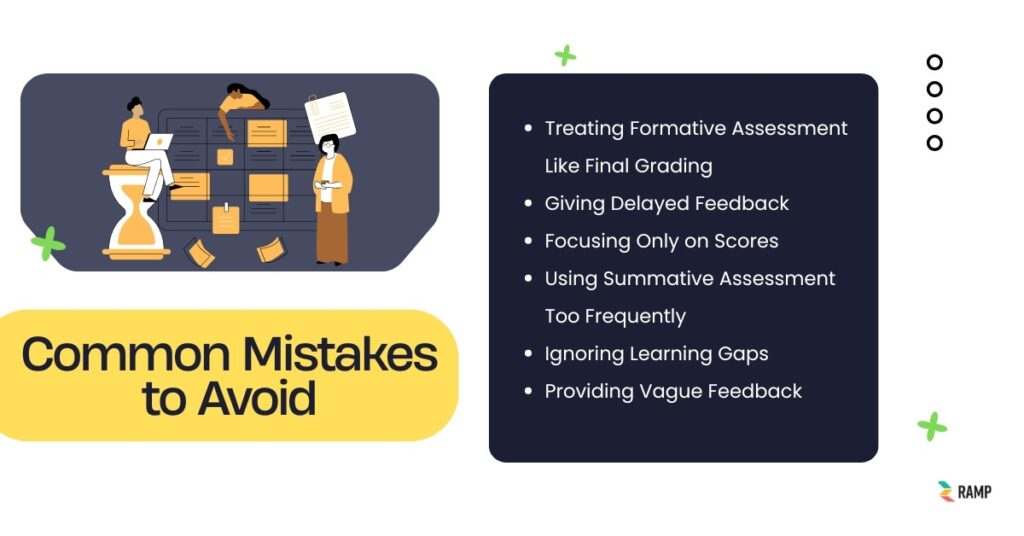
Common mistakes in formative and summative assessments often reduce the effectiveness of learning and evaluation. Avoiding these errors helps ensure feedback is clear, fair, and truly supports student or employee improvement.
The diagram below shows the common mistakes to avoid.
The following section explains each mistake.
- Treating Formative Assessment Like Final Grading: Formative assessment should guide improvement, not create unnecessary pressure.
- Giving Delayed Feedback: Late feedback reduces the effectiveness of formative learning support.
- Focusing Only on Scores: Assessment should measure understanding and progress, not just marks.
- Using Summative Assessment Too Frequently: Too many high-stakes evaluations can increase stress and reduce motivation to learn.
- Ignoring Learning Gaps: Assessment only becomes useful when educators use the results to improve teaching and learning strategies.
- Providing Vague Feedback: Learners improve more effectively when feedback is specific and actionable.
Both formative and summative assessments play essential roles in education and training. Formative assessment supports continuous learning, improvement, and skill development, while summative assessment measures overall achievement and final performance. When used together effectively, they create a balanced system that supports both growth and accountability in the learning process.
Use this inside classrooms, training sessions, and performance evaluations to improve learning outcomes and reduce bias.