

OKR review is the structured process of monitoring, evaluating, and discussing progress toward Objectives and Key Results over a defined period. It helps organizations measure performance using data-driven metrics, identify risks early, improve accountability, and ensure teams remain aligned with strategic priorities throughout the OKR cycle.
Core Structural Attributes of OKR Reviews
OKR Tracking Fundamentals
OKR tracking is the ongoing process of measuring progress against defined objectives and key results. Effective tracking ensures that teams move beyond goal-setting and actively manage execution.
Modern OKR tracking must be:
- Quantitative
- Consistent
- Transparent
- Data-driven
Key Components of OKR Tracking
The diagram below highlights the essential components of effective OKR tracking, showing how organizations use measurable progress updates, scoring methods, and milestone monitoring to maintain accountability and ensure continuous performance improvement.
The components are discussed in detail below.
Progress Measurement
Organizations continuously evaluate the progress made toward each key result.
Example:
- Increase website conversion rate from 2% to 5% by Q3.
Metric Definition: Conversion rate measures the percentage of website visitors who complete a desired action within a specific timeframe.
Quantitative Key Result Updates
Every update should include measurable data instead of subjective opinions.
Weak update:
- "We are doing better."
Strong update:
- "Conversion rate increased from 2.4% to 3.1% during the first month of Q3."
Percentage Completion Tracking
Many organizations use percentage-based progress indicators.
Example:
- Key Result completion: 65%
- Objective progress: 72%
This provides visibility into execution status.
Confidence Scoring
Teams often assign confidence levels to indicate the likelihood of achieving a key result.
Example:
- High confidence
- Medium confidence
- Low confidence
Confidence scoring helps identify risks before performance declines.
Milestone Checkpoints
Large OKRs are frequently divided into milestone stages to simplify tracking.
Example:
- Month 1: Product prototype completed
- Month 2: Beta launch initiated
- Month 3: Full release deployed
Milestones improve execution discipline and visibility.
Leading vs Lagging Key Results
Strong OKR systems balance both leading and lagging indicators.
Leading Indicators
Leading indicators provide early signals of future performance.
Examples:
- Sales pipeline growth
- Website traffic
- Product demo requests
- Qualified lead generation
These metrics help teams predict future outcomes before final results appear.
Lagging Indicators
Lagging indicators measure final outcomes after activities are completed.
Examples:
- Revenue growth
- Profit margin
- Customer retention rate
- Annual recurring revenue
Balanced Measurement Approach
Organizations achieve stronger visibility when both indicator types are used together.
Example
The chart below compares leading and lagging indicators in OKR tracking, demonstrating how organizations use both early performance signals and final outcome metrics to monitor progress and evaluate strategic success.
| Metric Type | Example |
| Leading Indicator | Increase qualified sales pipeline by 25% during Q2 |
| Lagging Indicator | Increase quarterly revenue by 15% by the end of Q2 |
Metric Definition: Sales pipeline growth measures the increase in potential revenue opportunities entering the sales process during a specific period.
This balance allows organizations to monitor both current execution and future outcomes.
Tracking Cadence & Rhythm
Consistent review rhythms create operational discipline and prevent OKRs from becoming inactive documents. The diagram below highlights the structured review rhythm used in OKR management, showing how regular check-ins and evaluation cycles help teams maintain alignment, track progress consistently, and adapt goals throughout the execution period.
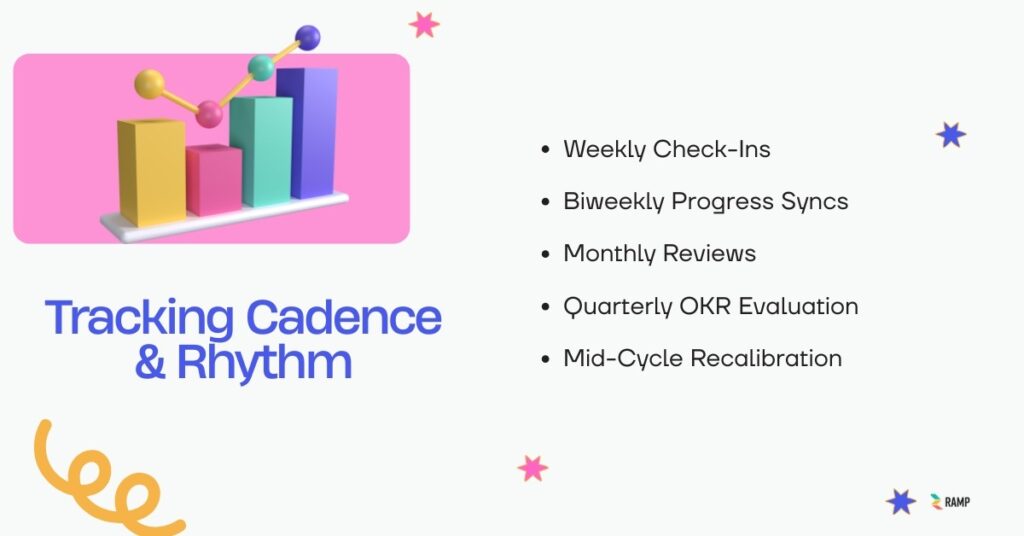
The details are explained below.
Weekly Check-Ins
Weekly updates focus on:
- Current progress
- Blockers
- Risk areas
- Immediate priorities
These meetings are usually short and operational.
Biweekly Progress Syncs
Biweekly reviews often include:
- Cross-functional coordination
- Dependency management
- Trend analysis
Monthly Reviews
Monthly reviews provide a deeper evaluation of:
- Key result performance
- KPI movement
- Execution effectiveness
- Resource allocation
Quarterly OKR Evaluation
Quarter-end reviews measure overall achievement and scoring.
This stage includes:
- Final scoring
- Retrospectives
- Lessons learned
- Performance analysis
Mid-Cycle Recalibration
Organizations may adjust OKRs mid-cycle when:
- Market conditions change
- Strategic priorities shift
- Resources become constrained
A disciplined cadence keeps OKRs active and actionable.
The article “From Vision to Reality: How OKRs Are Reshaping Team Goals in 2024” explains that OKRs help teams connect ambitious objectives with measurable key results, creating stronger alignment between individual effort, team priorities, and organizational goals. It also highlights the importance of regular review and adaptation cycles, such as biweekly or monthly assessments, to track progress and address challenges. This supports the value of OKR review and tracking because OKRs remain useful only when teams consistently monitor progress, discuss blockers, and adjust execution as conditions change.
Ownership & Accountability
OKRs fail quickly when ownership is unclear.
Defined OKR Owners
Every objective should have a primary owner responsible for:
- Coordination
- Reporting
- Execution visibility
Clear Key Result Accountability
Each key result should also have direct accountability.
Example:
- The marketing lead owns lead generation KR.
- The support manager owns the customer satisfaction KR.
Shared vs Individual Responsibilities
Some OKRs require cross-functional collaboration.
Examples:
- Product + engineering
- Marketing + sales
- HR + operations
Shared accountability must still include clearly assigned responsibilities.
Escalation Process
Organizations should define escalation procedures when:
- Progress stalls
- Risks increase
- Dependencies fail
Early escalation prevents major execution delays.
Cross-Team Coordination
Many OKRs depend on multiple teams working together. Review systems should identify interdependencies early.
Without clarity of ownership, OKRs become difficult to execute and impossible to evaluate fairly.
Review Meeting Structure
Structured OKR reviews improve consistency and decision-making quality.
Typical Review Agenda
1. Self-Assessment: Owners evaluate their current progress and challenges.
2. Data Review: Teams analyze measurable results using dashboards and reports.
3. KPI Evaluation: Organizations compare KPI movement against OKR targets.
Example:
- The customer churn rate decreased from 10% to 7% in Q2.
Metric Definition: Customer churn rate is the percentage of customers lost over a defined period.
4. Risk Identification: Review discussions identify:
- Execution blockers
- Resource gaps
- Timeline risks
5. Adjustment Discussion: Teams determine whether recalibration is necessary.
6. Action Plan Update: The meeting concludes with:
- Updated priorities
- Assigned actions
- Revised timelines
Structured review meetings reduce ambiguity and improve accountability for execution.
Scoring OKRs
Below are the scoring models of OKRs.
0.0–1.0 Scoring Model
Many organizations score OKRs on a scale from:
- 0.0 = no achievement
- 1.0 = full achievement
Example:
- 0.7 = strong progress
- 0.9 = near-complete achievement
70% Success Philosophy
OKRs are intentionally ambitious. Achieving approximately 70% is often considered successful.
This encourages stretch performance instead of conservative target-setting.
Red/Amber/Green Tracking
Visual tracking systems improve monitoring efficiency.
| Status | Meaning |
| Green | On track |
| Amber | At risk |
| Red | Off track |
Stretch Goal Interpretation
Stretch goals are designed to challenge teams beyond standard operational performance.
Partial achievement may still represent meaningful business progress.
Avoiding Binary Thinking
OKRs should not be viewed as simply:
- Completed
- Failed
Progress exists across a spectrum, and partial achievement often produces valuable learning outcomes.
Recalibration & Adjustments
Modern OKR systems require flexibility.
Adjusting Key Results
Organizations may revise key results when:
- Baseline assumptions change
- Market conditions shift
- New data emerges
Strategy Pivots
Strategic changes sometimes require replacing or restructuring OKRs entirely.
Resource Reallocation
Teams may redistribute:
- Budget
- Staffing
- Technology resources
to support high-priority objectives.
Removing Obsolete OKRs
Some OKRs lose relevance because of:
- Market changes
- Product changes
- Operational restructuring
Removing outdated OKRs maintains strategic clarity.
Avoiding Mid-Cycle Goal Drift
Adjustments should remain disciplined and intentional. Constantly changing OKRs weakens accountability and measurement integrity.
Technology & OKR Tools
Technology platforms simplify OKR management and visibility.
OKR Software
Dedicated OKR systems support:
- Goal creation
- Progress updates
- Alignment mapping
- Reporting
Performance Management Systems
Many organizations integrate OKRs into broader performance platforms.
Dashboard Visibility
Dashboards provide:
- Real-time updates
- Team visibility
- Executive reporting
- Trend analysis
Automated Reminders
Automated notifications improve:
- Update consistency
- Review participation
- Tracking discipline
Analytics Integration
Modern systems connect with:
- CRM platforms
- HR software
- Business intelligence tools
- Project management systems
Technology improves transparency and reduces the complexity of manual tracking.
Alignment Monitoring
Tracking is not only about progress measurement. It also ensures organizational alignment.
Vertical Alignment
OKRs should align across levels:
- Company
- Department
- Team
- Individual
This creates strategic consistency.
Horizontal Alignment
Cross-functional dependencies must also remain synchronized.
Example:
- Marketing demand generation impacts sales revenue goals.
Strategy Consistency
Review systems ensure teams continue supporting the broader business strategy.
Preventing Siloed Progress
Teams may appear successful individually while damaging company-wide priorities.
Alignment monitoring prevents disconnected execution.
Common OKR Tracking Mistakes
The common OKR tracking mistakes include:
- Setting OKRs but Never Reviewing Them: Without active reviews, OKRs lose operational value.
- No Measurable Key Results: Vague goals weaken accountability and tracking accuracy.
- Infrequent Check-Ins: Long review gaps delay problem identification.
- Too Many OKRs: Excessive goals dilute focus and reduce execution quality.
- Confusing Tasks With Results: Activities should not be mistaken for measurable business outcomes.
- Scoring Only at End of Cycle: Waiting until quarter-end removes opportunities for correction and learning.
- Using OKRs for Punitive Evaluation: Punishing teams for ambitious goals discourages innovation and transparency.
OKR Lifecycle Framework
A mature OKR system follows a structured operational cycle.
1. Set OKRs: Define strategic objectives and measurable key results.
2. Assign Ownership: Clarify accountability across all OKRs.
3. Track Weekly Progress: Monitor measurable updates consistently.
4. Review Monthly: Evaluate trends, risks, and execution effectiveness.
5. Adjust Mid-Cycle: Recalibrate when business conditions change.
6. Score Quarterly: Measure final achievement using structured scoring models.
7. Conduct Retrospective: Analyze:
- Wins
- Failures
- Lessons learned
- Improvement opportunities
8. Reset for Next Cycle: Use previous insights to improve future OKR quality and execution maturity.