
An employee performance review is a structured discussion between an employee and a manager that focuses on work performance, achievements, challenges, and future improvement. It is usually conducted regularly throughout the year to provide feedback, monitor progress, and help employees stay aligned with organizational goals. Performance reviews are generally development-focused and encourage open communication, coaching, and continuous improvement rather than only formal evaluation.
A systematic review of key strategies for measuring employee performance explains that organizations need clear, continuous ways to collect and evaluate performance data. The study highlights that performance measurement helps identify employee strengths and weaknesses, motivate improvement, and connect evaluation with employee development. This underscores the importance of employee performance reviews as a structured process for providing feedback, tracking goals, ensuring fairness, and fostering continuous growth.
What is a performance review?
Although many organizations use the terms interchangeably, performance reviews and performance appraisals are slightly different in practice. A performance review is generally more discussion-oriented. It focuses on:
- Ongoing feedback
- Employee development
- Goal tracking
- Communication between the manager and the employee
- Problem-solving and support
These reviews may happen monthly, quarterly, or biannually.
Why Performance Reviews Matter?
The benefits usually appear as:
- Performance clarity: Employees understand what is expected of them, where they are succeeding, and where they need improvement.
- Fairness: Standardized evaluations reduce confusion, inconsistency, and favoritism in workplace decisions.
- Growth: Constructive feedback helps employees build skills, improve productivity, and advance in their careers.
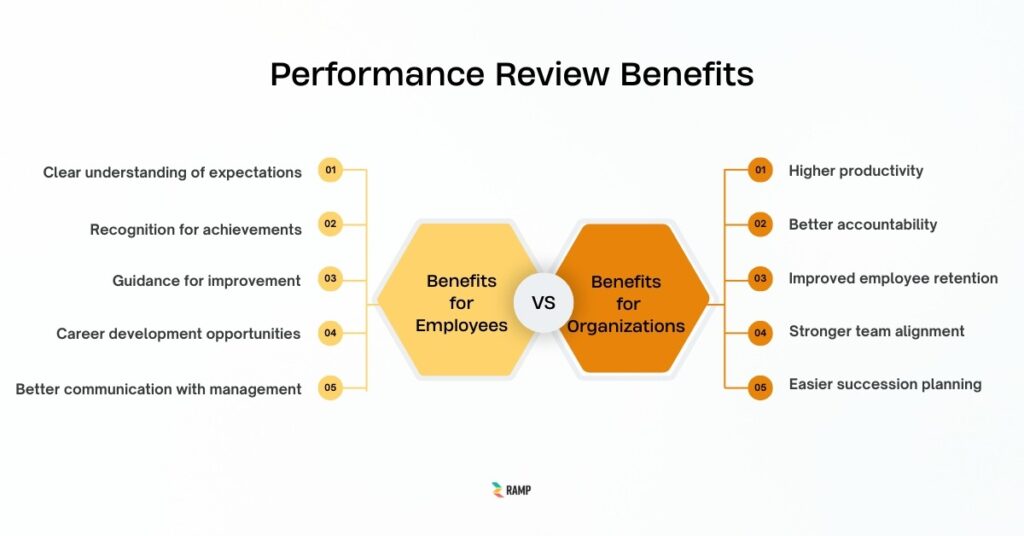
A well-designed review system benefits both employees and organizations.
Benefits for Employees
Employees gain:
- Clear understanding of expectations
- Recognition for achievements
- Guidance for improvement
- Career development opportunities
- Better communication with management
Constructive reviews also increase motivation because employees feel their work is noticed and valued.
Benefits for Organizations
Organizations benefit through:
- Higher productivity
- Better accountability
- Improved employee retention
- Stronger team alignment
- Easier succession planning
Performance reviews also help leaders identify skill gaps, training needs, and future leaders within the organization. The diagram below highlights the benefits of the performance review for both employees and the organization.
For example, a marketing manager may meet with a content specialist at the end of a quarter to review campaign results, discuss communication strengths, identify missed deadlines, and set goals for improving project management in the next cycle. The conversation may also influence training opportunities, bonuses, or future responsibilities.
Types of Performance Reviews
Performance reviews can be conducted in different ways depending on the organization's goals, work culture, and management style. Each type serves a different purpose, from measuring employee performance to supporting development and improving communication.
The most common types of performance reviews are listed below.
- Annual Performance Review
- Quarterly Performance Review
- Continuous Performance Review
- 360-Degree Performance Review
- Self-Assessment Performance Review
- Peer Performance Review
- Managerial Review
- Project-Based Performance Review
- Probationary Performance Review
- Rating Scale Performance Review
Organizations often combine multiple review methods rather than relying on a single approach.
For example:
- Annual reviews for formal evaluation
- Continuous feedback for daily improvement
- 360-degree reviews for leadership assessment
- Self-assessments for employee engagement
The best review system depends on:
- Company size
- Industry
- Work culture
- Team structure
- Business goals
A balanced review process improves communication, accountability, fairness, and employee growth.
How to Conduct an Effective Performance Review?
Performance reviews work best when they are organized, evidence-based, and focused on improvement rather than criticism. Employees should leave the meeting with a clear understanding of their strengths, challenges, and goals for the next review cycle. An effective performance review should never feel rushed or one-sided. Preparation and communication are essential.
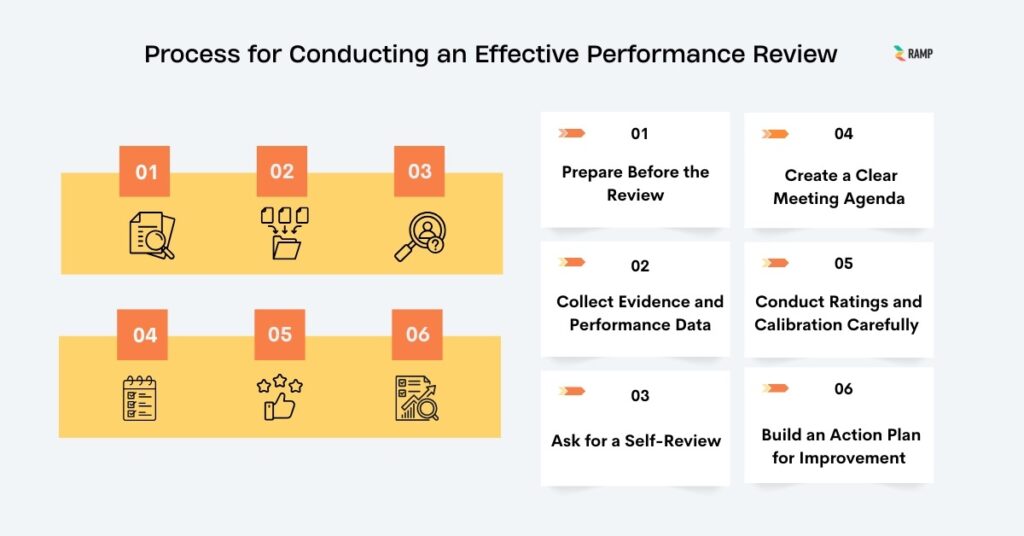
The Step-by-Step Process for Conducting Effective Performance Reviews includes:
1. Prepare Before the Review
Start preparing well in advance of the meeting date. A rushed review often leads to vague feedback, inaccurate ratings, and poor communication.
Review the employee's:
- Job responsibilities
- Previous goals
- Past review notes
- Development plans
- Current performance expectations
Schedule the meeting in advance and allow enough time for proper discussion.
Choose a private, comfortable setting where open conversation can take place without interruptions.
2. Collect Evidence and Performance Data
Collect factual information before evaluating performance. Avoid relying solely on memory or personal impressions.
Gather:
- Goal completion records
- KPI results
- Project outcomes
- Attendance records
- Customer or client feedback
- Team collaboration examples
- Quality and productivity reports
Compare actual results against established performance expectations.
Focus on:
- Measurable achievements
- Observable behaviors
- Consistency over time
- Problem-solving ability
- Communication and teamwork
Use specific examples instead of general statements.
For example:
- "Completed five projects before deadline"
- "Improved customer response time by 20%"
- "Missed three reporting deadlines during the quarter"
Specific evidence makes the review more accurate and fair.
3. Ask for a Self-Review
Invite the employee to complete a self-assessment before the meeting.
Ask the employee to reflect on:
- Major accomplishments
- Challenges faced
- Skills developed
- Areas needing improvement
- Career goals
- Support is required from management
Self-reviews encourage accountability and create a more balanced discussion.
Employees often provide useful context that managers may not fully see during daily operations.
4. Create a Clear Meeting Agenda
Structure the meeting carefully to keep the discussion productive and professional.
A simple review agenda may include:
- Opening discussion
- Review of goals and responsibilities
- Recognition of achievements
- Discussion of improvement areas
- Feedback from the employee
- Goal-setting for the future
- Development planning
- Summary and agreement
Start with positive contributions before discussing concerns.
Listen actively during the conversation. Allow employees to explain challenges, ask questions, and share ideas.
Keep the discussion focused on work performance and observable behaviors rather than personality traits.
Avoid emotional or overly personal comments.
5. Conduct Ratings and Calibration Carefully
If the organization uses performance ratings, apply them consistently.
Evaluate performance using:
- Predefined standards
- Clear scoring criteria
- Documented evidence
- Comparison against role expectations
Avoid common evaluation mistakes such as:
- Recency bias
- Favoritism
- Overrating or underrating
- Personal assumptions
Many organizations also use calibration meetings where managers discuss ratings together to improve fairness across teams. Calibration helps ensure that similar performance receives similar evaluations throughout the organization.
6. Build an Action Plan for Improvement
End the review with a practical development plan.
Agree on:
- New performance goals
- Skill development needs
- Training opportunities
- Deadlines and milestones
- Support is required from management
- Expectations for the next review cycle
Goals should be realistic, measurable, and clearly documented.
For example:
- Improve presentation skills through monthly training
- Increase sales conversion rate by 10% within six months
- Reduce reporting errors before the next review cycle
A performance review should always lead to action, not just discussion.
The diagram below summarizes the process for conducting an effective performance review.
Challenges in Employee Performance Reviews
Despite their importance, performance reviews still face several challenges. The diagram below shows the common problems organizations often struggle with.
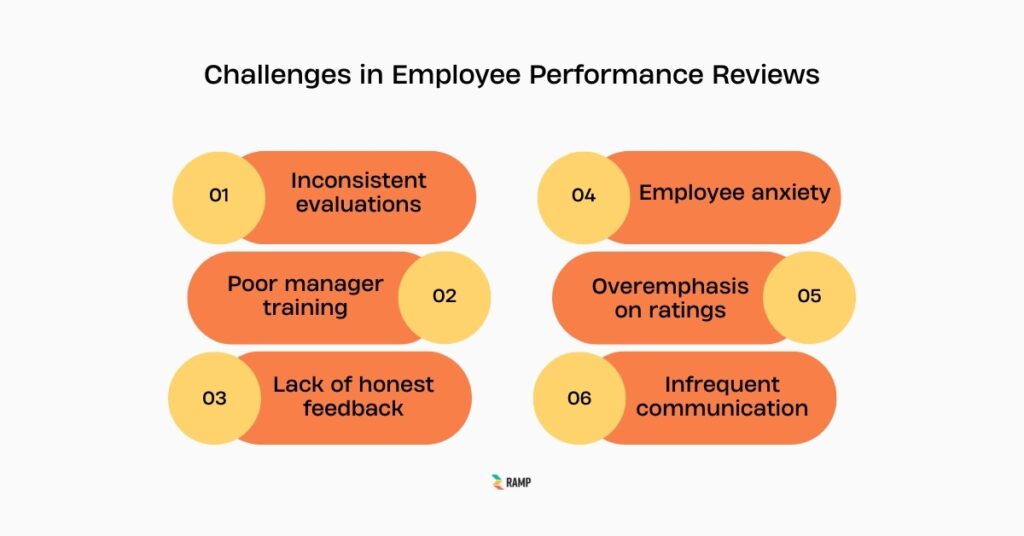
The problems in the diagram include:
- Inconsistent evaluations
- Poor manager training
- Lack of honest feedback
- Employee anxiety
- Overemphasis on ratings
- Infrequent communication
When reviews become purely administrative, employees stop seeing their value.
How Organizations Can Improve?
Companies can improve their systems by:
- Training managers properly
- Encouraging ongoing feedback
- Simplifying review processes
- Focusing on development, not punishment
- Making expectations transparent
Performance management works best when it supports growth rather than serving solely as a control system.
Best Practices for Performance Reviews
A strong performance review process should not feel like a yearly formality. It should create clarity, encourage communication, and help employees grow through constructive and well-documented feedback. The key performance review best practices include:
Use objective criteria
Evaluate employees using measurable standards such as goals, KPIs, quality metrics, productivity, and role-specific expectations instead of personal opinions.
Micro-example: A sales employee is assessed based on monthly revenue targets and client retention rates, rather than on a manager's preference.
Maintain a consistent review cadence
Conduct reviews regularly through quarterly check-ins, monthly discussions, or annual evaluations to keep feedback timely and relevant.
Micro-example: A manager schedules short performance discussions each month rather than waiting until year-end.
Encourage two-way feedback
Allow employees to share concerns, challenges, and ideas during the review conversation to make the process less one-sided.
Micro-example: An employee explains workload challenges that affected project deadlines and suggests process improvements.
Use evidence-based examples
Support feedback with clear facts, work samples, performance data, and specific situations rather than vague statements.
Micro-example: Instead of saying “communication needs improvement," the manager references delayed responses during a client project.
Check for evaluation bias
Review ratings carefully to reduce favoritism, recency bias, similarity bias, or overly harsh judgments.
Micro-example: A manager reviews performance records for the entire year rather than focusing only on the employee's most recent mistake.
Focus on future development
Use the review to guide growth, skill development, and career progression, rather than just judging past performance.
Micro-example: A supervisor recommends leadership training for an employee preparing for a team lead role.
Provide actionable coaching
Give practical suggestions that employees can apply immediately to improve performance and confidence.
Micro-example: A customer service employee receives coaching on handling difficult conversations more calmly and efficiently.
Recognize achievements openly
Acknowledge strong performance and contributions to maintain motivation and employee engagement.
Micro-example: A manager highlights how an employee improved team productivity during a high-pressure project.
Document discussions and decisions
Record goals, feedback, ratings, improvement plans, and agreed actions to maintain accountability and consistency.
Micro-example: After the review, both manager and employee receive a written summary of goals and development priorities.
Avoid These Common Mistakes
- Giving vague feedback without examples
- Conducting reviews only once a year with no follow-up
- Focusing entirely on weaknesses while ignoring achievements
These practices support 360-degree reviews, bias mitigation, and continuous feedback.