
Performance measurement works best when it is planned in advance rather than decided at review time. That means defining what success looks like, how it will be observed, which metrics will be used, who will assess it, and over what period. The difference between measuring activity and measuring performance is that activity tracks what someone does, while performance tracks the value and standard of what they achieve.
The measurement of Employee Performance
Measuring employee performance is the process of assessing how well an employee meets role expectations, contributes to team and business goals, demonstrates required behaviors, and develops capability over time. It is not limited to output counts. It also includes quality, consistency, collaboration, judgment, and growth.
What Is Measured?
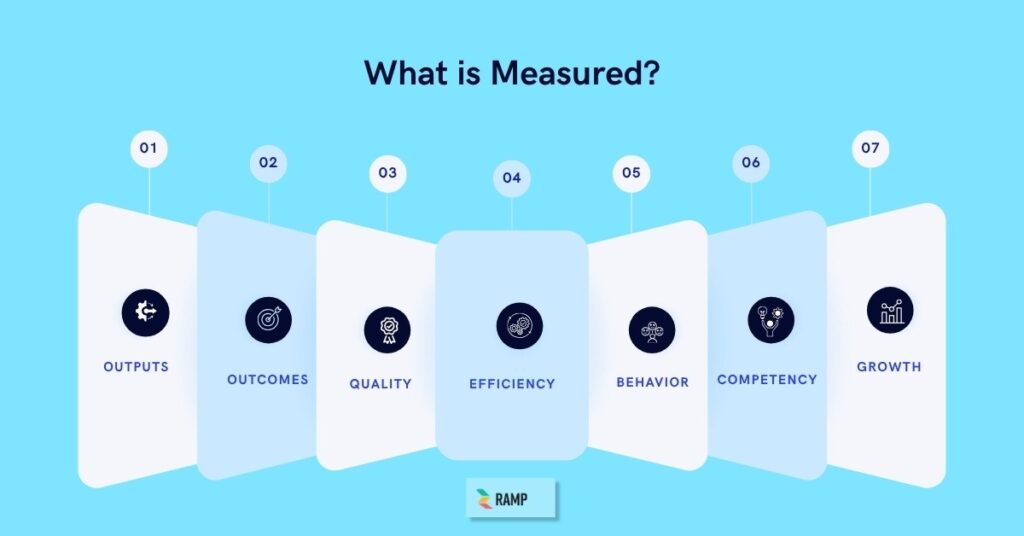
Employee performance is measured across results, behaviors, capabilities, and contributions. Results include the work an employee delivers. Behaviors include how the work is done. Capabilities include the skills and judgment that support sustained performance. The contribution includes the employee's impact on the team and business outcomes. The diagram shows the measurement areas.
These measurement areas are usually grouped as follows:
- Outputs: volume of work completed
- Outcomes: business results created by the work
- Quality: accuracy, reliability, and standard of delivery
- Efficiency: speed, resource use, or productivity rate
- Behavior: collaboration, accountability, communication, and initiative
- Competency: job-relevant skills and role capability
- Growth: learning, adaptability, and readiness for expanded responsibility
The difference between output and outcome is that output is the amount of work produced, while outcome is the effect that work has on business goals or customer results.
How It Is Measured?
The best way to measure employee performance is through a mixed-methods approach. Strong systems do not rely on a single score, a single manager's opinion, or a single end-of-year event. They combine quantitative data, qualitative judgment, competency assessment, and continuous tracking.
A complete measurement approach usually includes:
- Defined goals and role expectations
- Role-specific KPIs with clear units and timeframes
- Observed behaviors and work quality
- Feedback from appropriate sources
- Periodic reviews and documented evidence
- Calibration to improve fairness across teams
The difference between one-dimensional measurement and balanced measurement is that one-dimensional measurement focuses on a single factor, such as output volume, while balanced measurement considers results, quality, behaviors, and development together.
When It Is Measured?
Employee performance should be measured continuously, not only during formal review periods. Measurements are taken at several points throughout the work cycle so employees can improve before final evaluations are made.
A practical rhythm usually looks like this:
- Weekly: short check-ins on priorities, progress, and blockers
- Monthly: review of goals, metrics, and support needs
- Quarterly: broader performance discussion and progress summary
- Semiannually or annually: formal evaluation for rewards, promotion, or planning purposes
The timeframe matters because a metric only makes sense when its period is defined. For example, "project completion rate" should be defined as the percentage of assigned projects completed by the agreed deadline during a quarter. Without the unit and timeframe, the metric is too vague to use fairly.
Who Measures It?
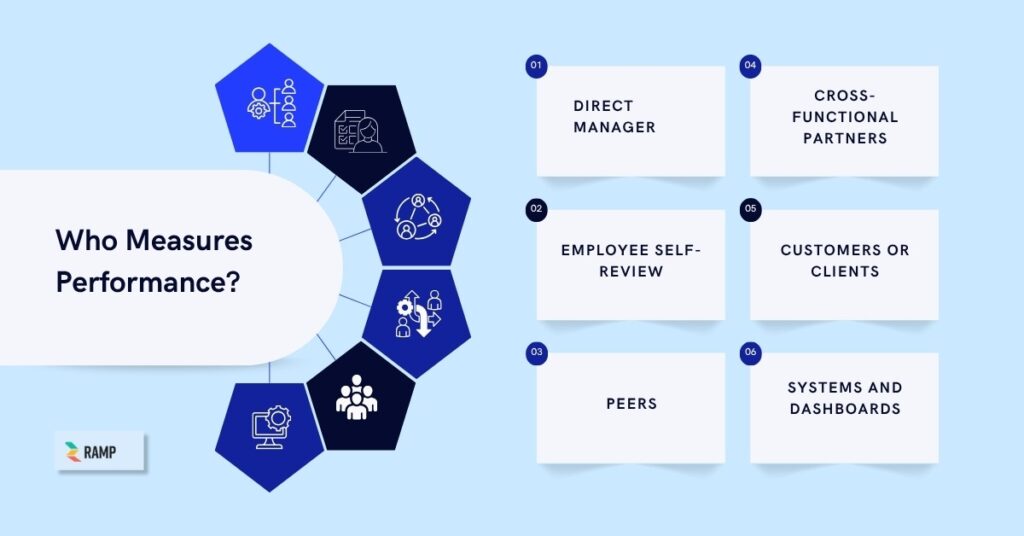
Performance is usually measured by combining people and data sources. The direct manager plays the central role because they are responsible for setting expectations, observing work, and discussing results. However, performance measurement becomes more reliable when it includes more than one perspective where appropriate.
The diagram below includes the common measurement sources.
It is explained further below.
- Direct manager: role expectations, observed results, coaching input
- Employee self-review: reflection, evidence, context, obstacles
- Peers: collaboration, reliability, and team contribution
- Cross-functional partners: service quality and responsiveness
- Customers or clients: satisfaction, quality, and communication
- Systems and dashboards: output, speed, error rates, goal status
The difference between manager-only evaluation and multi-source evaluation is that manager-only evaluation is simpler but more exposed to blind spots, while multi-source evaluation can improve fairness when used carefully.
Why Is It Measured?
Performance is measured to improve results, support growth, and make fair decisions. A good system tells employees what matters, shows whether expectations are being met, and helps managers identify where support or correction is needed.
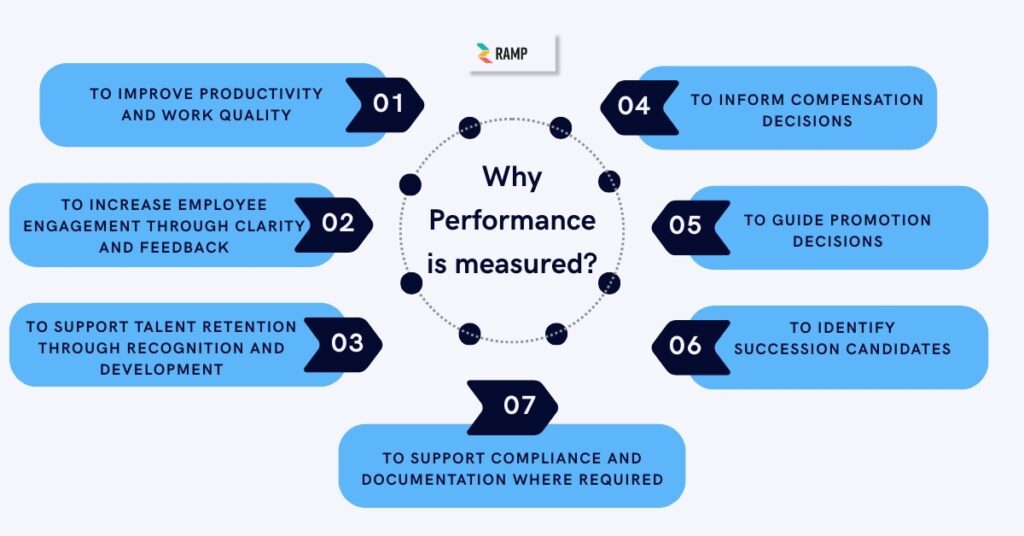
Organizations measure performance for several reasons. The diagram illustrates those reasons below.
The points in the diagram include:
- To improve productivity and work quality
- To increase employee engagement through clarity and feedback
- To support talent retention through recognition and development
- To inform compensation decisions
- To guide promotion decisions
- To identify succession candidates
- To support compliance and documentation where required
The difference between measuring for control and measuring for improvement is that control-focused systems mainly judge and record, while improvement-focused systems help employees perform better over time.
How does it connect to Strategy?
Performance measurement should connect directly to business strategy. If the company strategy emphasizes growth, customer loyalty, innovation, cost control, or operational excellence, employee performance measures should reflect those priorities.
This connection works through cascading goals. Senior leadership defines strategic priorities. Teams translate those into department goals. Managers then convert those goals into individual expectations and KPIs. When this is done well, daily work supports larger business outcomes.
The difference between isolated measurement and strategic measurement is that isolated measurement tracks work in a vacuum, while strategic measurement links employee effort to organizational success. Performance measurement becomes more useful when employees can clearly see how their role contributes to the company's direction.
Measurement Framework Attributes
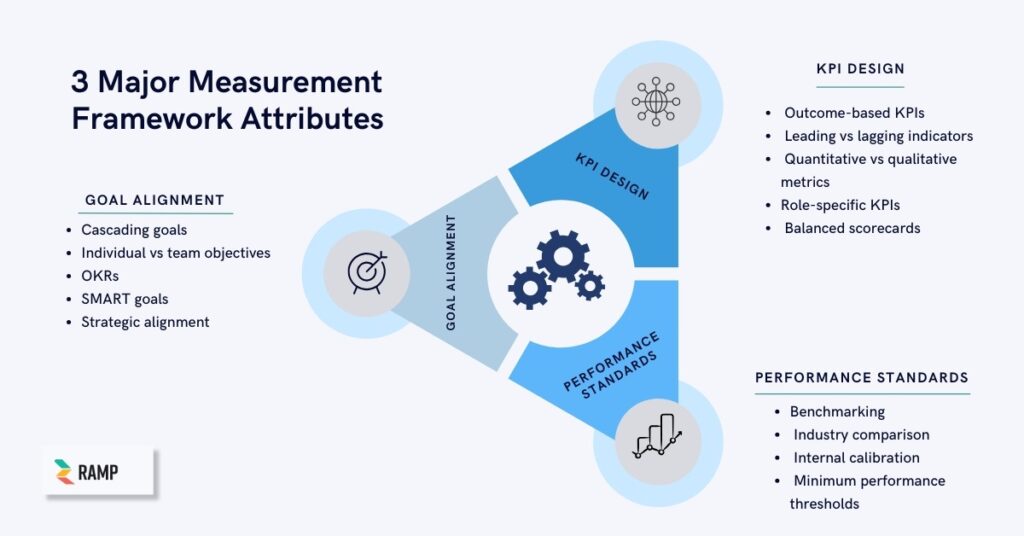
There are three major attributes of the measurement framework.
The details are discussed below.
1. Goal Alignment
Goal alignment means that employee objectives are aligned with team and business priorities. It is the foundation of effective performance measurement because employees cannot be fairly measured against goals that were never made clear.
Cascading goals start at the top of the organization and move downward into team and individual expectations. Individual goals define what one person is responsible for. Team objectives define the shared results the group must deliver. Both matter because many roles require both personal accountability and collaborative contribution.
OKRs and SMART goals are common goal frameworks. OKRs focus on ambitious objectives and measurable key results. SMART goals emphasize targets that are specific, measurable, achievable, relevant, and time-bound. The difference between goal assignment and goal alignment is that assignment gives a target, while alignment explains how that target supports wider priorities.
2. KPI Design
KPI design involves selecting the right metrics to represent performance. A KPI must measure something meaningful, controllable, and relevant to the role. Weak KPI design produces distorted behavior because employees optimize for what is counted rather than what matters.
Outcome-based KPIs focus on the results achieved, not just the tasks completed. Leading indicators signal future performance, while lagging indicators show final results already achieved. Quantitative metrics use numbers, rates, and volumes. Qualitative metrics assess judgment, communication, and work quality where numbers alone are not enough.
Role-specific KPIs matter because the right measure for a salesperson will not fit a designer or team leader. Balanced scorecards help combine financial, operational, customer, and people measures rather than overemphasizing any one area.
3. Performance Standards
Performance standards define the expected level of performance, not just the metric being tracked. A target without a standard is incomplete because employees need to know what counts as acceptable, strong, or exceptional performance.
Standards can be established through benchmarking, industry comparisons, internal calibration, or minimum performance thresholds. Benchmarking compares performance to an internal or external reference point. Industry comparisons can be useful for standardized roles, though they should not replace role context. Internal calibration helps managers apply expectations consistently across teams. For example. Rutgers University has provided some practical .edu examples for turning abstract metrics into standards. These sample performance standards can help us understand the real picture.
A minimum performance threshold is the lowest acceptable level for a metric over a defined period. For example, a service team may define first-response time as the average number of hours from ticket receipt to the first customer reply over a month, with a threshold of 4 hours or less. The unit is hours, and the timeframe is monthly.
Measurement Methods
The following methods measure employee performance.
1. Quantitative Methods
Quantitative methods use numerical data to assess results. These methods are useful because they create visibility, enable comparison, and show trends over time. However, they work best when managers clearly define each metric and ensure it fits the role.
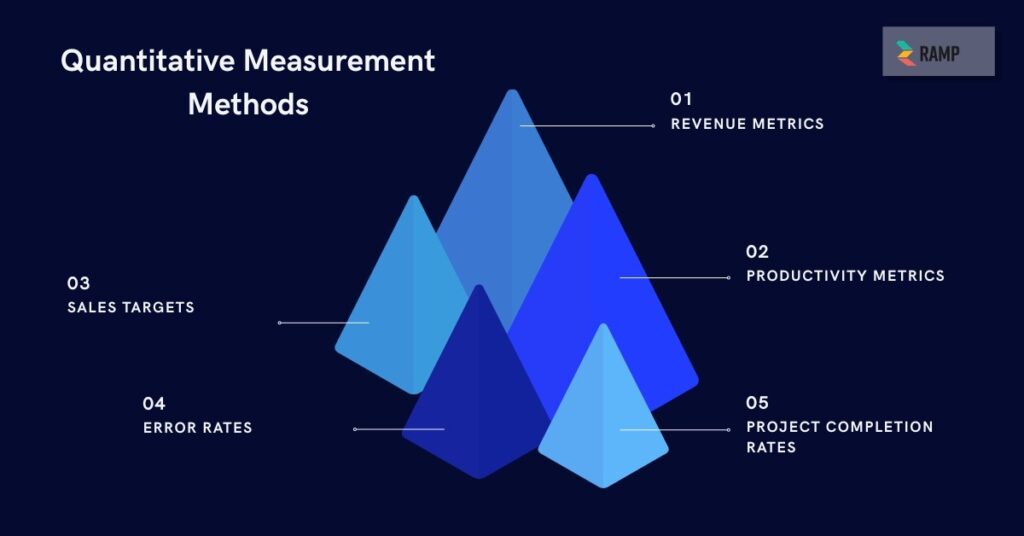
The diagram shows the quantitative methods used to measure performance.
The following section explains the methods further.
- Revenue metrics: total revenue generated in currency over a month or quarter
- Productivity metrics: units completed per employee per week
- Sales targets: percentage of sales quota achieved in a quarter
- Error rates: percentage of work items containing errors during a month
- Project completion rates: percentage of assigned projects completed by deadline in a quarter
Before using a metric, define it fully. For example, "error rate" means the number of defective or incorrect outputs divided by total outputs, expressed as a percentage during a defined month. This clarity prevents confusion and improves fairness.
2. Qualitative Methods
Qualitative methods assess factors that are harder to quantify. These methods help measure quality, behavior, teamwork, customer experience, and judgment. They are especially important in roles where value depends on communication, influence, or problem-solving.
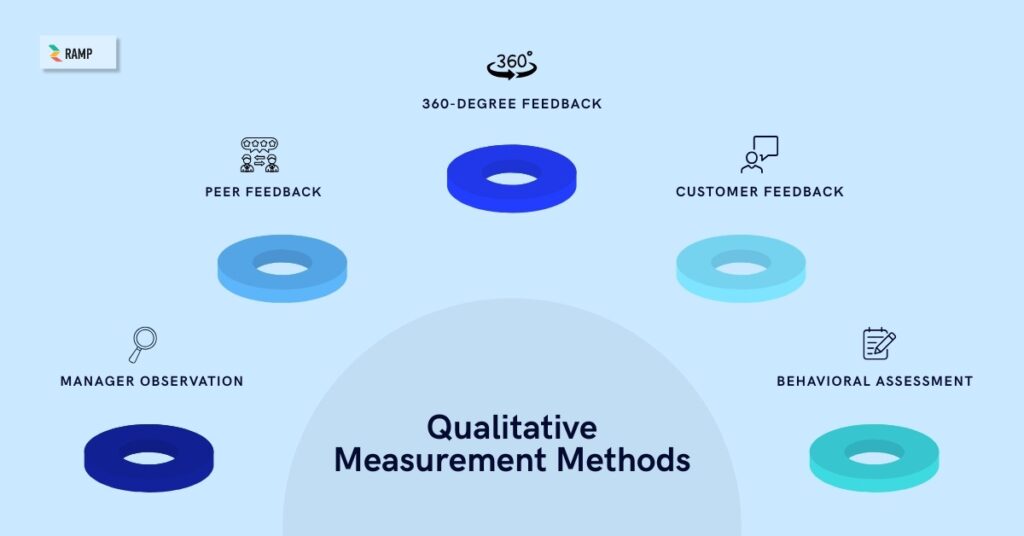
The diagram shows the qualitative methods used to measure performance.
The following section explains the methods in more detail. Common qualitative methods include:
- Manager observation: structured review of behavior, execution, and judgment
- Peer feedback: input on collaboration, reliability, and contribution
- 360-degree feedback: feedback from managers, peers, direct reports, and others
- Customer feedback: satisfaction, responsiveness, and service experience
- Behavioral assessment: review against role-specific behaviors or values
Managers should base qualitative measurement on clear evidence. The difference between qualitative evaluation and vague opinion is that qualitative evaluation uses examples, patterns, and defined criteria, while vague opinion relies solely on impression.
3. Competency-Based Evaluation
Competency-based evaluation measures whether the employee demonstrates the capabilities required for success in the role. This method is useful when performance depends not only on output, but also on how the employee thinks, communicates, and leads.
The diagram shows the competency-based evaluation method used to measure performance.
Common competency areas include:
- Skills assessment: technical and functional ability needed for the role
- Leadership capability: delegation, decision-making, coaching, and influence
- Communication effectiveness: clarity, listening, responsiveness, and stakeholder management
- Problem-solving ability: analysis, judgment, adaptability, and solution quality
Competency evaluation is especially important for roles where future potential matters, along with current results. Results measurement shows what employees achieve, while competency measurement shows their ability to sustain and improve performance over time.
4. Continuous Performance Tracking
Continuous performance tracking refers to measuring performance throughout the work cycle rather than only at the end. It improves accuracy by capturing trends rather than just isolated events. It also helps employees adjust earlier.
The diagram shows the continuous performance-tracking method used to measure performance.
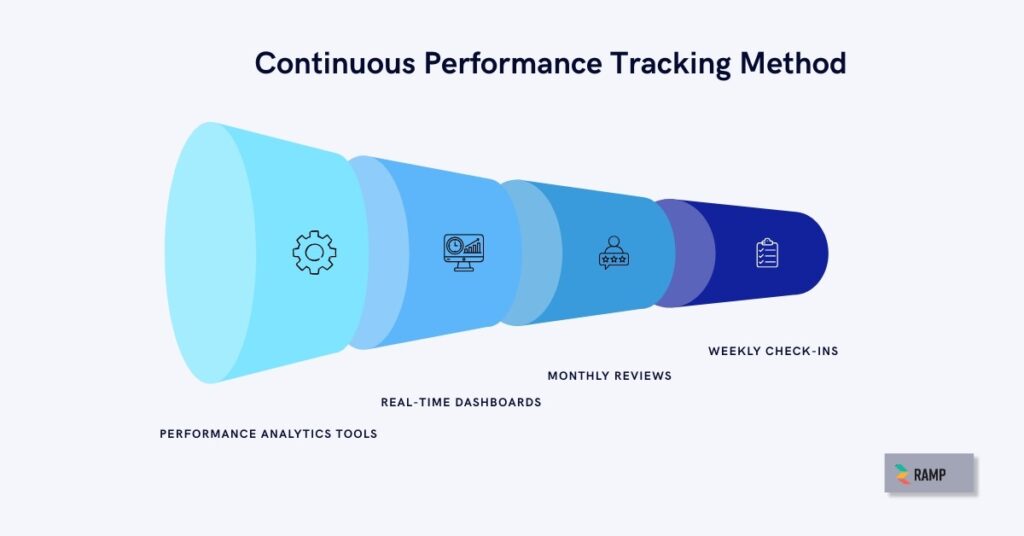
Common tracking methods include:
- Weekly check-ins: short review of current priorities, risks, and progress
- Monthly reviews: goal status, metric trends, and support discussion
- Real-time dashboards: live view of KPIs, workloads, and deadlines
- Performance analytics tools: systems that aggregate results, feedback, and patterns over time
Continuous tracking should support coaching, not surveillance. The difference between performance visibility and over-monitoring is that visibility gives enough information to guide improvement, while over-monitoring reduces trust and can distort behavior.
Process Attributes
Process attributes define a structured, repeatable way to measure employee performance. Instead of treating evaluation as a one-time event, this lifecycle shows the key steps organizations should follow to make performance measurement clearer, fairer, and more useful.
The following diagram shows the lifecycle of performance measurement.
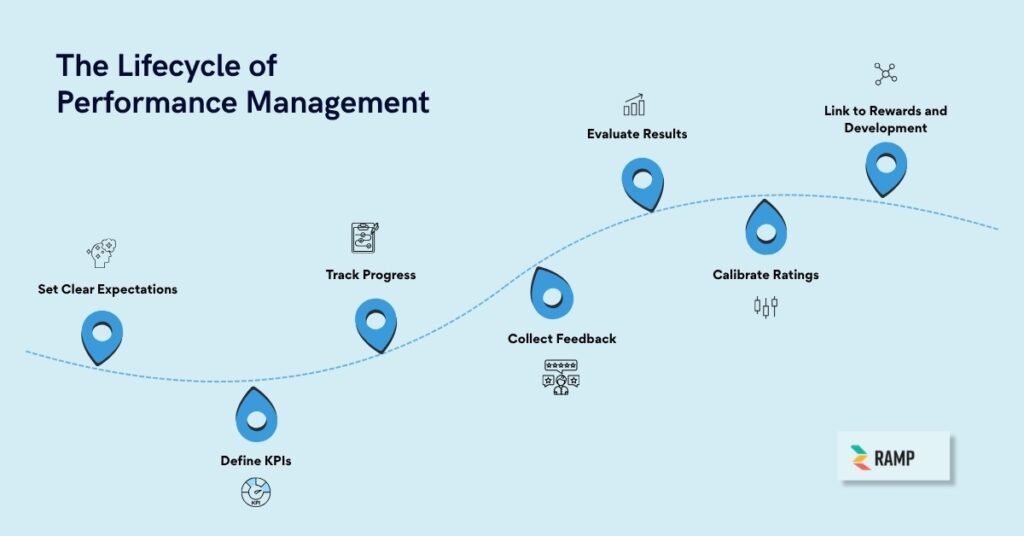
The section below explains the performance management lifecycle in detail.
1. Set Clear Expectations
The first step is to define what success looks like. Expectations should include goals, role scope, required behaviors, timelines, and standards. Employees should know the performance criteria before they begin their work.
2. Define KPIs
Next, select the measures that best reflect the role's performance. Each KPI should include a clear definition, unit, owner, and timeframe. For example, managers can define "sales quota attainment" as the percentage of the quarterly sales target an employee achieves.
3. Track Progress
Once managers and employees set expectations and KPIs, they should regularly monitor progress. Tracking should include both data and context because raw numbers may not capture changing conditions, obstacles, or role complexity.
4. Collect Feedback
Measurement improves when supported by manager notes, self-reflection, peer input, customer comments, or cross-functional feedback. This step adds depth and helps explain performance patterns.
5. Evaluate Results
At the review stage, the manager compares outcomes, behaviors, and competencies against the agreed standards. Strong evaluation is based on evidence, trends, and examples rather than memory alone.
6. Calibrate Ratings
Calibration means managers compare interpretations and standards across teams so that ratings are more consistent. This is especially important when promotions, pay, or talent decisions depend on the results.
7. Link to Rewards and Development
The final step is to use the measurement results. Strong performance may lead to bonuses, recognition, or consideration for promotion. Performance gaps should connect to coaching, training, or development plans.
Bias and Accuracy Controls
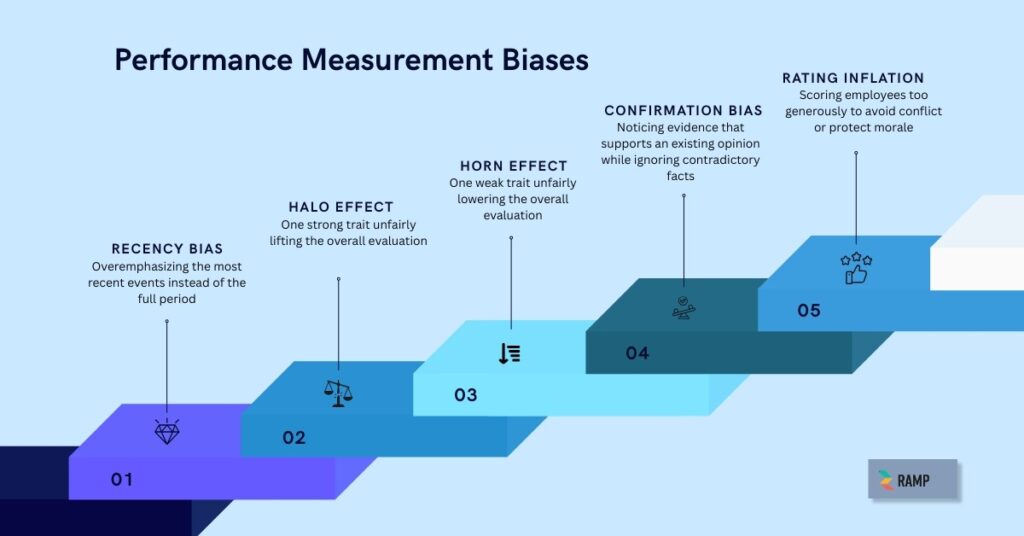
Bias makes performance measurement less reliable when organizations fail to control it. Accuracy depends on structure, evidence, and cross-checks rather than manager confidence alone. The diagram shows the common performance measurement biases.
Common risks include:
- Recency bias: overemphasizing the most recent events instead of the full period
- Halo effect: one strong trait unfairly lifts the overall evaluation
- Horn effect: one weak trait unfairly lowers the overall evaluation
- Confirmation bias: noticing evidence that supports an existing opinion while ignoring contradictory facts
- Rating inflation: scoring employees too generously to avoid conflict or protect morale
To reduce these risks, organizations should use clear standards, documented evidence, cross-team calibration sessions, and data-supported review discussions. The difference between data-driven evaluation and subjective judgment is not that data replaces judgment; rather, it is that data-driven evaluation uses data to inform judgment. It is that data that gives judgment a stronger foundation and reduces inconsistency.
Contextual Variations
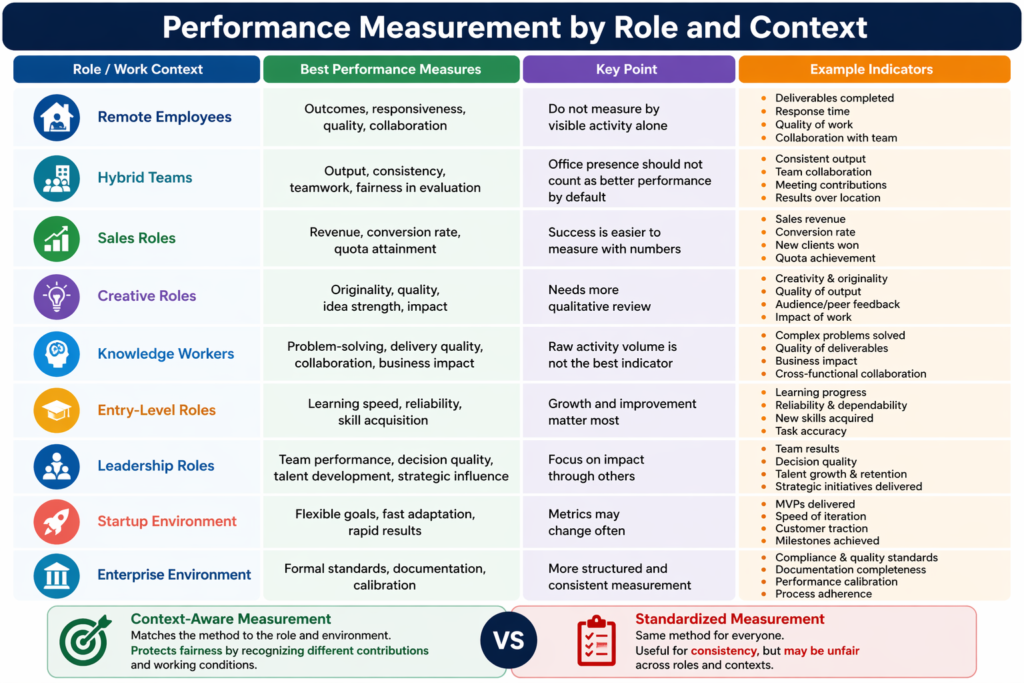
Performance measurement should change by role, work model, and organizational context. A system that fits one environment may fail in another.
Remote employees should be measured by outcomes, responsiveness, quality, and collaboration rather than by visible activity. Hybrid teams require extra care to avoid mistaking office presence for better performance. Sales roles often rely more on revenue and conversion metrics, while creative roles need a stronger qualitative review because originality and quality are harder to count precisely.
Managers should measure knowledge workers by problem-solving, delivery quality, collaboration, and business impact rather than raw activity volume. Entry-level roles may focus more on learning speed, reliability, and skill acquisition. Leadership roles should include team performance, decision quality, talent development, and strategic influence.
Startup environments may use flexible, rapidly changing goals, while enterprises often need more formal standards, documentation, and calibration. The difference between context-aware measurement and standardized measurement is that context-aware measurement protects fairness by matching the method to the role and environment.
The following diagram summarizes different contextual variations.
Technology and Data Layer
Modern performance measurement often uses technology to improve visibility and consistency. Common tools include HR analytics platforms, AI-based tracking systems, performance dashboards, project management tools, and employee engagement software, which are shown in the diagram below. These tools can help managers track progress, identify patterns, and maintain more accurate records.
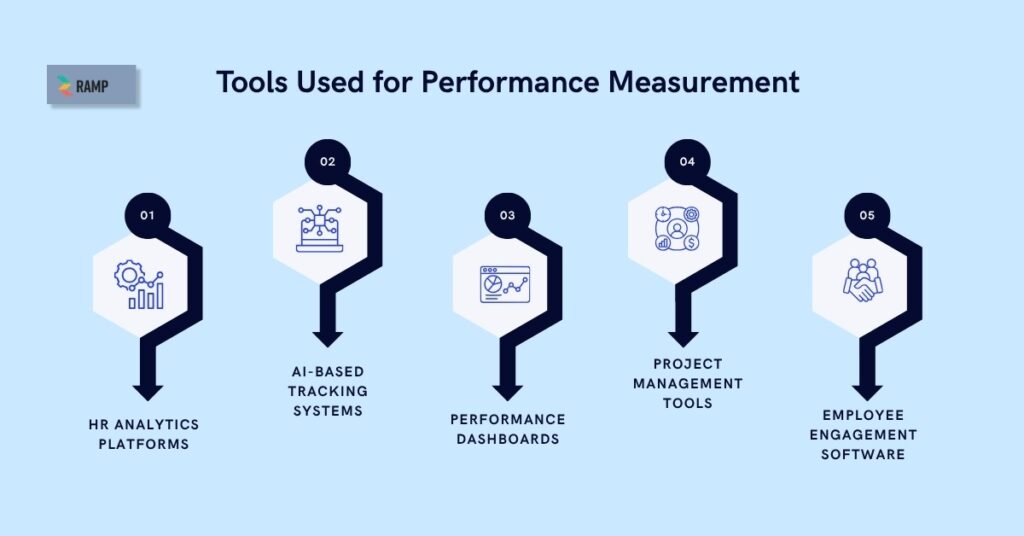
Technology can support measurement by consolidating goals, feedback, deadlines, output data, and sentiment signals into a single place. Project tools can show completion status and cycle time. Dashboards can display KPI trends. Engagement software can reveal whether performance challenges relate to workload, clarity, or morale.
However, technology also brings risks. Over-surveillance can make employees feel monitored rather than supported. Privacy concerns increase when organizations collect excessive behavioral data. Trust can decline when employees do not understand what managers track or why they track it. The difference between performance support technology and surveillance technology is that support tools help employees succeed, while surveillance tools primarily watch behavior in ways that can damage trust.
Outcome and Impact Attributes
Performance measurement matters because it influences both employee behavior and business decisions. When done well, it helps people focus on what matters, improve where needed, and feel recognized for meaningful contributions.
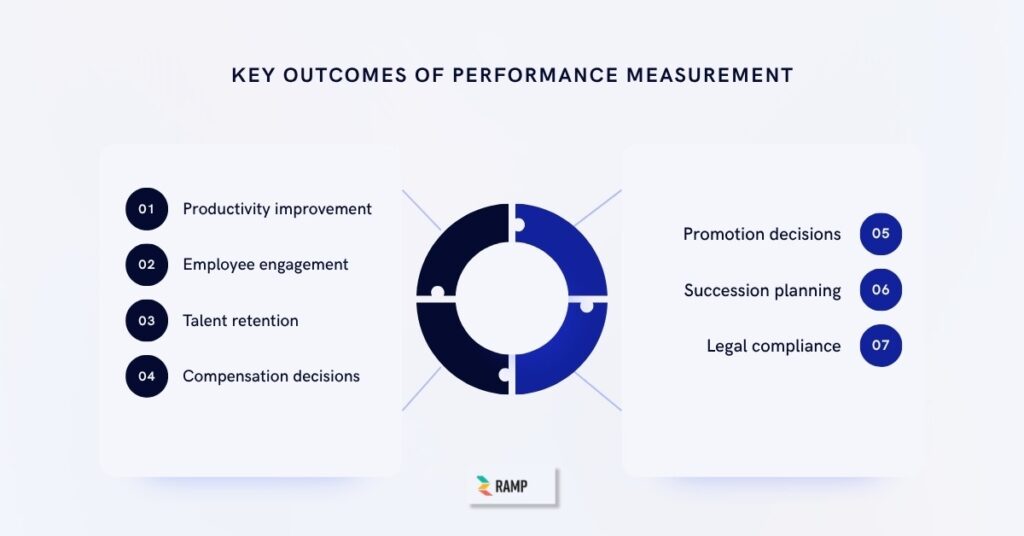
Key outcomes include:
- Productivity improvement: better focus, execution, and follow-through
- Employee engagement: stronger clarity, feedback, and perceived fairness
- Talent retention: higher likelihood that strong performers stay
- Compensation decisions: more informed pay and bonus choices
- Promotion decisions: clearer evidence of readiness and contribution
- Succession planning: better visibility into future leadership potential
- Legal compliance: clearer records for performance-based decisions where documentation matters
The diagram shows the key outcomes below.
The difference between measuring performance and using performance data well is that measurement collects information, while effective use turns that information into better decisions, stronger development, and improved business outcomes.
Practical Example of a Balanced Measurement Model
A balanced model performs best when it combines multiple categories rather than relying on a single number. A practical structure may include:
- 40% outcomes: business results tied to role goals
- 25% quality and reliability: accuracy, consistency, and standard of work
- 20% behaviors and collaboration: communication, teamwork, and accountability
- 15% development and capability: skill growth, adaptability, and readiness
These percentages are examples, not universal rules. The right weighting depends on the role. A salesperson may carry more outcome weight. A people manager may carry more leadership and development weight. A creative specialist may need a stronger quality component.