
A managerial review is a traditional performance evaluation conducted directly by a supervisor or manager to assess an employee's job performance, behavior, productivity, and achievement of assigned goals. This type of review focuses on how effectively employees fulfill their responsibilities and contribute to organizational objectives. Managerial reviews are widely used because supervisors typically have direct oversight of employee performance, attendance, work quality, and professional development.
How Managerial Performance Reviews Work?
Managerial performance reviews typically follow a structured evaluation process to ensure consistency and accountability. The process is shown in the diagram below.
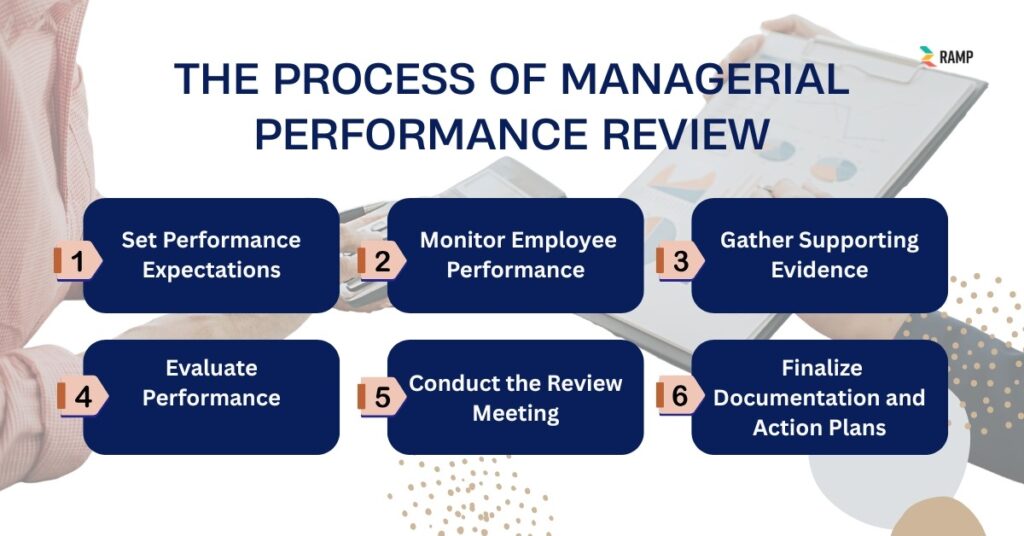
The details of the process are given below.
1. Set Performance Expectations
At the beginning of the review period, managers define job responsibilities, goals, KPIs, and behavioral expectations.
These expectations may include:
- Productivity targets
- Project completion goals
- Quality standards
- Communication expectations
- Team collaboration requirements
Clear expectations create a measurable foundation for evaluation.
2. Monitor Employee Performance
Managers observe employee performance throughout the review period.
Performance tracking may involve:
- KPI reports
- Work quality observations
- Attendance records
- Customer feedback
- Team collaboration
- Deadline management
- Behavioral observations
Continuous monitoring improves review accuracy.
3. Gather Supporting Evidence
Before the review meeting, managers collect performance-related information and examples.
This may include:
- Completed projects
- Productivity data
- Performance metrics
- Client or customer feedback
- Previous review notes
- Achievement records
Evidence-based reviews help reduce subjective judgment.
4. Evaluate Performance
Managers compare employee performance against established expectations and organizational standards.
The evaluation usually covers:
- Strengths and accomplishments
- Areas needing improvement
- Goal achievement
- Professional behavior
- Problem-solving ability
- Communication and teamwork
Some organizations also use rating systems during this stage.
5. Conduct the Review Meeting
The manager and employee meet to discuss the evaluation.
The discussion often includes:
- Performance achievements
- Challenges and concerns
- Development opportunities
- Employee feedback
- Career goals
- Future expectations
Constructive communication is essential for maintaining trust and motivation.
6. Finalize Documentation and Action Plans
After the discussion, managers complete formal review documentation.
The final review may include:
- Performance ratings
- Written feedback
- Development plans
- Training recommendations
- Promotion or compensation decisions
- Performance improvement actions
This documentation becomes part of the employee's performance record.
Advantages of Managerial Performance Reviews
Managerial reviews provide several important organizational benefits. The diagram below shows the advantages of managerial performance reviews.
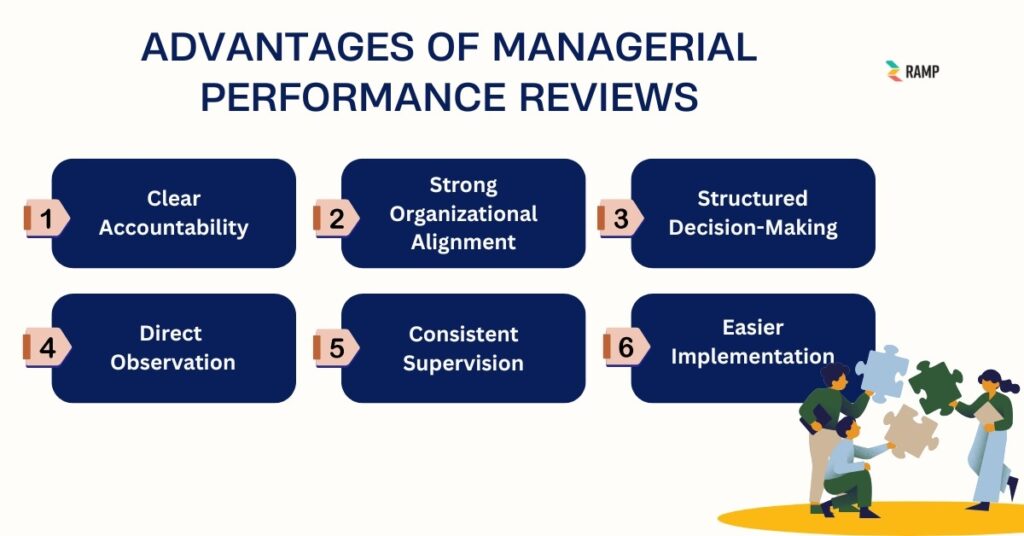
The details of the advantages are given below.
- Clear Accountability: Managers are directly responsible for evaluating employee performance and maintaining standards.
- Strong Organizational Alignment: Managers can assess how employee performance supports departmental and business goals.
- Structured Decision-Making: The review process supports decisions related to promotions, compensation, and development.
- Direct Observation: Managers often have firsthand knowledge of employee responsibilities and work quality.
- Consistent Supervision: Employees receive feedback from someone who regularly oversees their work performance.
- Easier Implementation: Managerial reviews are easier to organize than multi-source review systems.
Disadvantages of Managerial Performance Reviews
Despite their benefits, managerial reviews also have limitations. The diagram below shows the disadvantages of managerial performance review.
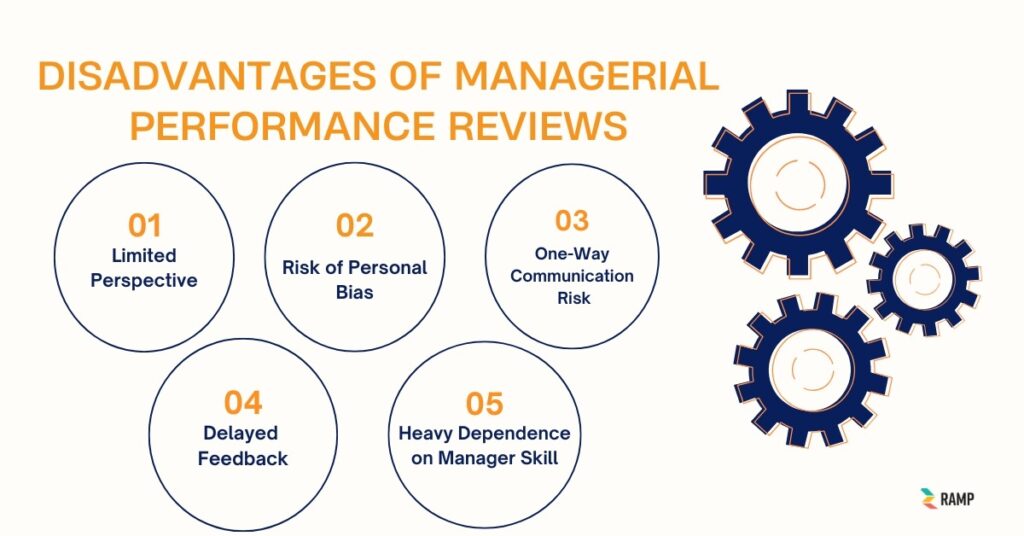
The disadvantages are explained further below.
- Limited Perspective: Managers may not fully observe all employee interactions, teamwork, or contributions.
- Risk of Personal Bias: Evaluations may be influenced by personal preferences or relationships.
- One-Way Communication Risk: Some reviews become manager-dominated discussions with limited employee participation.
- Delayed Feedback: Formal reviews may occur too infrequently to support continuous improvement.
- Heavy Dependence on Manager Skill: The quality of the review depends greatly on the manager's communication and evaluation ability.
Research on managerial interpersonal skills identifies supporting employees, motivating them, and managing conflict as three essential areas of managerial effectiveness. The study found that these skills relate to employee attitudes and performance, as well as managers’ own effectiveness. This highlights why managerial reviews require strong communication, individualized feedback, and constructive conflict-management skills.
Common Bias Risks
Several biases can affect the fairness and accuracy of managerial performance reviews. The diagram below shows the common biases in managerial review.
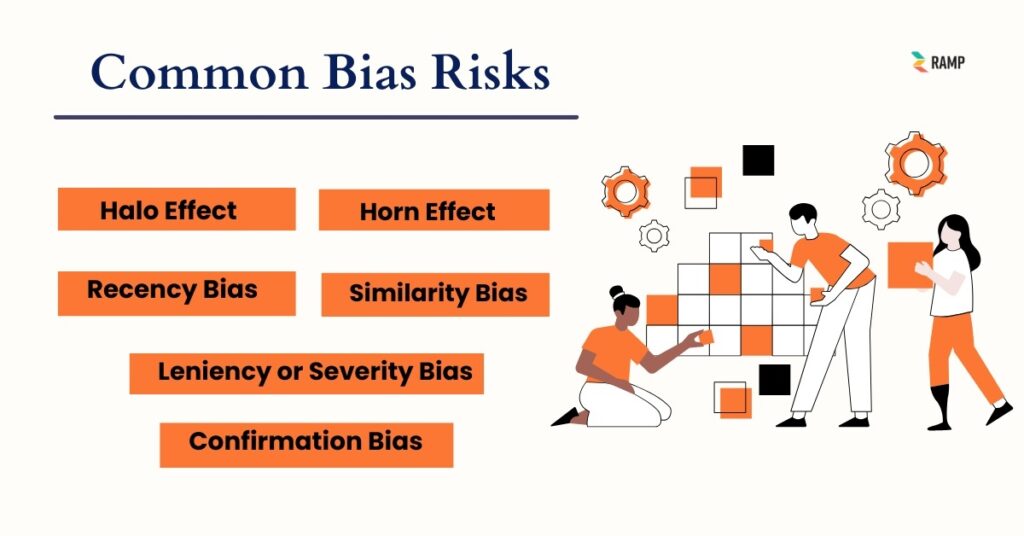
The biases are explained in detail below.
- Halo Effect: One strong positive quality may unfairly influence the entire evaluation.
- Horn Effect: A single mistake or weakness may negatively affect the overall review.
- Recency Bias: Managers may focus too heavily on recent performance instead of the full review period.
- Similarity Bias: Managers may favor employees with similar personalities, communication styles, or work habits.
- Leniency or Severity Bias: Some managers consistently rate employees too generously or too harshly.
- Confirmation Bias: Managers may focus mainly on information that supports their existing opinions about the employee.
Organizations should actively manage these risks to maintain fairness and consistency.
Safeguards for Effective Managerial Performance Reviews
Several safeguards improve the quality and credibility of managerial reviews. The diagram below lists the safeguards for effective managerial performance review.
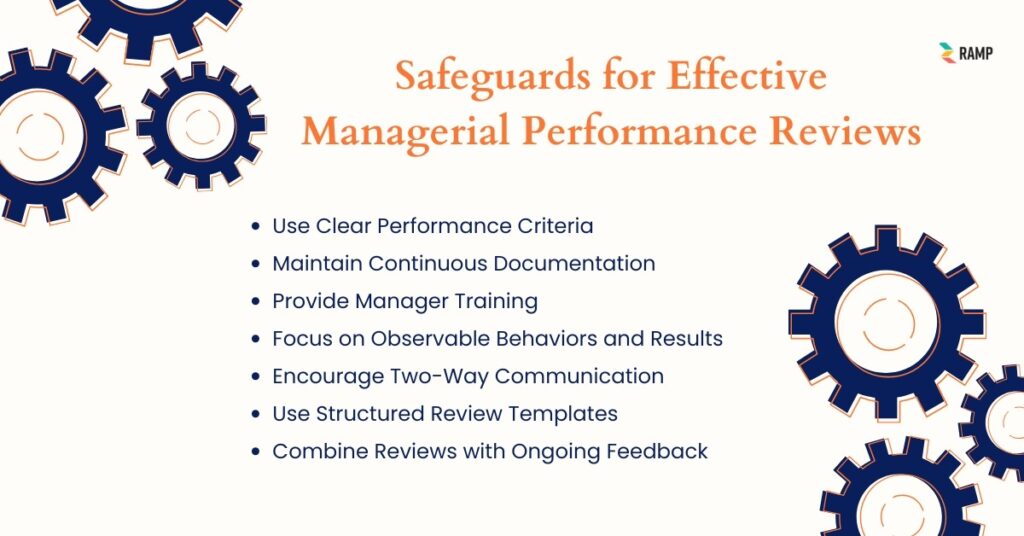
The details are given below.
- Use Clear Performance Criteria: Employees should understand evaluation standards, KPIs, and expectations clearly.
- Maintain Continuous Documentation: Managers should record observations and achievements throughout the review period.
- Provide Manager Training: Managers should receive training on delivering feedback, evaluating performance, and recognizing bias.
- Focus on Observable Behaviors and Results: Feedback should rely on measurable outcomes and workplace behaviors rather than assumptions.
- Encourage Two-Way Communication: Employees should have opportunities to share perspectives, challenges, and feedback.
- Use Structured Review Templates: Standardized formats improve consistency across departments.
- Combine Reviews with Ongoing Feedback: Regular check-ins reduce surprises during formal evaluations.
When to Use Managerial Performance Reviews
Managerial reviews work best when organizations need structured oversight and formal performance evaluation systems.
They are commonly used for:
- Annual performance reviews
- Promotion decisions
- Compensation planning
- Performance improvement management
- Employee development discussions
- Organizational accountability
Most traditional organizations use managerial reviews as a core performance management method.
Best Roles for Managerial Performance Reviews
Managerial reviews are especially effective for roles with clearly defined responsibilities and direct supervision.
Common Examples
- Administrative staff
- Operations employees
- Corporate office roles
- Customer service teams
- Manufacturing employees
- Retail employees
- Financial professionals
- Entry-level and mid-level staff
These roles often involve measurable performance standards and regular managerial oversight.
Situations Where Managerial Performance Reviews May Not Work Well
Managerial reviews may be less effective in certain work environments.
- Highly Collaborative Teams: Managers may not fully observe peer interactions or team dynamics.
- Remote Work Environments: Limited daily visibility may reduce evaluation accuracy.
- Creative or Knowledge-Based Roles: Complex creative contributions may be difficult for managers alone to assess completely.
- Fast-Changing Agile Workplaces: In rapidly changing environments, infrequent formal reviews can quickly become outdated.
- Weak Managerial Skills: Poor communication or evaluation skills can significantly reduce the effectiveness of reviews.
In these situations, organizations often combine managerial reviews with peer feedback, self-assessments, or continuous performance discussions.
Managerial performance reviews remain one of the most important and widely used employee evaluation methods because they provide structure, accountability, and direct oversight of performance. They help organizations measure employee contributions, support decision-making, and maintain alignment between individual performance and business goals.
However, the effectiveness of managerial reviews depends heavily on fair evaluation practices, strong communication, proper documentation, and manager training. When combined with continuous feedback and employee participation, managerial performance reviews become more balanced, accurate, and development-focused.