
Peer feedback is the process by which colleagues offer constructive observations on work performance, communication, collaboration, or behavior. Unlike manager-led evaluations, peer feedback comes from people at the same level who interact regularly on tasks and projects.
Its purpose is not to criticize. Effective peer feedback helps people recognize strengths, correct issues early, and improve how teams work together.
Why Does It Matter?
Peer feedback creates stronger communication and accountability within a team. Since coworkers often observe day-to-day behaviors more closely than managers do, their input can offer practical insights that improve performance.
It matters because it:
- Encourages continuous improvement
- Builds trust and collaboration
- Helps identify blind spots
- Improves teamwork and communication
- Reduces repeated misunderstandings
- Creates a culture of openness and respect
Teams that exchange useful feedback regularly tend to solve problems faster and work more efficiently.
Research on effective peer feedback explains that giving useful peer feedback requires specific capabilities, including understanding the purpose of feedback, delivering a suitable message, making fair judgments, and managing the social-emotional side of the conversation. This supports the value of peer feedback because coworkers need to provide comments that are clear, respectful, and helpful rather than vague or emotionally driven. When used well, peer feedback improves collaboration, communication, and continuous team learning.
Core Structure of Peer Feedback Using the SBI Framework
One of the simplest and most effective methods for giving peer feedback is the SBI Framework, which stands for:
- Situation — Describe when and where the behavior happened.
- Behavior — Explain the specific action you observed.
- Impact — Describe the result or effect of that behavior.
This structure keeps feedback objective and clear, rather than emotional or vague.
Short Example
"In yesterday’s client meeting, I observed that you interrupted the presenter several times while she was explaining the proposal. The impact was that the discussion became difficult to follow, and the client seemed less engaged."
This format works because it focuses on observable actions rather than personal judgment.
Characteristics of Peer Feedback
Good peer feedback usually has the following characteristics:
- Specific: It focuses on specific behaviors or actions rather than general opinions.
- Respectful: The message remains professional and avoids personal attacks.
- Timely: Feedback is more useful when shared soon after the situation occurs.
- Constructive: The goal is improvement, not blame.
- Balanced: Strong feedback recognizes both positive contributions and areas for growth.
- Action-Oriented: It provides direction that can help someone improve future performance.
The diagram below shows when to use peer feedback and when not to.
| When to Use It | When Not to Use It |
| After completing team projects | When emotions are still high after an argument |
| During collaborative assignments | If the feedback is based on assumptions rather than facts |
| When communication problems affect workflow | When there is no professional trust between coworkers |
| While preparing employees for leadership roles | If the issue is extremely minor and temporary |
| During performance review periods | When feedback is intended only to complain or embarrass someone publicly |
| When recurring behaviors influence team productivity | During urgent operational situations that require immediate action instead of reflection |
| It is especially useful when coworkers interact frequently and depend on each other to complete tasks. | In these cases, feedback may create defensiveness rather than improvement. |
When to Use It?
Peer feedback is most effective in situations such as:
- After completing team projects
- During collaborative assignments
- When communication problems affect workflow
- While preparing employees for leadership roles
- During performance review periods
- When recurring behaviors influence team productivity
It is especially useful when coworkers interact frequently and depend on each other to complete tasks.
When Not to Use It?
Peer feedback should be avoided in certain situations, including:
- When emotions are still high after an argument
- If the feedback is based on assumptions rather than facts
- When there is no professional trust between coworkers
- If the issue is extremely minor and temporary
- When feedback is intended only to complain or embarrass someone publicly
- During urgent operational situations that require immediate action instead of reflection
In these cases, feedback may create defensiveness rather than improvement.
Sentence Starters for Effective Feedback
The following sentence starters help keep feedback professional and structured:
- "In [situation], I observed…"
- "The impact was…"
Example
"In the weekly project review, I observed that some deadlines were communicated very late to the design team. The impact was that the team had less time to complete revisions and felt unnecessary pressure before submission."
These phrases encourage factual communication instead of emotional reactions.
Common Mistakes to Avoid
Many people give feedback incorrectly without realizing it. The diagram below shows the common mistakes to avoid while giving peer feedback.
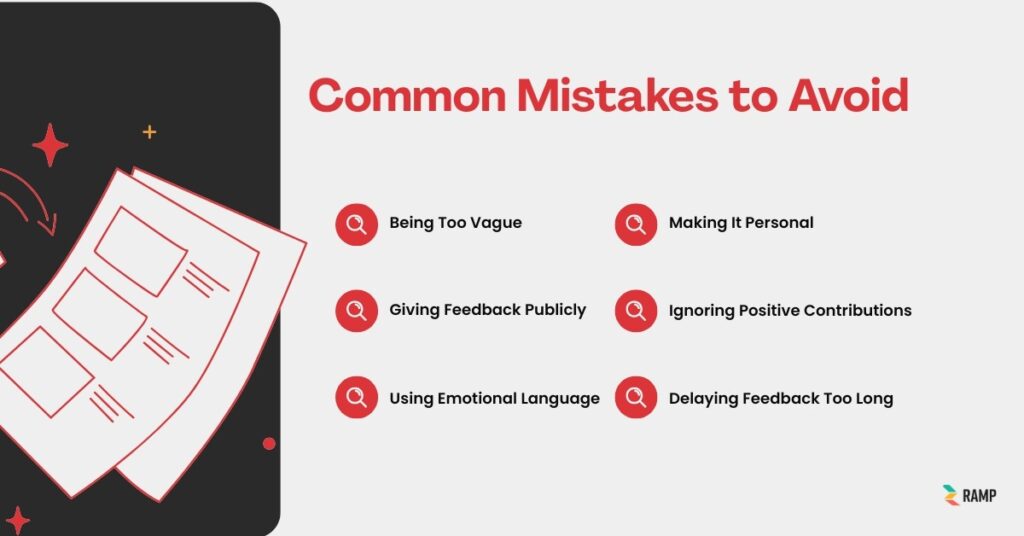
The details are given below.
- Being Too Vague: Statements like "You need to improve communication" are unclear and difficult to act on.
- Making It Personal: Feedback should focus on actions, not personality traits.
- Giving Feedback Publicly: Sensitive feedback should usually be shared privately to avoid embarrassment.
- Ignoring Positive Contributions: Pointing out mistakes alone can damage morale and motivation.
- Using Emotional Language: Aggressive wording often causes defensiveness and weakens the message.
- Delaying Feedback Too Long: Waiting too long reduces relevance and impact.
Peer feedback is an important part of healthy teamwork and professional growth. When delivered respectfully and clearly, it helps employees improve communication, strengthen collaboration, and solve problems before they grow larger.
Using structured methods, such as the SBI framework, makes feedback more objective and productive. The most effective peer feedback focuses on observable behavior, clearly explains its impact, and encourages improvement rather than criticism.
Peer Feedback Best Practices
Peer feedback best practices are practical guidelines for delivering clear, respectful, and constructive feedback between coworkers, improving communication, and enhancing professional growth.
1. Ask Permission or Set Context First
Before giving feedback, make sure the other person is open to the conversation. A simple introduction creates a more respectful and productive discussion.
Example:
"Can I share a quick observation from today's meeting?"
This reduces defensiveness and prepares the person to listen.
2. Be Specific
Clear feedback is more useful than general comments. Focus on exact situations, actions, or behaviors.
Good Example: "In yesterday's presentation, your summary at the end helped the client understand the next steps clearly."
Vague Example: "You did well in the meeting."
Specific feedback is easier to understand and apply.
3. Focus on Behaviors, Not Personality
Discuss observable actions instead of personal traits or assumptions.
Better Approach: "You interrupted several responses during the discussion."
Avoid: "You are disrespectful."
Behavior-focused feedback feels more objective and professional.
4. Balance Impact With Suggestions
Explain the effect of the behavior and offer a practical improvement idea when needed.
Example:
"The fast pace of the explanation made it difficult for newer team members to follow. Slowing down slightly during technical sections may help improve clarity."
This keeps feedback constructive rather than critical.
5. Keep Feedback Timely
Feedback is most effective when shared close to the actual situation. Waiting too long can reduce relevance and accuracy.
Timely feedback helps people:
- Remember the situation clearly
- Make faster improvements
- Prevent repeated mistakes
Short, immediate conversations are often more useful than delayed formal reviews.
6. Avoid Turning Peer Feedback Into Performance Ratings
Peer feedback should support improvement and collaboration, not feel like scoring or judging coworkers.
Avoid statements such as:
- "You're the weakest person on the team."
- "Your performance is below everyone else."
Instead, focus on behaviors, communication, and teamwork.
7. Follow Up After Feedback
Good feedback should not end after one conversation. Follow-up discussions help track progress and reinforce improvement.
Helpful follow-up questions include:
- "How has the new process been working?"
- "Did the adjustment improve the workflow?"
- "Is there anything else I can support?"
Follow-up shows that the goal is improvement, not criticism.
Effective peer feedback should always stay aligned with team expectations, workplace communication standards, and any review rubrics or collaboration guidelines used within the organization.