An effective performance improvement plan is a structured document and process used to help an employee correct specific performance or behavioral problems within a defined timeframe. It sets measurable expectations, provides support, tracks progress, and clarifies consequences if improvement does not occur.
Research on the foundations of performance improvement explains that organizations need clear principles and practical models to identify and solve performance problems effectively. The article emphasizes that performance improvement should be guided by structured analysis rather than trial-and-error decisions. This supports the purpose of an effective Performance Improvement Plan because a strong PIP uses clear expectations, measurable goals, documented support, and regular review to help employees improve fairly.
Core Attributes of an Effective PIP
An effective PIP is specific, fair, documented, measurable, and supportive. It should not be used as a surprise punishment or a disguised termination notice. A strong PIP gives the employee a real opportunity to improve while giving the organization a clear record of expectations, support, and outcomes.
A PIP also needs consistent management. The document alone does not improve performance. The manager must coach the employee, remove barriers, review progress, document check-ins, and evaluate results fairly.
Purpose Attributes of PIP
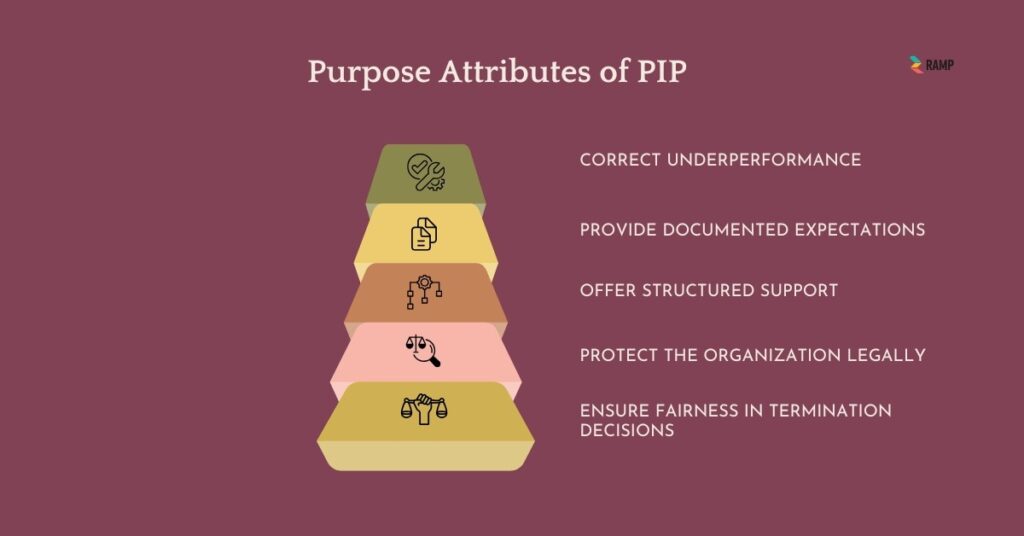
The diagram below shows the purpose attributes of PIP.
Below are the details of the PIP purpose attributes.
- Correct Underperformance
A PIP exists to correct ongoing underperformance that has not improved through normal feedback or informal coaching. It identifies the exact performance issue, explains the expected standard, and gives the employee a structured path to close the gap.
- Provide Documented Expectations
A PIP creates a written record of what the employee must improve, how success will be measured, what support will be provided, and when progress will be reviewed. This prevents confusion and reduces disputes about what was expected.
- Offer Structured Support
A good PIP is not only a warning. It should include coaching, training, mentorship, tools, clarification of the workload, or process support. Without support, the PIP becomes a compliance document rather than a genuine improvement process.
- Protect the Organization Legally
PIPs help organizations document performance concerns, support provided, check-ins, employee responses, and final decisions. Employment guidance commonly emphasizes fair process, evidence, and documentation when managing poor performance or capability issues.
- Ensure Fairness in Termination Decisions
If termination becomes necessary, a PIP can show that the employee had notice, a chance to improve, clear expectations, and reasonable support. This helps reduce the risk of unfair or inconsistent decisions.
Core Components of an Effective PIP
The core components of an effective PIP are illustrated in the diagram below. It includes clear performance gaps, measurable improvement goals, a timeline, support and resources, and consequences.
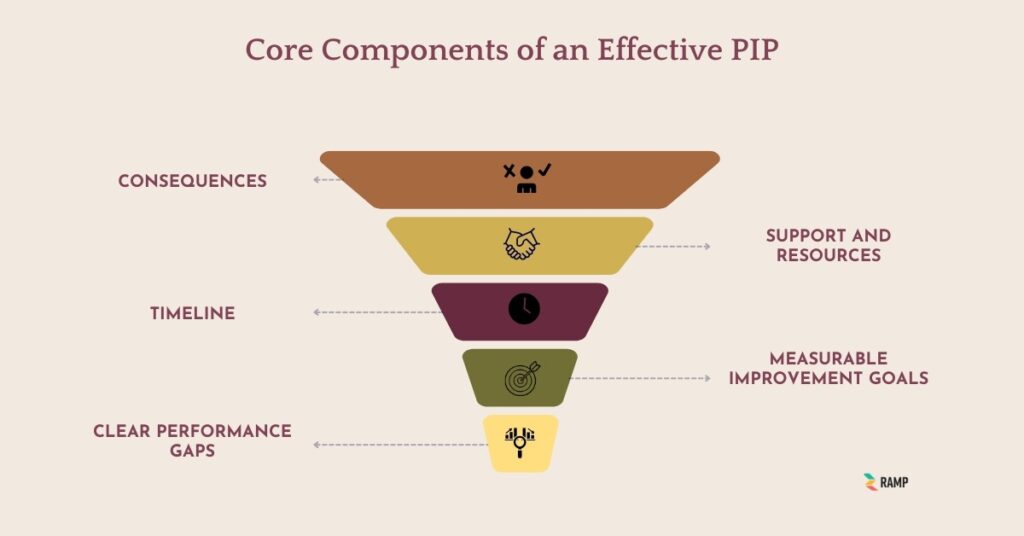
The details are given below.
1. Clear Performance Gaps
The PIP must describe the exact gap between current performance and expected performance. Vague statements such as "needs to improve attitude" or "must be more productive" are weak and unfair. Instead, the document should include specific deficiencies, evidence-based documentation, and data-backed examples.
Example: "Three of the last five client reports were submitted after the agreed deadline, causing project delays," is stronger than "the employee misses deadlines."
A strong performance gap section includes:
- What happened
- When it happened
- What standard was missed
- What impact did it cause
- What evidence supports the concern
2. Measurable Improvement Goals
Improvement goals should be SMART: specific, measurable, achievable, relevant, and time-bound. They should connect directly to KPIs or job expectations.
Examples:
- Submit all weekly reports by Friday at 5 p.m. for the next 60 days.
- Maintain a customer satisfaction score of at least 90% for the next quarter.
- Reduce data-entry errors to fewer than 2 per 100 records within 30 days.
Measurable goals prevent subjective evaluation and help both the employee and manager know whether improvement is actually happening.
3. Timeline
A PIP should include a clear timeframe. Common structures are 30, 60, or 90 days, depending on the role, severity of the issue, and type of improvement required.
A 30-day PIP may be appropriate for urgent or narrow issues. A 60-day PIP works for moderate performance gaps. A 90-day PIP may be useful for complex roles, sales cycles, leadership behaviors, or skill-building needs.
The timeline should include milestone checkpoints, not just a final review date.
4. Support and Resources
A PIP must explain what support the organization will provide. This may include:
- Manager coaching
- Skills training
- Mentorship
- Process documentation
- Job aids or templates
- Software access
- Workload clarification
- Additional feedback sessions
Support is essential because an effective PIP should help the employee improve, not simply record failure.
5. Consequences
The PIP should clearly explain what happens if expectations are met, partially met, or not met. Consequences may include successful completion, extension of the PIP, reassignment, demotion, or termination.
Transparency matters. If failure to meet expectations may lead to termination, the document should clearly and professionally state so.
When to Use a PIP
A PIP should be used when performance or conduct problems are serious enough to require formal correction, but improvement is still possible.
Use a PIP for:
- Ongoing underperformance: The employee repeatedly fails to meet expected job standards.
- Missed KPIs: The employee consistently misses measurable targets, including deadlines, sales goals, quality scores, and productivity benchmarks.
- Behavioral concerns: Issues such as poor collaboration, unprofessional communication, missed commitments, or failure to follow team norms.
- Repeated policy violations: Recurring attendance, compliance, communication, or process violations.
- Failure after informal coaching: The manager has already provided feedback or coaching, but the issue continues.
When Not to Use a PIP
A PIP should not be used for:
- Minor one-time mistakes: A single error should usually be handled through coaching.
- Lack of proper training: If the employee was never trained, the solution is training, not discipline.
- Organizational system failures: If unclear goals, poor tools, broken processes, or unrealistic workloads caused the issue, the organization must fix those conditions first.
Measurement and Tracking
Measurement is what turns a PIP from a warning into a performance management process. The manager should track progress weekly, compare results against KPIs, document observations, and hold formal check-ins.
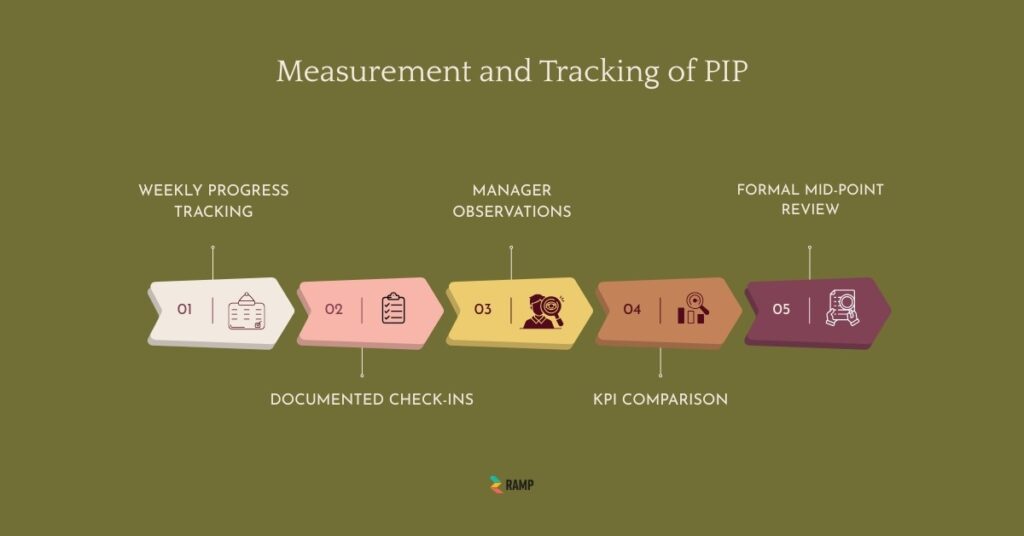
Key tracking methods include:
- Weekly progress tracking: Review goals, completed work, missed targets, and barriers.
- Documented check-ins: Record meeting dates, discussion points, employee responses, and agreed actions.
- Manager observations: Capture observed behavior, quality changes, communication improvements, and reliability.
- KPI comparison: Compare actual results against the PIP's measurable benchmarks.
- Formal mid-point review: Evaluate whether the employee is on track halfway through the plan.
For example, if the PIP goal is to reduce customer complaint escalations from 10 per month to 3 per month, the manager should track weekly escalations and review patterns before making the final decision.
Legal and Compliance Attributes
PIPs have legal and compliance significance because they can affect discipline, demotion, or termination decisions. Employers should use consistent documentation standards, involve HR, and apply the process fairly across employees. The EEOC warns employers to consider whether they are holding an employee to stricter standards than others or treating similar cases differently, especially after protected activity. The diagram below shows the legal and compliance attributes.
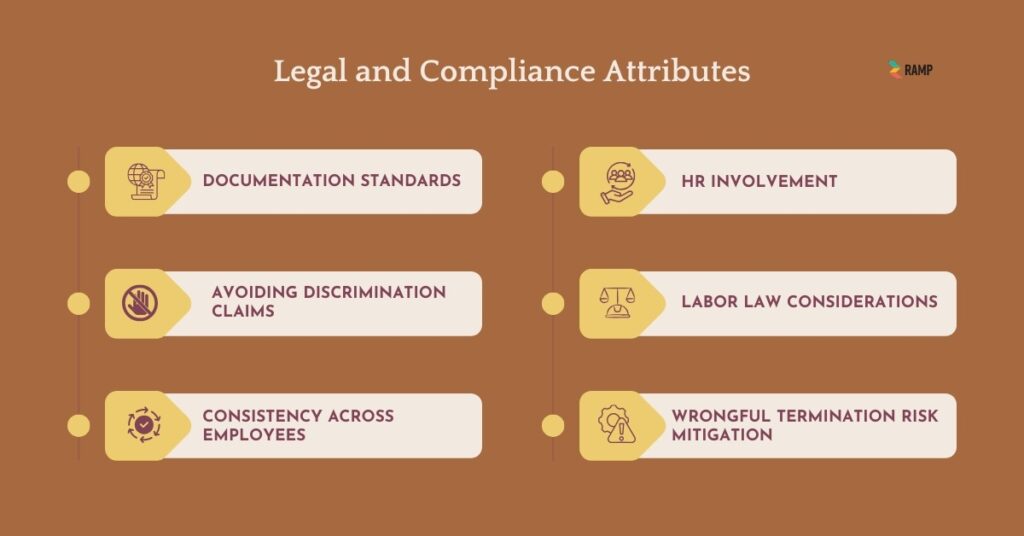
The details of important compliance attributes include:
- Documentation standards: Keep factual, dated, job-related records.
- Avoiding discrimination claims: Apply standards consistently regardless of protected characteristics.
- Consistency across employees: Similar performance issues should receive similar treatment unless there is a legitimate reason.
- HR involvement: HR should review the PIP for fairness, clarity, alignment with policy, and legal risk.
- Labor law considerations: Requirements vary by country, state, contract, union status, and company policy.
- Wrongful termination risk mitigation: Fair process, evidence, support, and consistency reduce risk.
Employers should also consider disability accommodation obligations where relevant; EEOC guidance notes that performance standards should be job-related and that reasonable accommodations may be required for qualified employees with disabilities.
Psychological and Cultural Attributes
PIPs often damage morale when handled poorly. Employees may interpret a PIP as a signal that the company has already decided to terminate them. That is why emotional intelligence, dignity, and clarity are essential.
An effective PIP should maintain psychological safety by allowing the employee to ask questions, explain obstacles, and request support. The manager should avoid humiliation, public criticism, threatening language, or emotional blame. The diagram below shows the psychological and cultural attributes.
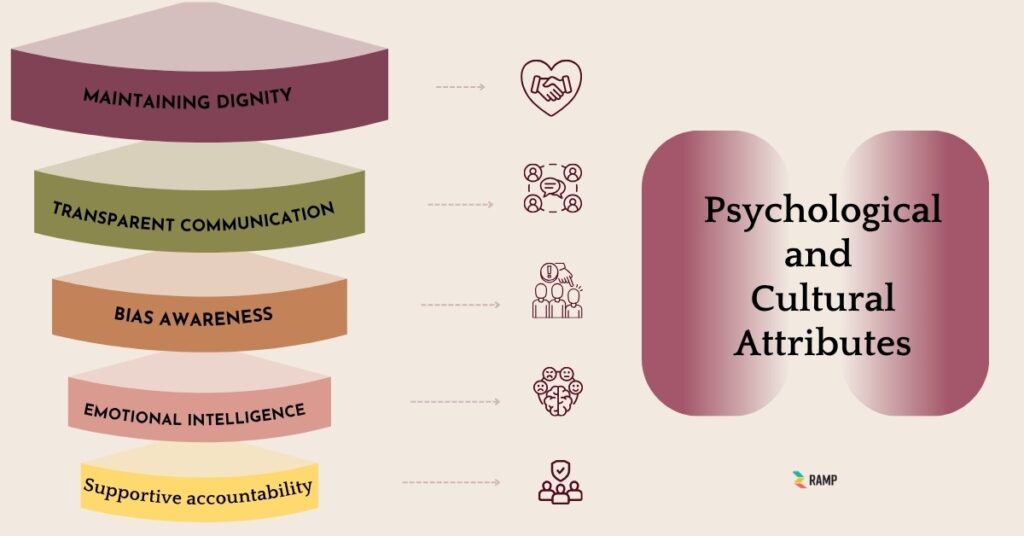
Details of the important cultural attributes include:
- Maintaining dignity: Discuss the PIP privately and respectfully.
- Transparent communication: Explain the issue, the process, the timeline, and the consequences clearly.
- Bias awareness: Review whether assumptions, personality judgments, or proximity bias influenced the decision.
- Emotional intelligence: Deliver the message calmly and constructively.
- Supportive accountability: Balance empathy with clear standards.
Company culture strongly affects PIP success. In a high-trust culture, a PIP may be seen as a genuine recovery path. In a fear-based culture, it may be seen as a termination warning.
Managerial Responsibilities
Most PIPs fail because managers lack the skill, discipline, or consistency to run them properly. A manager's role is not only to identify poor performance; it is to coach improvement. The diagram below shows the manager's responsibilities.
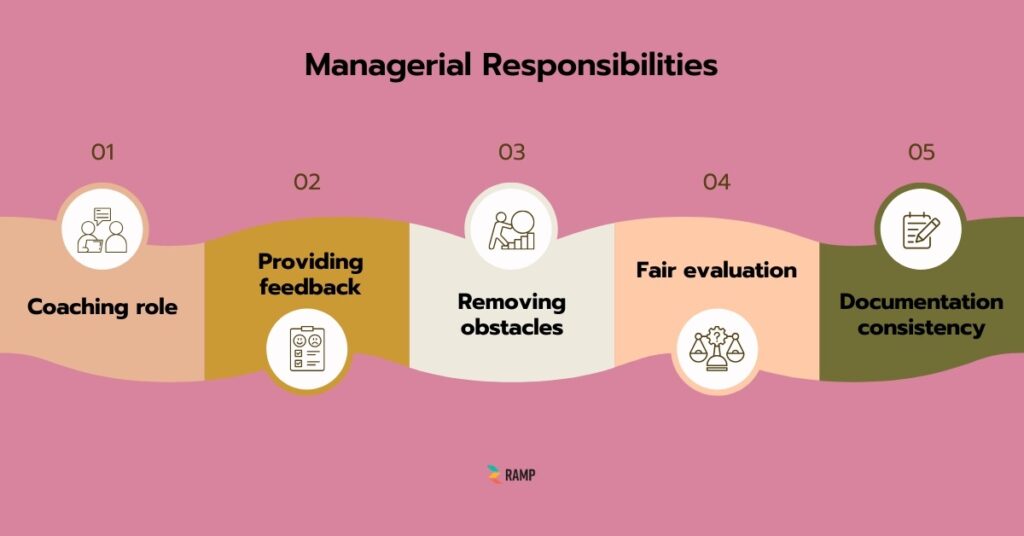
Manager responsibilities include:
- Coaching role: Help the employee understand what to change and how.
- Providing feedback: Give timely, specific, behavior-based feedback.
- Removing obstacles: Address unclear priorities, missing tools, workload issues, or training gaps.
- Fair evaluation: Judge progress against the documented goals, not personal frustration.
- Documentation consistency: Record check-ins, progress, barriers, and decisions.
A manager should not create a PIP and disappear until the final review. Regular involvement is what makes the plan credible and fair.
Common PIP Mistakes
The diagram below lists all the common PIP mistakes.
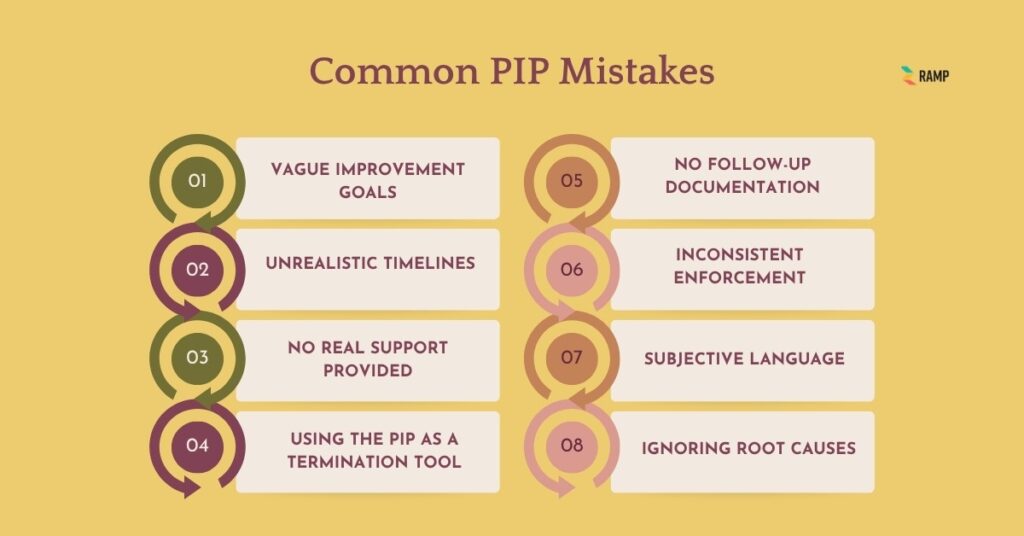
Common mistakes include:
- Vague improvement goals: "Improve communication" is too broad unless defined with specific behaviors.
- Unrealistic timelines: Some skills or business cycles cannot improve meaningfully in 30 days.
- No real support provided: A PIP without coaching or resources is weak.
- Using the PIP as a termination tool: If the outcome is already decided, the process is not genuine.
- No follow-up documentation: Undocumented check-ins weaken the final decision.
- Inconsistent enforcement: Applying PIPs differently across employees creates fairness and legal concerns.
- Subjective language: Avoid labels such as “lazy,” “negative,” or “not committed.”
- Ignoring root causes: Poor performance may come from training gaps, unclear goals, or system failures.
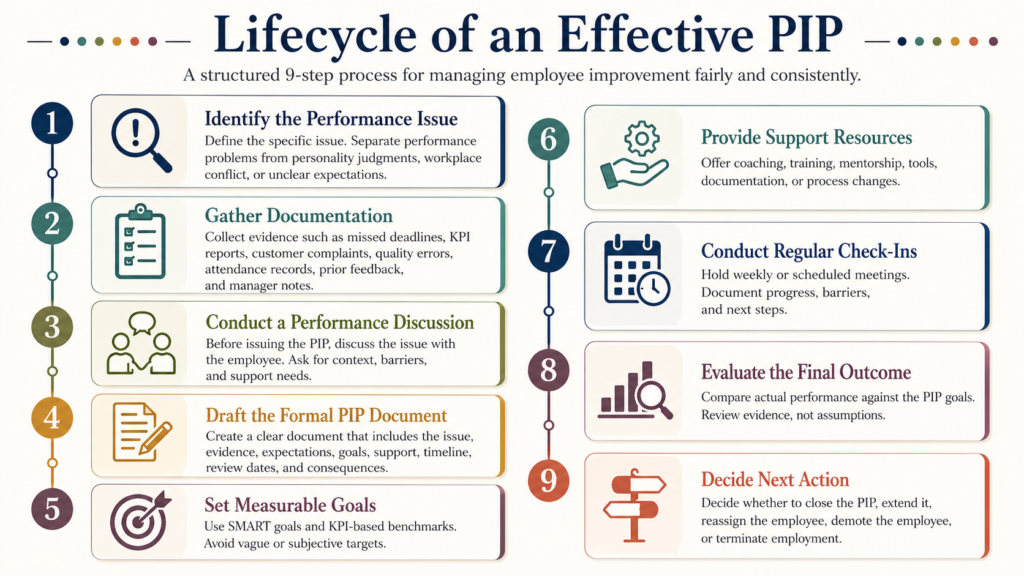
Lifecycle of an Effective PIP
Step 1: Identify the Performance Issue
Define the specific issue. Separate performance problems from personality judgments, workplace conflict, or unclear expectations.
Step 2: Gather Documentation
Collect evidence such as missed deadlines, KPI reports, customer complaints, quality errors, attendance records, prior feedback, and manager notes.
Step 3: Conduct a Performance Discussion
Before issuing the PIP, discuss the issue with the employee. Ask for context, barriers, and support needs.
Step 4: Draft the Formal PIP Document
Create a clear document that includes the issue, evidence, expectations, goals, support, timeline, review dates, and consequences.
Step 5: Set Measurable Goals
Use SMART goals and KPI-based benchmarks. Avoid vague or subjective targets.
Step 6: Provide Support Resources
Offer coaching, training, mentorship, tools, documentation, or process changes.
Step 7: Conduct Regular Check-Ins
Hold weekly or scheduled meetings. Document progress, barriers, and next steps.
Step 8: Evaluate the Final Outcome
Compare actual performance against the PIP goals. Review evidence, not assumptions.
Step 9: Decide Next Action
Decide whether to close the PIP, extend it, reassign the employee, demote the employee, or terminate employment.
The diagram below summarizes the following steps.
PIP vs Other Corrective Actions
The chart below compares PIP and other corrective actions in terms of purpose, formality, and when best used.
| Corrective Actions Comparison | |||
| Corrective Action | Purpose | Formality | Best Used When |
| Informal coaching | Improve early issues through guidance | Low | First-time or minor performance gaps |
| Verbal warning | Notify employee that behavior or performance must change | Low to Moderate | Issue continues after coaching |
| Written warning | Create formal record of concern | Moderate | Repeated or more serious issues |
| Performance counseling | Discuss performance barriers and support needs | Moderate | Employee needs guidance and clarification |
| Performance Improvement Plan | Formal improvement process with goals, timeline, and tracking | High | Ongoing underperformance with opportunity to improve |
| Demotion | Move employee to lower responsibility level | High | Employee cannot meet current role requirements but may succeed elsewhere |
| Termination | End employment | Highest | Serious failure, no improvement, misconduct, or role mismatch |
A PIP is more formal than coaching or a warning but less final than termination. Its main purpose is structured improvement.
30-60-90 Day PIP Example
Scenario
An account manager has missed client follow-up deadlines, failed to consistently update the CRM, and received repeated complaints about delayed communication.
First 30 Days: Stabilize Performance
Goals:
- Update all active client records in the CRM within 24 hours of each client interaction.
- Respond to client emails within one business day.
- Attend weekly coaching sessions with the manager.
- Submit a weekly client follow-up summary every Friday.
Measurement:
- CRM audit
- Email response review
- Manager check-ins
- Client escalation count
Days 31–60: Build Consistency
Goals:
- Maintain 95% compliance with CRM updates for the month.
- Reduce client follow-up delays to no more than one missed deadline per month.
- Demonstrate improved planning through weekly account prioritization.
- Receive no repeated complaints from the same client account.
Measurement:
- CRM dashboard
- Client feedback
- Account review notes
- Manager observations
Days 61–90: Sustain Improvement
Goals:
- Maintain agreed service standards without prompting from the manager.
- Meet all client follow-up deadlines for 30 consecutive days.
- Show consistent ownership of account planning.
- Complete final review with evidence of sustained improvement.
Possible outcomes:
- PIP closed successfully
- PIP extended for partial improvement
- Reassignment considered
- Employment terminated if expectations are not met
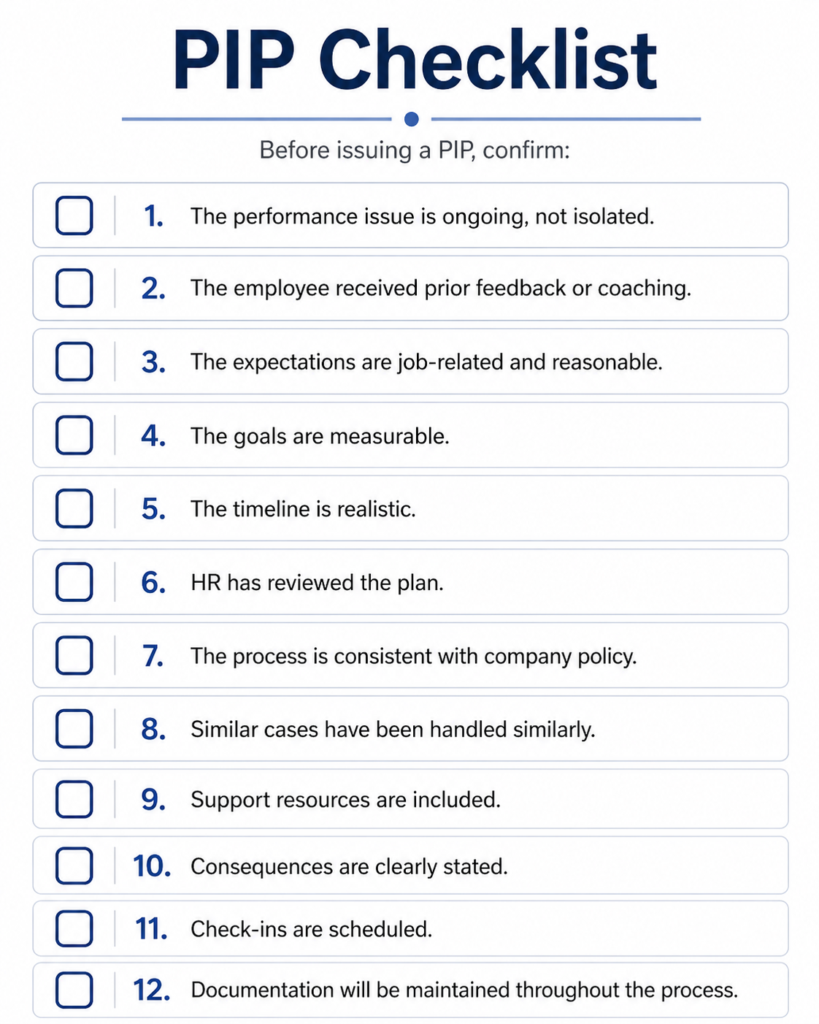
PIP Checklist
Use this PIP checklist before issuing a Performance Improvement Plan to confirm that the process is fair, documented, and supported by clear expectations. It helps managers and HR reduce risk, improve consistency, and give employees a genuine opportunity to improve.
When to Involve HR
The following points indicate when to involve HR in PIP.
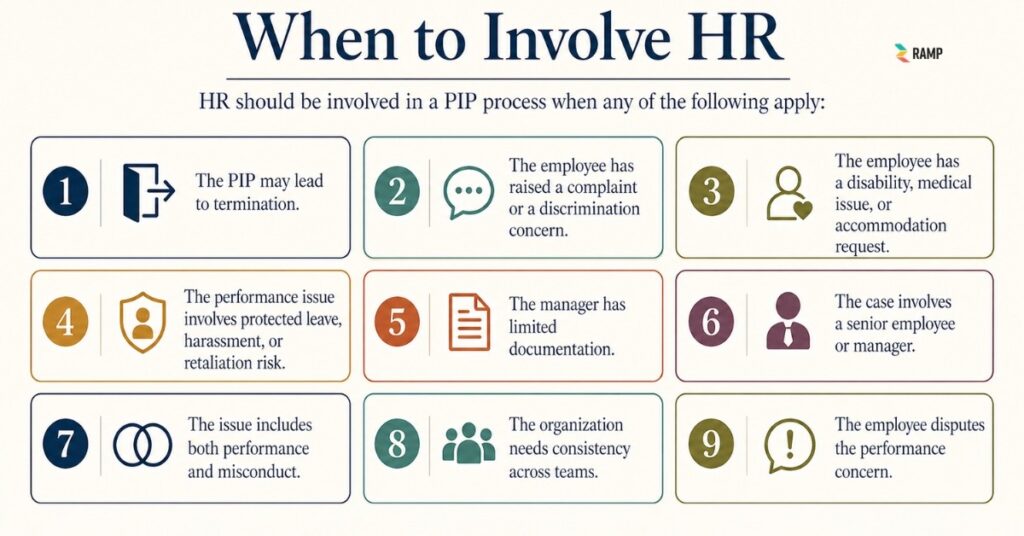
HR involvement helps ensure that the PIP is fair, consistent, properly documented, and aligned with employment policies.
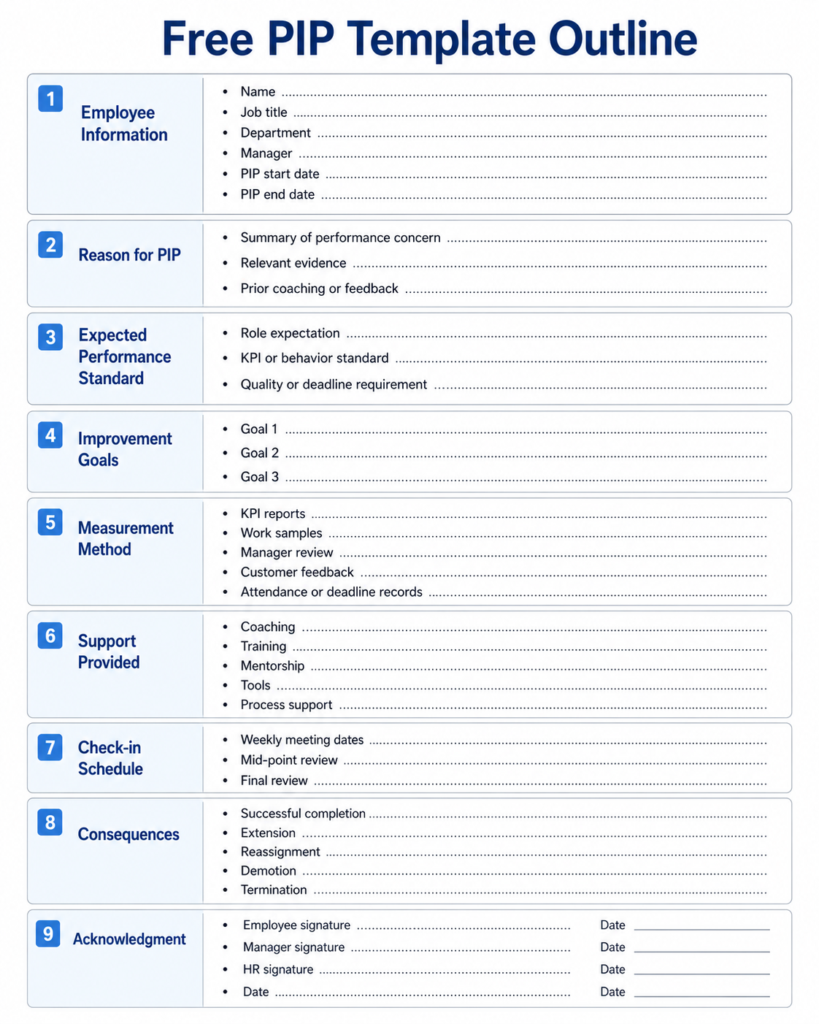
Free PIP Template Outline
Use this Performance Improvement Plan template. It helps managers set clear expectations, provide support, and ensure accountability throughout the improvement process.