
Employee feedback is the process of providing employees with constructive, specific, and ongoing information about their performance, behavior, skills, and contributions to help improve individual growth, workplace communication, and organizational success.
Employee feedback is a key part of performance management because it helps employees understand expectations, improve performance, stay engaged, and develop professionally. Effective feedback is not limited to formal reviews. It should happen regularly through conversations, coaching, and daily workplace interactions.
Research on employee feedback and regular recognition indicates that effective feedback should be clear, consistent, empathetic, and aligned with employee goals. The article highlights that regular feedback and recognition help build accountability, appreciation, engagement, and stronger workplace relationships. This supports the importance of employee feedback as an ongoing process that improves performance, motivation, and professional development.
Characteristics of Effective Employee Feedback
Effective employee feedback helps employees understand their performance, improve their skills, and stay aligned with organizational expectations. Good feedback is not only about pointing out mistakes or praising success. It should guide employees clearly, respectfully, and constructively toward improvement and growth.
The diagram below shows the key characteristics of effective employee feedback.
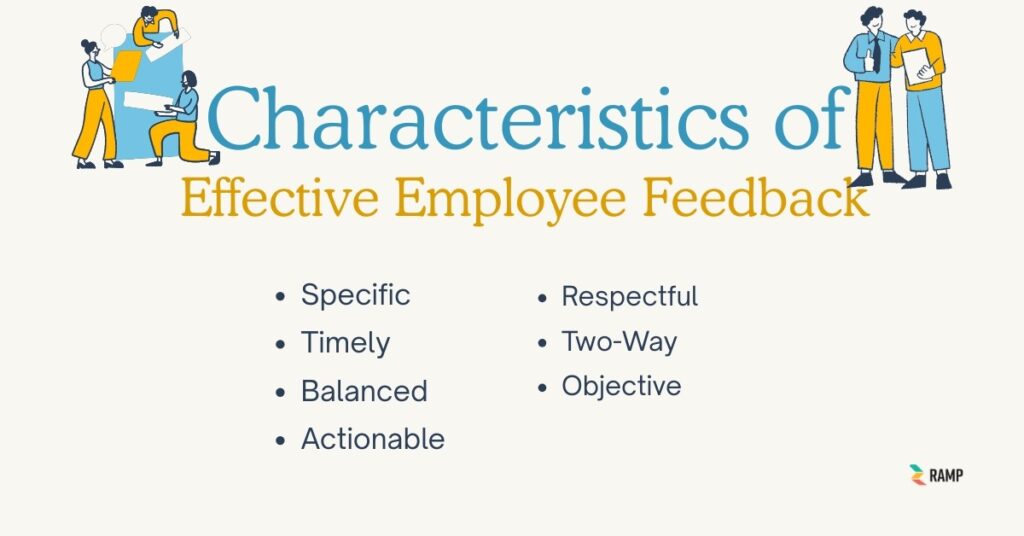
The key characteristics of effective employee feedback are explained in detail below.
Specific
Effective feedback focuses on clear actions, behaviors, or outcomes rather than vague comments.
Example: Instead of saying, "You need to improve," say, "Your report was well researched, but adding clearer data summaries would improve readability."
Specific feedback helps employees understand exactly what they did well or what needs improvement.
Timely
Feedback should be given as close as possible to the event or behavior being discussed.
Timely feedback:
- Improves learning
- Helps employees correct mistakes faster
- Keeps information relevant and accurate
Delayed feedback often loses impact and effectiveness.
Balanced
Effective feedback includes both strengths and areas for improvement.
Balanced feedback:
- Builds confidence
- Encourages motivation
- Maintains fairness
- Creates trust
Employees need recognition for good work as well as guidance for improvement.
Actionable
Employees should clearly understand what actions they can take after receiving feedback.
Actionable feedback provides:
- Clear recommendations
- Practical next steps
- Improvement suggestions
- Achievable goals
Without action steps, feedback may create confusion instead of progress.
Respectful
Feedback should always be delivered professionally and respectfully.
Respectful communication helps:
- Maintain employee confidence
- Encourage openness
- Reduce defensiveness
- Strengthen workplace relationships
Harsh or personal criticism can damage trust and motivation.
Two-Way
Effective feedback allows employees to respond, ask questions, and share their perspectives.
Two-way feedback improves:
- Understanding
- Collaboration
- Employee engagement
- Problem-solving
Feedback works best when it becomes a conversation rather than a one-sided judgment.
Objective
Feedback should focus on observable behaviors, measurable outcomes, and factual examples rather than personal opinions or assumptions.
Objective feedback reduces:
- Misunderstandings
- Emotional reactions
- Bias and favoritism
Using evidence improves fairness and credibility.
Types of Feedback
Employee feedback can take different forms depending on the purpose, timing, communication style, and workplace situation. Different types of feedback help organizations improve performance, strengthen communication, encourage growth, and maintain employee engagement.
Below are the most common types of employee feedback used in modern workplaces.
- Positive Feedback
- Constructive Feedback
- Negative Feedback
- Formal Feedback Vs Informal Feedback
- Formative Vs Summative
- Upward Feedback
- Peer Feedback
- Self-Feedback or Self-Assessment
- Continuous Feedback
- 360-Degree Feedback
- Coaching Feedback
- Real-Time Feedback
- Sandwich Feedback
- Appreciative Feedback
Organizations that combine multiple feedback types create stronger communication, better employee development, and more effective performance management systems. The most successful workplaces treat feedback as an ongoing process rather than a once-a-year event.
Rogers' Five Feedback Types
Rogers' five feedback types are a practical framework for classifying different ways of giving feedback, making communication clearer, more purposeful, and better suited to the situation and desired outcome.
The diagram below shows Rogers' five feedback framework.
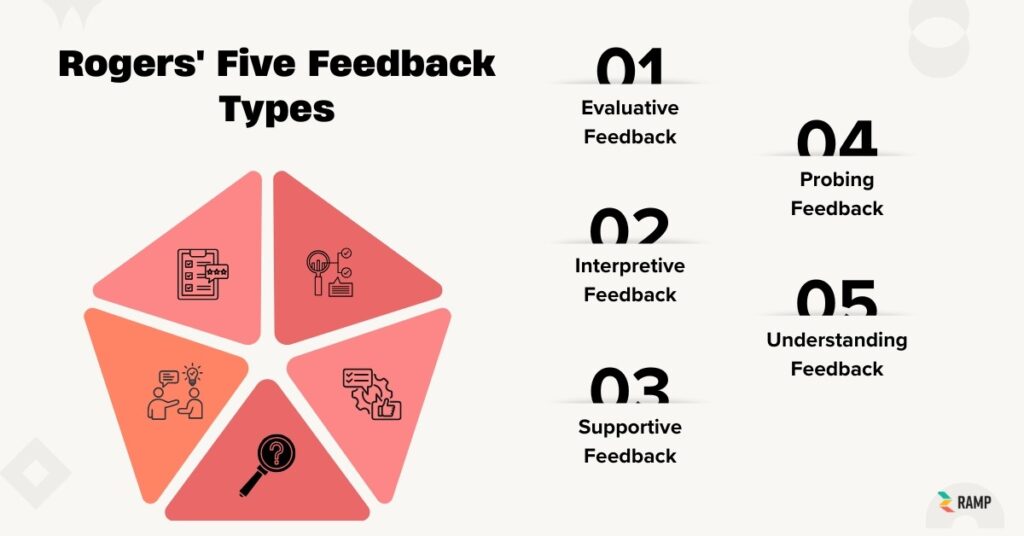
Rogers’ five feedback types are explained in detail below.
1. Evaluative Feedback
Evaluative feedback judges performance against a standard, expectation, or goal.
Example: "Your presentation met the project requirements and was delivered professionally."
2. Interpretive Feedback
Interpretive feedback explains personal opinions, assumptions, or interpretations about someone's behavior or actions.
Example: "I think your hesitation during the meeting showed that you needed more preparation time."
3. Supportive Feedback
Supportive feedback encourages confidence, motivation, and emotional reassurance.
Example: "You handled the client discussion calmly, and your effort really helped the team stay focused."
4. Probing Feedback
Probing feedback uses questions to encourage reflection, deeper thinking, and self-assessment.
Example: "What do you think could improve communication during the next project meeting?"
5. Understanding Feedback
Understanding feedback focuses on listening, clarifying, and confirming understanding before responding or advising.
Example: "So you felt the timeline became difficult because priorities changed during the project?"
Choosing the Right Feedback Type
- Choose supportive feedback when the goal is to motivate and encourage confidence.
- Choose evaluative feedback when the goal is to correct performance or measure results.
- Choose probing feedback when the goal is to develop learning, reflection, and problem-solving skills.
Benefits of Employee Feedback
The diagram below shows the benefits of employee feedback.
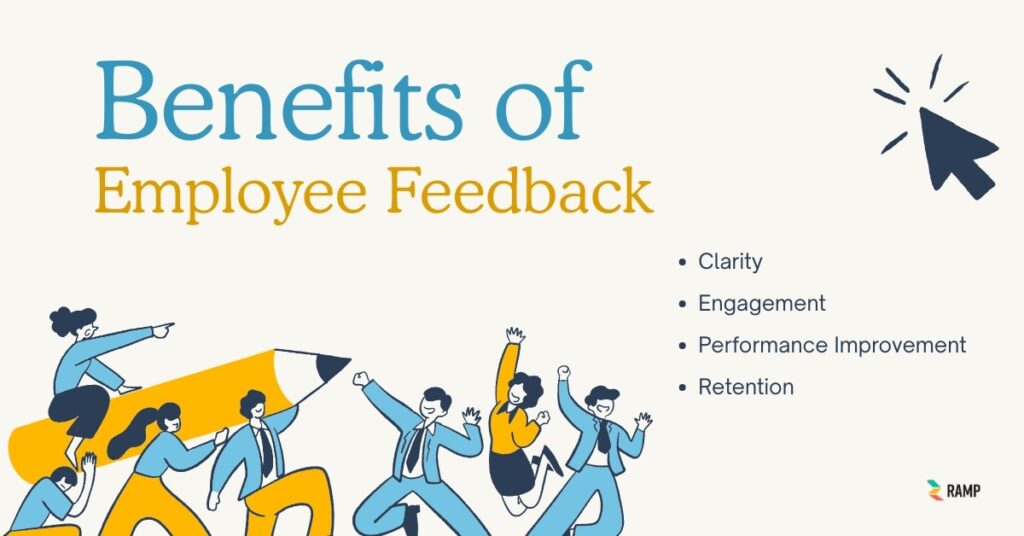
The benefits of employee feedback are explained in detail below.
1. Clarity
One of the primary benefits of employee feedback is performance clarity. Employees perform better when they clearly understand what is expected of them, what they are doing well, and where they need improvement.
Clear feedback helps employees:
- Understand priorities
- Recognize performance expectations
- Avoid repeated mistakes
- Improve decision-making
- Align work with organizational goals
Evidence-Style Impact
When managers provide specific, timely feedback, employees gain clearer direction, reducing confusion and improving performance consistency.
However, feedback without clarity can create anxiety. Vague comments such as "do better" or "improve communication" often leave employees uncertain about what actions they should actually take.
2. Engagement
Employee feedback also strengthens engagement by helping employees feel heard, valued, and connected to their work.
Constructive feedback encourages:
- Open communication
- Employee participation
- Workplace trust
- Recognition and motivation
- Stronger manager-employee relationships
Employees who receive regular feedback are more likely to stay emotionally connected to their responsibilities and workplace goals.
Evidence-Style Impact
When employees receive balanced recognition and constructive guidance, they often become more motivated and involved in their work because they feel their contributions are noticed and supported.
3. Performance Improvement
Feedback plays a direct role in improving employee performance by identifying strengths, correcting problems early, and encouraging continuous development.
Effective feedback helps employees:
- Improve skills
- Correct performance issues quickly
- Build confidence
- Develop stronger workplace behaviors
- Increase productivity
Performance improvement becomes more sustainable when feedback focuses on observable actions and practical solutions rather than personal criticism.
Evidence-Style Impact
When employees receive regular coaching and actionable feedback, performance problems are identified earlier, allowing faster correction and long-term improvement.
4. Retention
Employees are more likely to remain with organizations that foster consistent, supportive, and development-focused communication.
Feedback supports retention by:
- Strengthening workplace relationships
- Creating growth opportunities
- Reducing frustration and uncertainty
- Improving employee satisfaction
- Building trust in leadership
Employees who feel ignored or unsupported often become disengaged over time.
Evidence-Style Impact
When organizations provide continuous feedback and career development discussions, employees often feel more valued and are less likely to seek opportunities elsewhere.
Common Challenges in Employee Feedback
Employee feedback plays a major role in performance improvement and workplace communication, but many organizations struggle to make feedback clear, consistent, and constructive. When feedback is poorly delivered or avoided completely, it can reduce employee trust, motivation, and overall effectiveness.
The diagram below shows the common challenges in employee feedback.
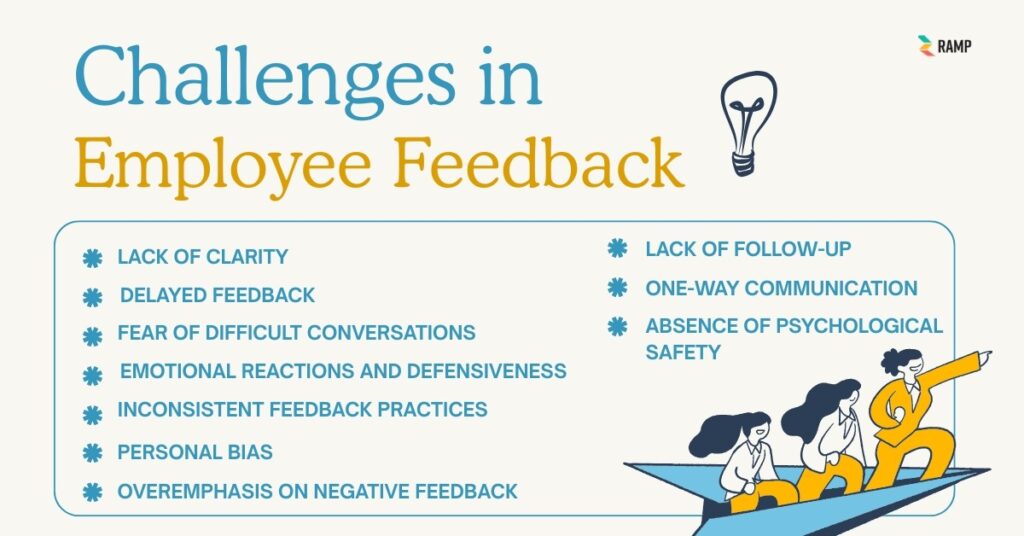
The challenges in employee feedback are explained in detail below.
1. Lack of Clarity
One of the biggest feedback challenges is giving vague or unclear comments that leave employees unsure what needs improvement.
Examples of unclear feedback include:
- "You need to do better."
- "Improve your communication."
- "Be more proactive."
Without specific examples or actionable guidance, employees may feel confused rather than supported.
2. Delayed Feedback
Feedback given too long after an event often loses its relevance and impact.
Delayed feedback can:
- Reduce learning opportunities
- Make examples harder to recall
- Prevent quick correction of mistakes
- Create frustration for employees
Timely feedback is far more effective for behavior change and improvement.
3. Fear of Difficult Conversations
Many managers avoid giving honest feedback because they fear conflict, discomfort, or negative emotional reactions.
This can lead to:
- Avoidance of important issues
- Unresolved performance problems
- Mixed messages
- Reduced accountability
Avoiding feedback often creates bigger problems over time.
4. Emotional Reactions and Defensiveness
Employees may feel criticized, embarrassed, or discouraged when receiving feedback, especially if it is delivered poorly.
Common reactions include:
- Defensiveness
- Frustration
- Anxiety
- Withdrawal from discussion
Emotional responses can prevent productive conversations and limit improvement.
5. Inconsistent Feedback Practices
Some employees receive regular coaching and communication, while others receive very little feedback.
Inconsistency can create:
- Perceived unfairness
- Confusion about expectations
- Unequal development opportunities
- Reduced trust in leadership
Feedback should be consistent across teams and individuals.
6. Personal Bias
Bias can affect both how feedback is given and how performance is interpreted.
Common examples include:
- Favoritism
- Recency bias
- Halo effect
- Similarity bias
Biased feedback reduces fairness and damages credibility.
7. Overemphasis on Negative Feedback
Some managers focus mainly on mistakes and weaknesses while overlooking achievements and strengths.
This can lead to:
- Lower motivation
- Reduced confidence
- Employee disengagement
- Fear of future feedback
Balanced feedback is more effective for development and morale.
8. Lack of Follow-Up
Giving feedback without checking progress often limits long-term improvement.
Without follow-up:
- Employees may forget action steps
- Behavior change may not happen
- Accountability weakens
- Feedback feels unimportant
Ongoing support is necessary for meaningful progress.
9. One-Way Communication
Feedback can become ineffective when it feels like a manager is delivering judgment instead of having a conversation.
Employees need opportunities to:
- Ask questions
- Explain challenges
- Share perspectives
- Request support
Two-way dialogue improves understanding and trust.
10. Absence of Psychological Safety
Employees may avoid honest conversations if they fear embarrassment, punishment, or negative consequences.
Without psychological safety:
- Employees hide problems
- Feedback becomes less honest
- Communication breaks down
- Trust weakens
A safe and respectful environment is essential for effective feedback.
Common feedback challenges, such as unclear communication, delayed responses, inconsistency, and bias, can reduce the effectiveness of performance discussions. Organizations that focus on timely, balanced, respectful, and two-way communication create stronger feedback systems that support employee growth and workplace success.