
Continuous feedback is an ongoing process in which employees, managers, or team members regularly share observations, suggestions, and recognition regarding performance and behavior. Instead of waiting for annual reviews or formal evaluations, feedback is given consistently during daily work activities.
The purpose of continuous feedback is to encourage improvement, strengthen communication, and solve issues early before they become larger problems.
Why Does It Matter?
Continuous feedback helps individuals and teams improve faster because guidance is provided in real time. When people receive regular input, they can adjust their performance immediately rather than repeating the same mistakes for months.
It matters because it:
- Encourages continuous learning
- Improves communication within teams
- Increases employee engagement
- Helps resolve issues quickly
- Builds trust and transparency
- Supports stronger performance management
- Promotes professional growth and accountability
Organizations that practice continuous feedback often create healthier and more collaborative work environments.
Research on continuous feedback loops for real-time change adaptation explains that organizations can use ongoing feedback systems to capture employee insights and respond quickly to changing needs. The article highlights tools such as pulse surveys, employee listening platforms, and sentiment analysis as ways to create a feedback ecosystem that supports agility, responsiveness, and employee involvement. This supports the value of continuous feedback as a practical approach for improving communication, solving issues early, and adapting performance management in real time.
Core Structure of Continuous Feedback Using the SBI Framework
A widely used method for giving continuous feedback is the SBI Framework, which stands for:
- Situation — Explain the specific context.
- Behavior — Describe the observable action.
- Impact — Explain the result of that behavior.
This structure keeps feedback focused, professional, and easy to understand.
Short Example
"In yesterday's team discussion, I observed that you summarized the project risks clearly before the deadline review. The impact was that the team understood the priorities better and responded more quickly to the issues."
This framework works well because it focuses on observable facts rather than assumptions or emotions.
Characteristics of Continuous Feedback
Effective continuous feedback usually has the following characteristics:
- Timely: Feedback is shared soon after the situation occurs.
- Specific: It focuses on clear behaviors and actions instead of vague comments.
- Consistent: Feedback happens regularly rather than occasionally.
- Constructive: The goal is improvement and development, not criticism.
- Balanced: It includes both positive recognition and improvement suggestions.
- Two-Way: Continuous feedback encourages open conversations instead of one-sided communication.
Workflow of Continuous Feedback and One-on-One Meetings
Continuous feedback and one-on-one meetings work best when they follow a clear and consistent process. A structured workflow helps managers and employees communicate regularly, address issues early, and track progress more effectively over time. The diagram below shows the workflow process of continuous feedback.
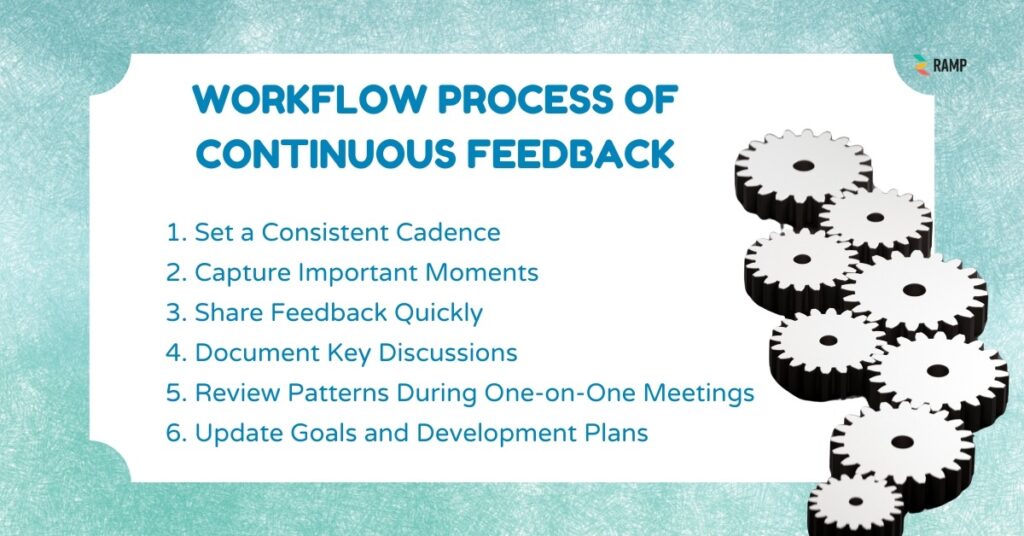
The process is explained in detail below.
1. Set a Consistent Cadence
The process begins by establishing a regular schedule for feedback and one-on-one discussions. The cadence should be predictable so employees know when conversations will happen and can prepare accordingly.
Common approaches include:
- Weekly one-on-one meetings
- Biweekly check-ins
- Monthly development conversations
- Quick post-project feedback discussions
Consistency is important because irregular feedback often leads to confusion, delayed corrections, and weaker communication.
2. Capture Important Moments
Managers and employees should observe and note meaningful situations as work happens. These moments may include:
- Strong performance during meetings
- Missed deadlines or communication gaps
- Leadership behaviors
- Collaboration successes
- Client interactions
- Problem-solving examples
The focus should remain on specific behaviors and outcomes rather than assumptions or personal opinions.
Capturing feedback close to the event improves accuracy and relevance.
3. Share Feedback Quickly
Feedback is most effective when shared shortly after the situation occurs. Immediate or near-term discussions help employees connect the feedback directly to their actions.
Effective feedback should be:
- Clear
- Specific
- Respectful
- Balanced
- Action-oriented
Short, focused conversations are often more effective than long, formal evaluations.
For example:
"In yesterday’s client presentation, I noticed that you explained the technical details very clearly. It helped the client understand the proposal faster and reduced follow-up questions."
Quick feedback creates opportunities for immediate improvement and reinforcement.
4. Document Key Discussions
After feedback conversations, important points should be recorded briefly for future reference. Documentation helps both managers and employees track:
- Recurring strengths
- Improvement areas
- Agreed action steps
- Progress toward goals
- Development priorities
The purpose of documentation is not excessive reporting. It exists to create continuity between conversations and reduce misunderstandings over time.
5. Review Patterns During One-on-One Meetings
One-on-one meetings should focus on identifying recurring themes rather than discussing isolated incidents only.
Managers and employees can review:
- Progress since the last meeting
- Ongoing challenges
- Behavioral patterns
- Team collaboration
- Workload concerns
- Career development opportunities
These discussions create a safer environment for honest communication and long-term growth.
Sample One-on-One Meeting Agenda
- Review progress since the previous meeting
- Discuss recent successes and challenges
- Share feedback on performance and communication
- Identify support, resources, or development needs
- Confirm action items and next steps
A structured agenda keeps meetings focused and productive.
6. Update Goals and Development Plans
The final step is adjusting goals based on feedback trends and current priorities.
This may include:
- Improving communication skills
- Strengthening leadership abilities
- Increasing productivity
- Expanding technical knowledge
- Managing time more effectively
Continuous feedback becomes valuable when it leads to measurable action and long-term improvement rather than repeated discussion without progress.
The chart below highlights the most effective situations for using continuous feedback, along with scenarios where it may become unproductive or difficult to apply successfully.
| When to Use It | When Not to Use It |
| During ongoing projects or assignments | When emotions are still high after conflict or failure |
| When employees are learning new responsibilities | If feedback is given too frequently without purpose |
| After meetings, presentations, or client interactions | When comments are based on assumptions instead of facts |
| In fast-paced work environments where quick adjustments are necessary | If employees feel constantly monitored or criticized |
| During leadership and employee development | During urgent operational situations requiring immediate action |
| When improving communication and teamwork | When there is no trust or psychological safety within the team |
| While tracking progress toward goals or performance targets | |
| It is especially useful in workplaces where collaboration and adaptability are important. | In these situations, feedback can feel overwhelming, stressful, or unproductive. |
When to Use Continuous Feedback?
Continuous feedback is most effective in situations such as:
- During ongoing projects or assignments
- When employees are learning new responsibilities
- After meetings, presentations, or client interactions
- In fast-paced work environments where quick adjustments are necessary
- During leadership and employee development
- When improving communication and teamwork
- While tracking progress toward goals or performance targets
It is especially useful in workplaces where collaboration and adaptability are important.
When Not to Use Continuous Feedback?
Continuous feedback may be less effective in certain situations, including:
- When emotions are still high after conflict or failure
- If feedback is given too frequently without purpose
- When comments are based on assumptions instead of facts
- If employees feel constantly monitored or criticized
- During urgent operational situations requiring immediate action
- When there is no trust or psychological safety within the team
In these situations, feedback can feel overwhelming, stressful, or unproductive.
Sentence Starters for Effective Continuous Feedback
The following sentence starters help make feedback more structured and professional:
- "In [situation], I observed…"
- "The impact was…"
Example
"In the client support meeting, I observed that you handled customer concerns calmly and explained the solution clearly. The impact was that the client felt reassured and the discussion remained productive."
These sentence starters help maintain clarity, professionalism, and objectivity.
Common Mistakes to Avoid
Many organizations struggle with continuous feedback because of poor delivery methods. The diagram below shows the common mistakes to avoid while giving continuous feedback.
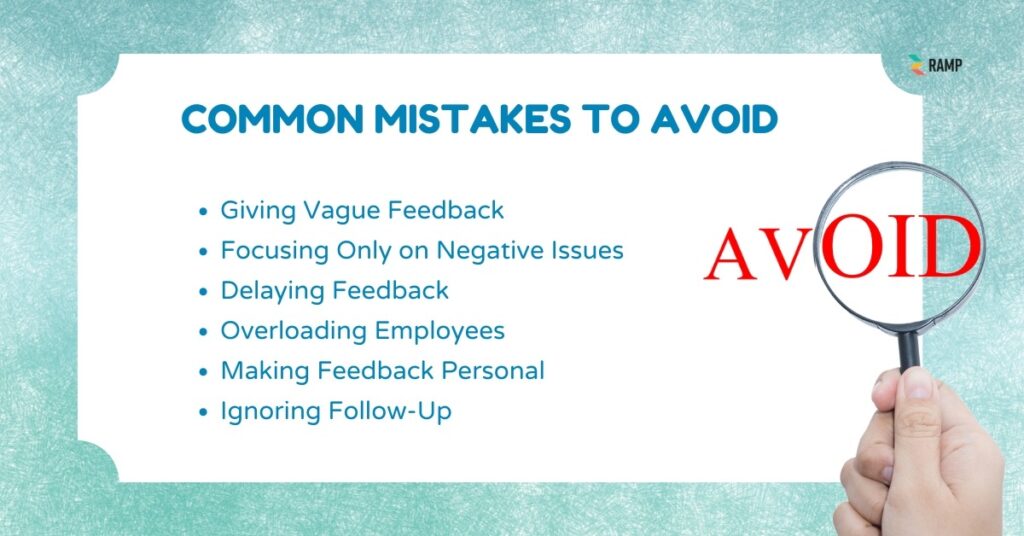
The common mistakes are explained in detail below.
- Giving Vague Feedback: General comments like "Good job" or "You need improvement" provide little value.
- Focusing Only on Negative Issues: Continuous feedback should also recognize strengths and achievements.
- Delaying Feedback: Waiting too long reduces relevance and effectiveness.
- Overloading Employees: Too much feedback at once can become overwhelming.
- Making Feedback Personal: Feedback should address behaviors and actions, not personality traits.
- Ignoring Follow-Up: Feedback becomes ineffective if progress is never reviewed afterward.
Continuous feedback is an important tool for improving communication, performance, and professional growth. By providing regular, constructive input, individuals and teams can identify problems early, strengthen collaboration, and consistently improve results over time.
Using frameworks like SBI helps make feedback more organized, objective, and actionable. Effective continuous feedback is timely, respectful, and balanced, fostering a culture of learning and improvement rather than criticism alone.