
Team communication is the process through which team members exchange information, ideas, updates, and feedback to achieve shared objectives. Effective team communication helps employees stay aligned, coordinate responsibilities, solve problems efficiently, and maintain strong working relationships. It serves as the foundation for collaboration, accountability, trust, and overall team performance in every organization.
Importance of team communication
Team communication matters because it keeps employees aligned, informed, and connected while helping teams work efficiently toward shared goals. Strong communication improves collaboration, productivity, problem-solving, and decision-making by ensuring that information, expectations, and feedback are clearly understood.
It reduces misunderstandings, workplace errors, delays, and conflict while strengthening trust, accountability, and employee engagement. Effective communication also supports innovation, builds a healthier workplace culture, improves team morale, and increases confidence in leadership.
In remote, hybrid, and fast-paced work environments, communication becomes even more important because it helps teams coordinate tasks, maintain transparency, and deliver consistent performance across departments and projects.
The article “What Team Communication Can Tell Us About Team Effectiveness” explains how team members communicate, share information, and interact during meetings can provide useful insights into team effectiveness. It highlights that communication is not only about exchanging messages, but also about understanding team dynamics, collaboration patterns, and how people work together toward shared goals. This underscores the importance of team communication, as clear, consistent, and purposeful communication helps teams stay aligned, solve problems, make decisions, and perform more effectively.
Core Functions of Team Communication
Communication is not limited to conversations or messages. It is a working system that keeps teams connected, informed, and productive. Strong communication enables teams to function with clarity and direction.
The diagram below shows the core functions of team communication.
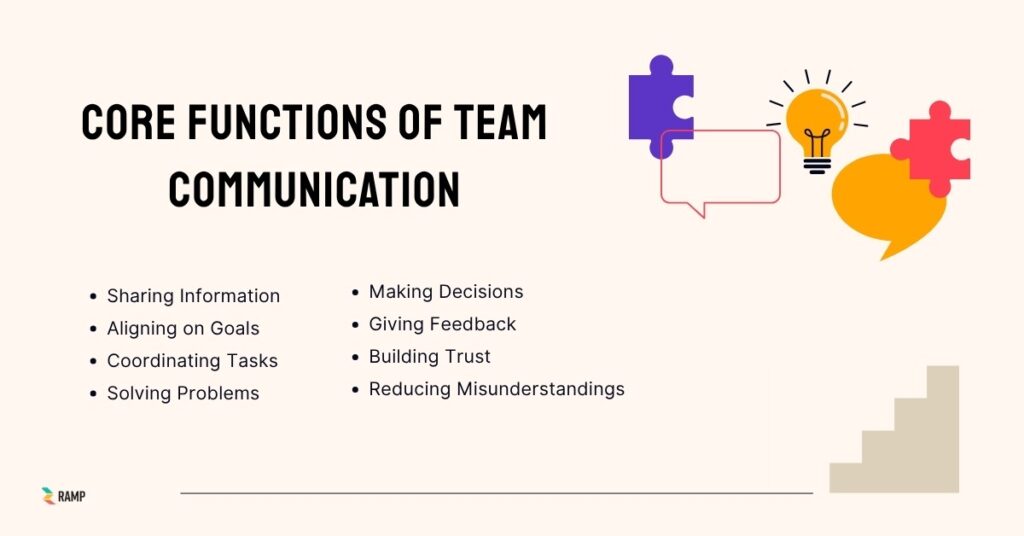
The details of the functions are given below.
Sharing Information
Teams rely on communication to distribute important information such as project updates, deadlines, priorities, policies, and operational changes. Without clear information flow, employees may work with incomplete or outdated knowledge.
Effective information sharing helps teams:
- Stay informed about ongoing work
- Avoid duplicated effort
- Respond quickly to changes
- Improve coordination across departments
Aligning on Goals
Communication ensures that everyone understands team objectives, performance expectations, and strategic priorities. When goals are communicated clearly, employees can focus their efforts on outcomes that support organizational success.
Goal alignment helps teams:
- Understand priorities
- Clarify responsibilities
- Connect individual work to broader objectives
- Reduce confusion about expectations
Coordinating Tasks
Team communication helps organize workflows, assign responsibilities, and track progress. Coordination becomes especially important when multiple people depend on each other to complete projects.
Task coordination supports:
- Better scheduling
- Resource allocation
- Workflow management
- Cross-functional collaboration
Solving Problems
Strong communication allows teams to identify issues early, discuss solutions, and make informed decisions. Open discussions encourage employees to raise concerns before small problems become major obstacles.
Problem-solving communication includes:
- Sharing challenges openly
- Brainstorming solutions
- Evaluating risks
- Discussing alternatives
Making Decisions
Teams communicate to analyze information, discuss options, and reach conclusions. Clear communication during decision-making reduces uncertainty and increases commitment to final decisions.
Effective decision communication ensures:
- Transparency in reasoning
- Shared understanding
- Faster implementation
- Reduced resistance
Giving Feedback
Feedback helps employees improve performance, adjust their behavior, and recognize their strengths. Teams that communicate feedback regularly tend to develop stronger accountability and continuous improvement habits.
Constructive feedback supports:
- Skill development
- Performance improvement
- Employee growth
- Stronger working relationships
Building Trust
Consistent, honest communication builds trust within teams. Trust grows when employees feel heard, respected, and informed.
Communication builds trust by:
- Encouraging openness
- Reducing uncertainty
- Promoting fairness
- Strengthening relationships
Reducing Misunderstandings
Clear communication minimizes confusion, incorrect assumptions, and avoidable mistakes. Teams with poor communication often experience delays, duplicated work, and interpersonal tension.
Misunderstanding prevention depends on:
- Clear instructions
- Active listening
- Confirmation of expectations
- Consistent updates
Team Communication Channels
Communication occurs through multiple channels, depending on the message's purpose and urgency. The diagram below shows the team communication channels.
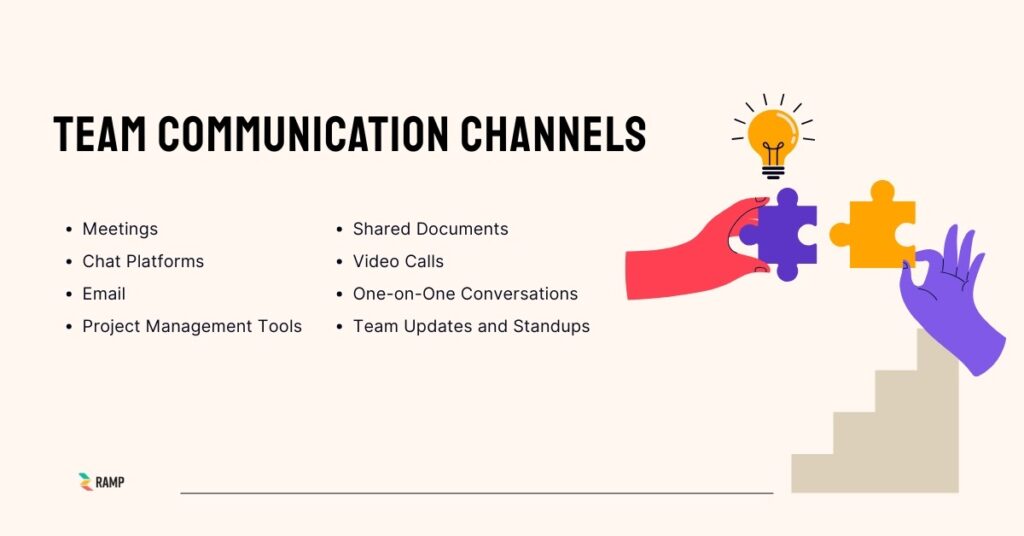
The details of the communication channels are discussed below.
Meetings
Meetings allow teams to discuss priorities, review progress, and solve problems collectively.
Common meeting types include:
- Team meetings
- Planning meetings
- Review meetings
- Strategy discussions
Effective meetings require:
- Clear agendas
- Defined objectives
- Time management
- Action items
Chat Platforms
Messaging tools support quick communication and daily coordination.
Teams use chat platforms for:
- Fast updates
- Quick questions
- Collaboration
- Informal discussions
These platforms improve responsiveness but can also create distractions if unmanaged.
Email remains one of the most common formal communication channels in organizations.
It works best for:
- Detailed information
- Official communication
- Documentation
- External communication
Project Management Tools
Project management systems centralize tasks, deadlines, responsibilities, and updates.
These tools help teams:
- Track progress
- Assign tasks
- Monitor timelines
- Improve accountability
Shared Documents
Shared files and collaborative documents allow multiple employees to contribute information in real time.
Benefits include:
- Transparency
- Version control
- Collaborative editing
- Knowledge sharing
Video Calls
Video communication supports remote collaboration and fosters stronger interpersonal connections than text-only communication.
It help teams:
- Discuss complex issues
- Conduct virtual meetings
- Improve engagement
- Maintain remote collaboration
One-on-One Conversations
Private conversations between managers and employees support coaching, feedback, and relationship building.
One-on-one discussions are useful for:
- Career development
- Performance conversations
- Personal support
- Clarification
Team Updates and Standups
Short recurring updates help teams stay informed about progress, blockers, and priorities.
Standups improve:
- Visibility
- Accountability
- Coordination
- Workflow efficiency
Key Qualities of Effective Team Communication
High-performing teams communicate with specific qualities that improve understanding and collaboration. The diagram below shows the key qualities of effective team communication.
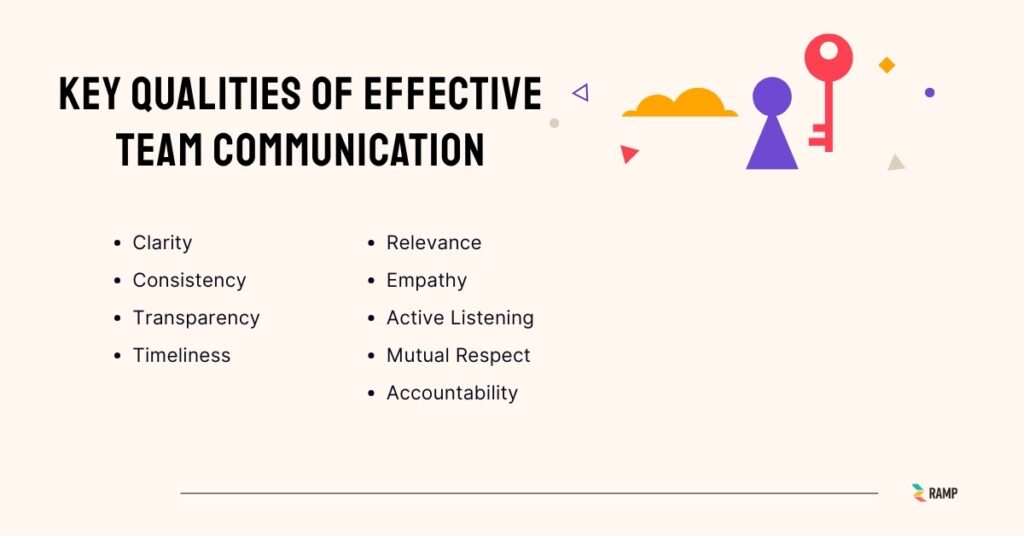
The details are discussed below.
Clarity
Messages should be simple, direct, and easy to understand. Clear communication reduces confusion and improves execution.
Clear communication includes:
- Specific expectations
- Simple language
- Defined responsibilities
- Actionable instructions
Consistency
Teams perform better when communication remains stable and predictable.
Consistency involves:
- Regular updates
- Reliable messaging
- Standard processes
- Ongoing follow-through
Transparency
Transparent communication creates openness and trust within teams.
Transparency includes:
- Sharing relevant information
- Explaining decisions
- Addressing challenges honestly
- Communicating organizational changes
Timeliness
Information should be shared at the right time. Delayed communication often creates inefficiency and frustration.
Timely communication supports:
- Faster decision-making
- Better responsiveness
- Reduced delays
- Improved coordination
Relevance
Messages should contain useful and necessary information rather than unnecessary detail.
Relevant communication helps:
- Maintain focus
- Reduce overload
- Improve efficiency
- Support decision-making
Empathy
Empathy allows team members to communicate with understanding and emotional awareness.
Empathetic communication improves:
- Relationships
- Psychological safety
- Conflict resolution
- Employee support
Active Listening
Communication is not only about speaking. Strong teams listen carefully to understand perspectives, concerns, and feedback.
Active listening involves:
- Paying attention
- Asking clarifying questions
- Confirming understanding
- Avoiding interruptions
Mutual Respect
Respectful communication creates a healthy working environment where employees feel valued and heard.
Respect is demonstrated through:
- Professional language
- Open-mindedness
- Fair treatment
- Consideration of opinions
Accountability
Strong communication reinforces ownership and responsibility.
Accountability communication includes:
- Clear expectations
- Progress tracking
- Follow-up discussions
- Transparent reporting
Communication Barriers and Breakdowns
Even skilled teams experience communication challenges. Identifying barriers helps organizations improve collaboration and reduce friction. The diagram below shows the communication barriers and breakdowns.
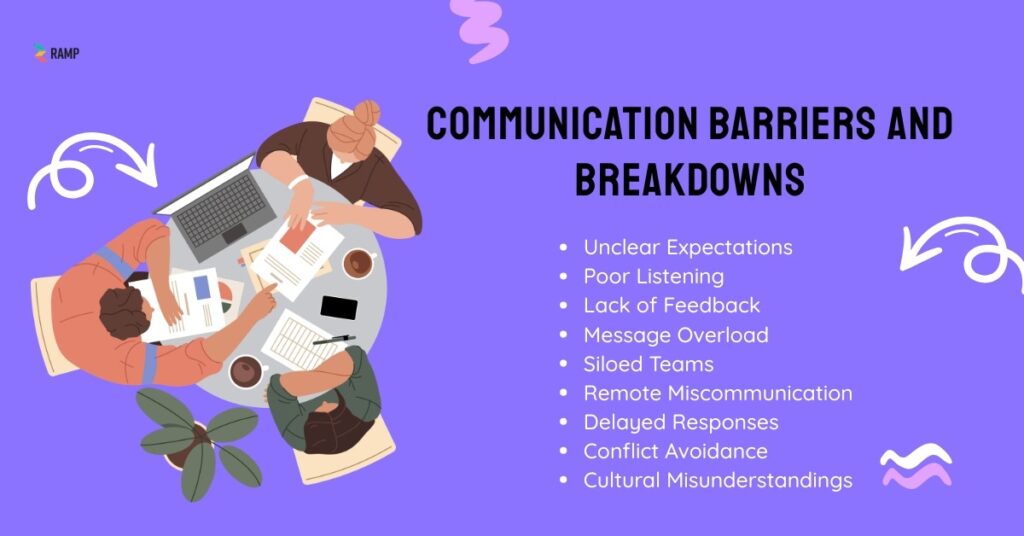
The details are discussed below.
Unclear Expectations
Vague instructions create confusion about responsibilities, priorities, and outcomes.
This often leads to:
- Errors
- Delays
- Rework
- Frustration
Poor Listening
Teams struggle when employees focus on responding rather than understanding.
Poor listening may cause:
- Misinterpretation
- Conflict
- Missed information
- Reduced trust
Lack of Feedback
Without feedback, employees may not know whether they are meeting expectations or improving performance.
Limited feedback often results in:
- Performance stagnation
- Reduced engagement
- Unresolved problems
Message Overload
Too many messages, meetings, or notifications can overwhelm employees and reduce attention.
Communication overload may lead to:
- Missed information
- Burnout
- Lower productivity
- Delayed responses
Siloed Teams
Departments that rarely communicate with each other often develop disconnected goals and workflows.
Silos create:
- Duplication of effort
- Misalignment
- Poor collaboration
- Reduced innovation
Remote Miscommunication
Remote work increases the risk of misunderstandings due to limited face-to-face interaction.
Common remote communication challenges include:
- Lack of context
- Delayed clarification
- Tone misinterpretation
- Isolation
Delayed Responses
Slow communication can interrupt workflows and slow decision-making.
Delayed responses may affect:
- Project timelines
- Customer service
- Team coordination
- Productivity
Conflict Avoidance
Teams that avoid difficult conversations often allow problems to grow over time.
Avoidance can lead to:
- Hidden tension
- Reduced trust
- Poor accountability
- Unresolved issues
Cultural Misunderstandings
Different communication styles, languages, and cultural norms can create confusion in diverse teams.
Organizations must encourage:
- Cultural awareness
- Inclusive communication
- Respectful interaction
- Clear expectations
Communication and Workplace Culture
Communication strongly influences workplace culture by shaping how employees experience leadership, collaboration, and organizational values.
Transparency
Organizations with open communication tend to build stronger trust and credibility. Employees feel more secure when leaders communicate honestly about goals, changes, and challenges.
Inclusion
Inclusive communication ensures employees feel heard, respected, and involved in discussions and decisions.
Inclusive workplaces encourage:
- Diverse perspectives
- Equal participation
- Psychological safety
- Collaboration
Accountability Culture
Clear communication establishes expectations and responsibilities. Teams become more accountable when goals, deadlines, and performance standards are openly discussed.
Engagement
Employees are more engaged when communication is frequent, meaningful, and supportive.
Strong communication improves:
- Employee participation
- Motivation
- Commitment
- Job satisfaction
Trust in Leadership
Leadership communication directly affects employee confidence in management. Transparent and consistent communication strengthens organizational trust.
Team Morale
Positive communication improves workplace relationships and creates a more supportive environment. Poor communication, on the other hand, often damages morale and increases workplace stress.
Metrics and Indicators of Communication Health
Organizations can evaluate communication effectiveness using measurable indicators and performance data.
Employee Engagement Scores
High engagement scores often indicate employees feel informed, connected, and valued.
Organizations typically measure:
- Communication satisfaction
- Leadership trust
- Team collaboration
- Employee involvement
Meeting Effectiveness Feedback
Teams can assess whether meetings provide value through employee feedback and participation metrics.
Indicators include:
- Meeting clarity
- Participation levels
- Action completion
- Time efficiency
Project Delays Caused by Misalignment
Frequent delays may signal communication problems, such as unclear priorities or coordination issues.
Organizations should track:
- Missed deadlines
- Workflow interruptions
- Rework frequency
- Dependency failures
Response Times
Communication responsiveness affects operational efficiency and the quality of collaboration.
Useful response metrics include:
- Email response time
- Support response speed
- Decision turnaround time
- Task acknowledgment time
Cross-Team Collaboration Quality
Organizations can evaluate how effectively departments communicate and work together.
Indicators include:
- Collaboration success rates
- Shared project outcomes
- Conflict frequency
- Interdepartmental feedback
Feedback Frequency
Healthy teams exchange feedback regularly rather than limiting communication to annual reviews.
Organizations may track:
- Manager check-ins
- Coaching sessions
- Recognition frequency
- Performance conversations
Manager Communication Ratings
Employee surveys often measure how effectively managers communicate expectations, feedback, and organizational updates.
Common evaluation areas include:
- Clarity
- Availability
- Transparency
- Listening ability
The diagram below summarizes the metrics and indicators of communication health.
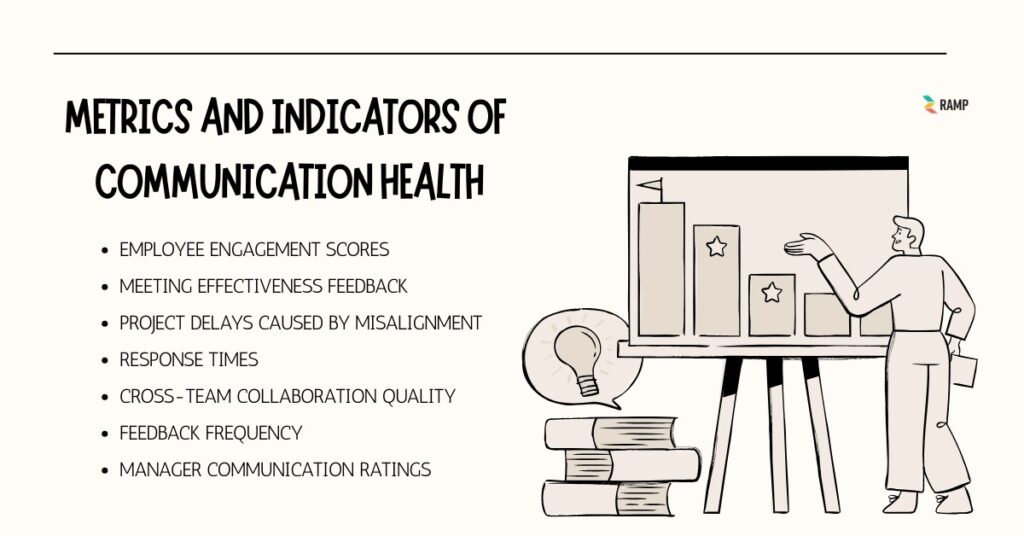
Team communication is one of the most important drivers of organizational effectiveness. It supports collaboration, strengthens trust, improves accountability, and keeps teams aligned toward shared goals. Teams that communicate clearly and consistently are better equipped to solve problems, adapt to change, and maintain strong workplace relationships. In contrast, weak communication creates confusion, delays, disengagement, and cultural instability. Organizations that invest in effective communication systems, leadership communication skills, and collaborative practices create stronger, healthier, and more productive teams.