

Appreciative feedback focuses on recognizing strengths, positive behaviors, achievements, and valuable contributions. Its purpose is to reinforce effective actions, encourage motivation, and help individuals understand what they are doing well.
Unlike corrective feedback, appreciative feedback highlights success and progress while encouraging continued positive performance and behavior.
Why Does It Matter?
Appreciative feedback matters because recognition has a strong impact on confidence, engagement, and workplace morale. When people feel valued for their contributions, they are more likely to stay motivated and maintain strong performance.
It matters because it:
- Increases employee motivation
- Builds confidence and morale
- Reinforces positive behaviors
- Strengthens workplace relationships
- Encourages continued high performance
- Creates a more supportive work culture
- Improves engagement and teamwork
Organizations that regularly practice appreciative feedback often build healthier and more productive environments.
The article "Thriving Workforces Use the Appreciative Feedback Model" explains that appreciative feedback helps organizations build stronger engagement, retention, and workplace culture by focusing on employee strengths and meaningful recognition. It highlights that managers should use appreciation intentionally, not as generic praise, but as a leadership practice that reinforces what employees do well. This supports the value of appreciative feedback because specific, timely, and genuine recognition helps employees feel valued, motivated, and encouraged to continue strong performance.
Core Structure of Appreciative Feedback Using the SBI Framework
A useful method for giving appreciative feedback is the SBI Framework, which stands for:
- Situation — Explain the specific event or context.
- Behavior — Describe the observable action.
- Impact — Explain the positive result of that behavior.
This framework helps appreciation feel meaningful and specific rather than generic.
Short Example
"In the client onboarding meeting, I observed that you explained the process very clearly and answered every question patiently. The impact was that the client felt more confident and comfortable working with the team."
Using the SBI method makes appreciation more genuine and effective.
Characteristics of Appreciative Feedback
Appreciative feedback has several important characteristics that make it effective and motivating in professional environments. The diagram below includes the characteristics of appreciative feedback.
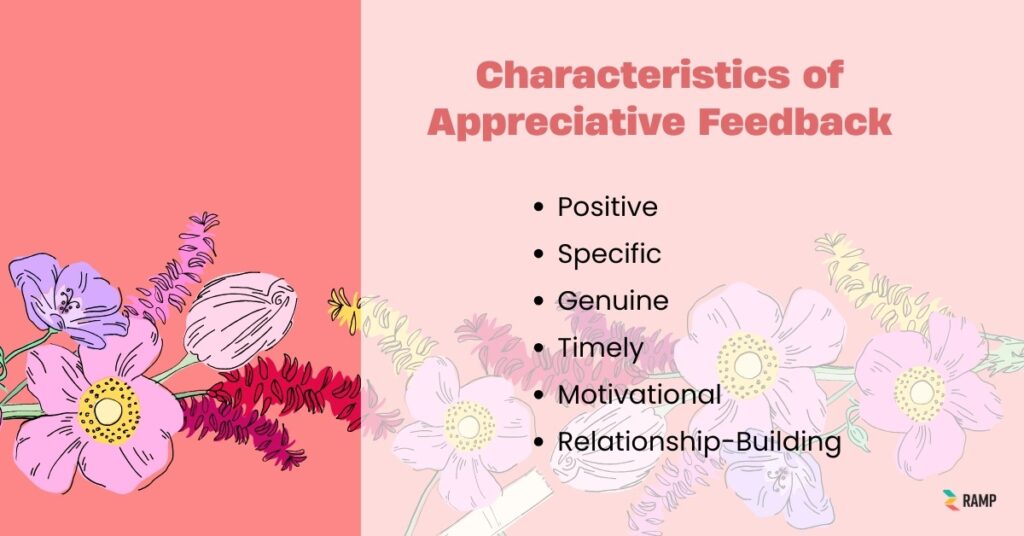
The characteristics are explained in detail below.
- Positive: It focuses on strengths, achievements, and effective behaviors.
- Specific: The feedback highlights specific actions rather than general praise.
- Genuine: Appreciation should feel honest and sincere.
- Timely: It is most effective when given soon after the positive action occurs.
- Motivational: The feedback encourages individuals to continue strong performance.
- Relationship-Building: It strengthens trust, morale, and communication between people.
When to Use It?
Appreciative feedback is most effective in situations such as:
- After successful presentations or meetings
- When recognizing teamwork and collaboration
- During employee recognition and performance discussions
- After achieving goals or project milestones
- When encouraging positive workplace behavior
- During coaching, mentoring, or leadership development
- When boosting employee confidence and motivation
It is especially useful in workplaces that value engagement, recognition, and continuous improvement.
When Not to Use It?
Appreciative feedback may be less effective in certain situations, including:
- When serious performance problems need immediate correction
- If praise sounds exaggerated or insincere
- When recognition is too vague to feel meaningful
- During highly emotional conflicts or disciplinary situations
- If appreciation is given without understanding actual contributions
- When positive feedback completely replaces necessary constructive feedback
In these situations, appreciative feedback can feel unrealistic, unbalanced, or less credible.
The chart below outlines the situations where appreciative feedback is most effective, along with scenarios where excessive or poorly delivered praise may reduce its credibility and impact.
| When to Use It | When Not to Use It |
| After successful presentations or meetings | When serious performance problems need immediate correction |
| When recognizing teamwork and collaboration | If praise sounds exaggerated or insincere |
| During employee recognition and performance discussions | When recognition is too vague to feel meaningful |
| After achieving goals or project milestones | During high emotional conflicts or disciplinary situations |
| When encouraging positive workplace behavior | If appreciation is given without understanding actual contributions |
| During coaching, mentoring, or leadership development | When positive feedback completely replaces necessary constructive feedback |
| When boosting employee confidence and motivation | |
| It is especially useful in workplaces that value engagement, recognition, and continuous improvement. | In these situations, appreciative feedback can feel unrealistic, unbalanced or less credible. |
Sentence Starters for Effective Appreciative Feedback
The following sentence starters help make appreciation more structured and professional:
- "In [situation], I observed…"
- "The impact was…"
Example
"In the weekly project review, I observed that you supported newer team members by answering their questions patiently and clearly. The impact was that the team worked more confidently, and communication improved during the project."
These sentence starters help make appreciative feedback more thoughtful and specific.
Common Mistakes to Avoid
People often reduce the effectiveness of appreciative feedback by making avoidable mistakes. The diagram below shows the common mistakes to avoid while giving appreciative feedback.
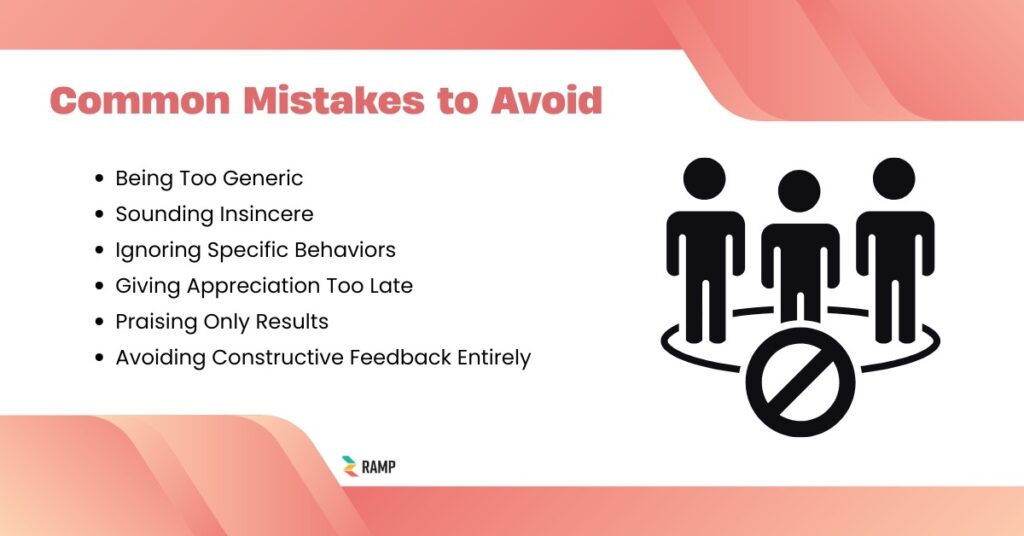
Common examples include:
- Being Too Generic: Comments like "Great work" without details feel less meaningful.
- Sounding Insincere: Exaggerated praise can reduce trust and credibility.
- Ignoring Specific Behaviors: Employees should understand exactly what actions are being appreciated.
- Giving Appreciation Too Late: Delayed recognition loses emotional impact and relevance.
- Praising Only Results: Recognizing effort, collaboration, and behavior is also important.
- Avoiding Constructive Feedback Entirely: Positive feedback should not replace necessary improvement discussions.
Appreciative feedback is a valuable communication approach that recognizes strengths, reinforces positive behavior, and improves motivation. When people feel genuinely valued for their contributions, they are more likely to stay engaged, confident, and committed to strong performance.
Using structured methods like the SBI framework helps appreciation become clearer, more specific, and more meaningful. Effective appreciative feedback creates a workplace culture where recognition, encouragement, and professional growth are consistently supported.