

Teams perform better when everyone understands what they are working toward, why it matters, and how success will be measured. That is the purpose of SMART goals. While SMART goals are often discussed at the individual level, they become far more powerful when applied to teams, fostering coordination, accountability, and shared direction.
A team-focused SMART framework helps organizations turn broad business priorities into practical, measurable actions. It connects daily work with strategic outcomes, reduces confusion, improves collaboration, and gives managers a reliable way to monitor progress.
This article explains SMART goals through a team lens, shows how they align with business strategy, compares SMART goals with OKRs, provides practical examples, highlights common mistakes, and explains how teams can continuously track and manage goals effectively.
What are SMART goals?
SMART stands for Specific, Measurable, Achievable, Relevant, and Time-Bound. In a team environment, each element must support collaboration, role clarity, operational alignment, and measurable business contribution.
S – Specific
A team goal must clearly define what the team is expected to achieve. Vague goals create inconsistent priorities and confusion about ownership.
A specific team goal should include:
- A clear objective
- A defined scope
- A visible deliverable
- Defined owners or responsible contributors
What "Specific" Means in a Team Context?
- Instead of saying: "Improve customer support”
- A specific team goal would say: "Reduce average customer ticket resolution time by redesigning the escalation workflow and introducing live-chat support."
The second example identifies:
- The exact improvement area
- The process involved
- The expected operational focus
Key Elements of Team-Specific Goals
Clear Team Objective
The goal must explain the exact result the team is pursuing. Example: Increase onboarding completion rates for new customers.
Defined Scope
The team should know what is included and excluded. Example: Focus only on first-time users in the mobile application.
Clear Deliverable
The output should be visible and concrete. Example: Launch a redesigned onboarding flow with automated reminders.
Defined Owner(s)
Every goal requires accountability. Example:
- The product manager owns workflow design.
- The customer success lead owns onboarding communication.
Without ownership, team goals often become shared intentions rather than actionable commitments.
M – Measurable
Team goals need measurable outcomes so progress can be tracked objectively. Measurement creates accountability and allows leaders to identify performance gaps early.
What "Measurable" Means in a Team Context?
A measurable goal answers:
- How much improvement is expected?
- How will progress be tracked?
- What defines success?
Important Measurement Components
Quantifiable Outcomes
Results should use clear numerical indicators. Example: Increase customer retention rate from 78% to 85% within one quarter.
Here:
- Retention rate = percentage of customers who continue using the service
- Unit = percentage (%)
- Timeframe = one quarter
KPI Tracking
KPIs (Key Performance Indicators) monitor ongoing performance. Example KPIs:
- Ticket resolution time in hours
- Monthly sales revenue in USD
- Customer satisfaction score out of 10
- Employee turnover rate in percentage (%)
Milestones
Large goals should be broken into smaller checkpoints. Example:
- Week 2: Workflow audit completed
- Week 5: Prototype approved
- Week 8: Team training completed
Success Metrics
Success metrics define the final expected outcome.
Example: Achieve a 20% reduction in customer complaints within six months.
Here:
- Reduction in complaints = percentage decrease compared with baseline complaint volume
- Unit = percentage (%)
- Timeframe = six months
A – Achievable
A team goal must be realistic based on available resources, team capacity, skills, and timelines. Unrealistic goals reduce morale and damage trust in leadership.
What "Achievable" Means in a Team Context?
Teams should stretch performance without creating operational burnout.
An achievable goal considers:
- Current workload
- Budget availability
- Team expertise
- Technology limitations
- Staffing levels
Core Elements of Achievable Goals
Resource Alignment
The team must have sufficient tools, funding, and support.
Example:
- Marketing automation software is available before campaign launch.
Capacity Planning
Managers must evaluate workload distribution.
Example:
- A five-person development team cannot realistically complete a six-month project in four weeks without quality risks.
Skill Readiness
The team should possess the required capabilities.
Example:
- Data analytics training is completed before implementing advanced reporting targets.
Timeline Realism
Deadlines should reflect operational reality.
Example:
- Expanding into three international markets may require a phased approach rather than immediate execution.
Achievable goals maintain motivation because teams believe success is possible.
R – Relevant
A team goal must support broader organizational priorities. Teams perform better when they understand how their work contributes to larger business outcomes.
What "Relevant" Means in a Team Context?
A relevant goal connects:
- Team activities
- Department priorities
- Company strategy
- Business performance
Key Components of Relevant Goals
Alignment With Company Strategy
Goals should directly support the strategic direction.
Example:
- If the company's strategy focuses on customer retention, support teams may prioritize faster response times and proactive engagement.
Department-Level Contribution
Every department should understand its role in the company's success.
Example:
- HR improves retention through employee engagement programs.
- Sales increases revenue through account expansion strategies.
Business Impact
The goal should influence measurable organizational outcomes.
Example:
- Improving supply-chain efficiency reduces operational costs and increases delivery reliability.
Teams become more engaged when they understand the business value behind their goals.
T – Time-Bound
Deadlines create urgency, focus, and execution discipline. Without timelines, goals often remain unfinished or continuously postponed.
What "Time-Bound" Means in a Team Context?
Time-bound goals establish:
- Final deadlines
- Interim checkpoints
- Review cycles
- Accountability schedules
Important Time Structures
Deadlines
The final completion date must be clearly defined.
Example:
- Launch the new customer portal by September 30.
Sprint Cycles
Agile teams often work in short execution periods.
Example:
- Complete feature testing during a two-week sprint cycle.
Quarterly Targets
Many organizations structure goals around quarterly planning periods.
Example:
- Increase quarterly recurring revenue by 12% during Q3.
Here:
- Recurring revenue = predictable subscription-based income
- Unit = percentage increase (%)
- Timeframe = one quarter
Milestone Checkpoints
Progress reviews reduce execution drift.
Example:
- Monthly performance reviews
- Mid-project audits
- Weekly operational check-ins
Time-bound goals improve focus because teams know exactly when outcomes are expected.
The chart below explains the SMART framework for teams by showing how specific, measurable, achievable, relevant, and time-bound goals create clear direction, accountability, and stronger business alignment.
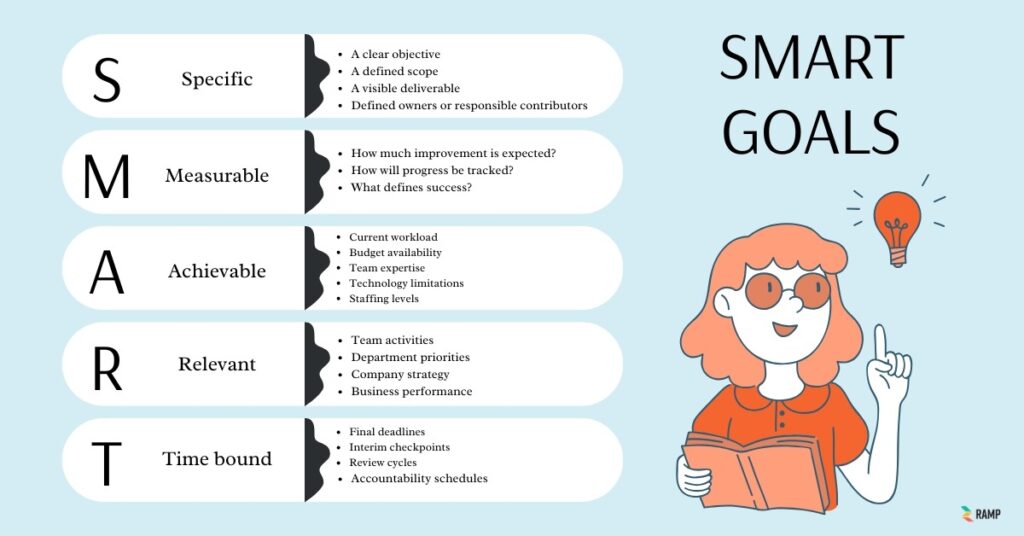
Research on SMART goal intervention shows that using SMART goal instructions can help individuals achieve goals more effectively. The study found that participants who applied the SMART goal approach reported greater goal attainment and need satisfaction, along with improved positive affect. This supports the value of SMART goals because clear, measurable, achievable, relevant, and time-bound goals make performance expectations easier to understand, track, and complete.
How to Align Team Goals With Business Strategy?
Many organizations fail because departments pursue disconnected objectives. Team goals should always support strategic priorities.
Steps for Strategic Goal Alignment
The diagram below outlines the key steps organizations follow to align team goals with business strategy, ensuring that daily activities contribute directly to broader company objectives and measurable results.
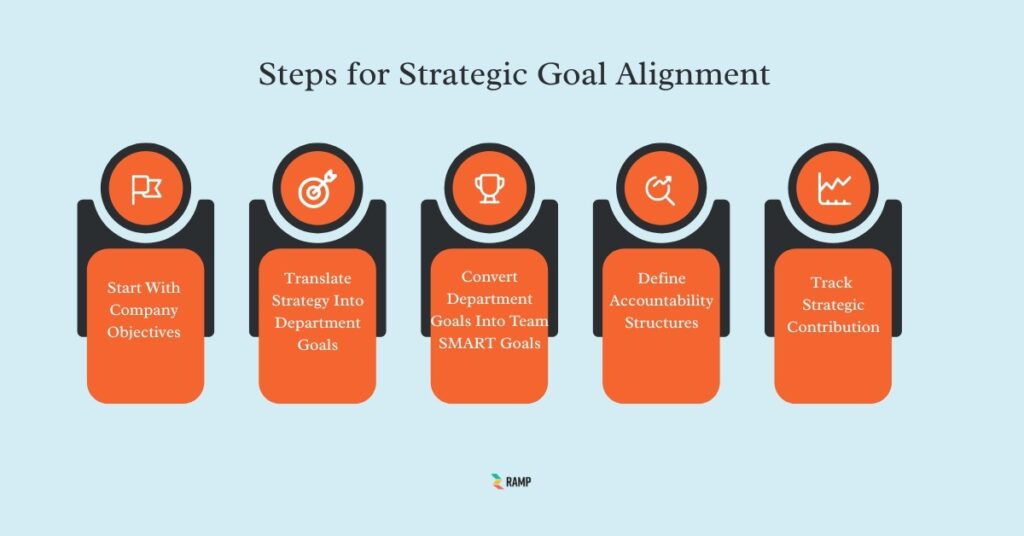
The steps for strategic goal alignment are detailed below.
1. Start With Company Objectives
Leadership must define:
- Growth targets
- Customer goals
- Operational priorities
- Market expansion plans
Example:
- Company objective: Improve customer retention by 15% within one year.
2. Translate Strategy Into Department Goals
Each department contributes differently.
Examples:
- Customer support reduces resolution time.
- Product teams improve usability.
- Marketing strengthens customer engagement.
- HR improves employee retention.
3. Convert Department Goals Into Team SMART Goals
Example:
- Support team goal: Reduce average first-response time from 8 hours to 2 hours within three months.
Here:
- First-response time = average time before a customer receives an initial reply
- Unit = hours
- Timeframe = three months
4. Define Accountability Structures
Assign:
- Goal owners
- Review schedules
- Reporting responsibilities
5. Track Strategic Contribution
Teams should regularly evaluate whether activities still support business priorities.
Questions to ask:
- Does this goal still support the company's strategy?
- Is the goal to produce a measurable impact?
- Are resources properly allocated?
Strategic alignment prevents teams from working hard on low-impact initiatives.
SMART Goals vs OKRs: What's the Difference?
SMART goals and OKRs are both performance-management frameworks, but they serve different purposes. The chart below compares SMART Goals and OKRs by highlighting how each framework differs in focus, execution style, strategic purpose, and performance management approach.
| Aspect | SMART Goals | OKRs |
| Focus | Focus on structured execution | Focus on strategic ambition |
| Outcomes | Emphasize realistic outcomes | Encourage stretch performance |
| Nature | Usually operational | Often strategic and transformational |
| Level of Detail | Detailed and process-oriented | Broad and outcome-oriented |
| Best Used For | Best for execution tracking | Best for strategic alignment |
When Teams Should Use SMART Goals
SMART goals work best for:
- Operational improvement
- Project execution
- Performance tracking
- Team accountability
- Process management
When Teams Should Use OKRs
OKRs work best for:
- Innovation initiatives
- Growth strategy
- Company transformation
- Cross-functional alignment
- High-level performance vision
Many organizations use both frameworks together:
- OKRs define strategic direction
- SMART goals define execution plans
This chart explains when teams should use SMART Goals or OKRs by highlighting the different situations where each framework delivers the greatest value in planning, execution, and strategic alignment.
| When Teams Should Use SMART Goals | When Teams Should Use OKRs | Using Both Together |
| SMART Goals work best for: | OKRs work best for: | Many organizations use both frameworks together: |
| Operational improvement | Innovation initiatives | OKRS: define strategic direction SMART Goals: define execution plans |
| Project execution | Growth strategy | |
| Performance tracking | Company transformation | |
| Team accountability | Cross-functional alignment | |
| Process management | High-level performance vision |
Examples of SMART Goals for Different Teams
Sales Team
Goal:
- Increase monthly qualified leads from 400 to 550 within four months through targeted outbound campaigns and referral partnerships.
Definitions:
- Qualified leads = prospects meeting predefined sales criteria
- Unit = number of leads
- Timeframe = four months
Marketing Team
Goal:
- Improve website conversion rate from 2.5% to 4% within six months by redesigning landing pages and optimizing call-to-action placement.
Definitions:
- Conversion rate = percentage of visitors completing a desired action
- Unit = percentage (%)
- Timeframe = six months
Customer Support Team
Goal:
- Reduce average ticket resolution time from 18 hours to 10 hours within one quarter by implementing AI-assisted ticket routing.
Definitions:
- Ticket resolution time = average time required to fully resolve a support request
- Unit = hours
- Timeframe = one quarter
HR Team
Goal:
- Reduce employee turnover rate from 16% to 10% within one year through onboarding improvements and employee-development programs.
Definitions:
- Employee turnover rate = percentage of employees leaving the organization
- Unit = percentage (%)
- Timeframe = one year
Product Development Team
Goal:
- Release three major application features within two development quarters while maintaining a software defect rate below 2%.
Definitions:
- Software defect rate = percentage of released features containing critical bugs
- Unit = percentage (%)
- Timeframe = two quarters
Common Mistakes When Setting Team Goals
This image highlights the most common mistakes teams make when setting goals, showing how unclear objectives, poor alignment, and weak accountability can reduce overall performance and execution effectiveness.
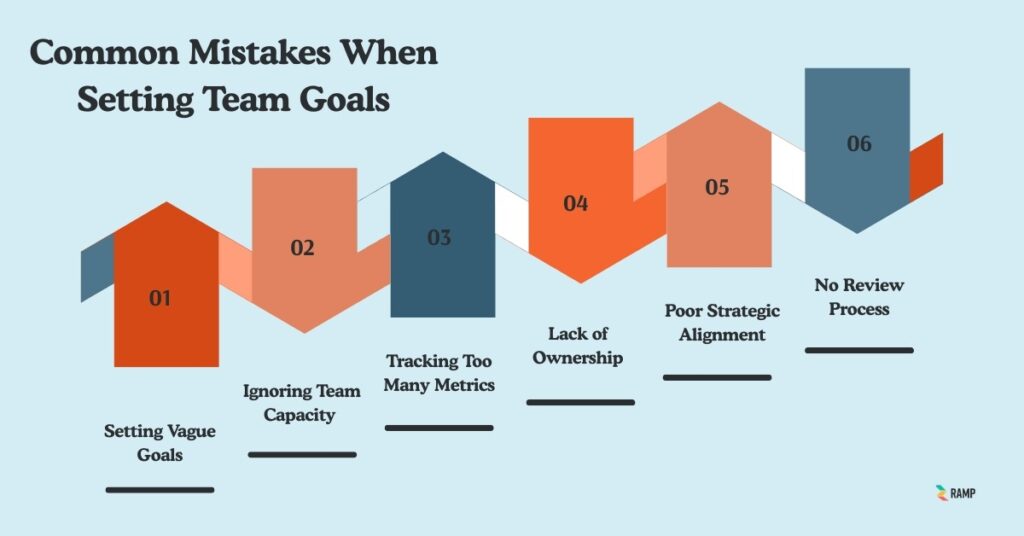
The common mistakes are explained in detail below.
1. Setting Vague Goals
Problem: Teams lack direction.
Bad Example: "Improve productivity."
Better Example: "Increase project completion rate from 70% to 90% within six months."
2. Ignoring Team Capacity
Problem: Unrealistic expectations cause burnout.
Solution: Evaluate workload before assigning targets.
3. Tracking Too Many Metrics
Problem: Teams lose focus.
Solution: Prioritize a small number of high-impact KPIs.
4. Lack of Ownership
Problem: Accountability becomes unclear.
Solution: Assign primary owners for every goal.
5. Poor Strategic Alignment
Problem: Teams work on activities with little business impact.
Solution: Link goals directly to company priorities.
6. No Review Process
Problem: Teams continue ineffective approaches for too long.
Solution: Conduct scheduled performance reviews and adjustments.
Tracking and Measuring Team SMART Goals
Tracking systems help teams stay focused and make informed decisions. The image below highlights the key methods organizations use to track and measure team SMART goals, including KPI dashboards, progress reviews, milestone tracking, performance reports, and employee feedback.
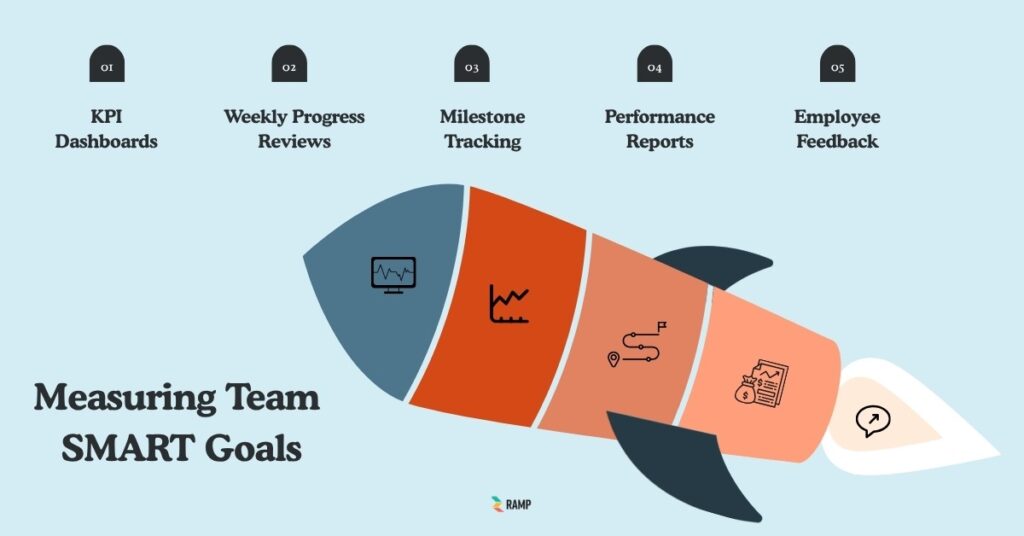
Important Tracking Methods
The tracking methods are explained in detail below.
KPI Dashboards
Dashboards provide real-time visibility into:
- Revenue
- Productivity
- Service quality
- Operational efficiency
Weekly Progress Reviews
Short review meetings help teams:
- Identify blockers
- Reallocate resources
- Adjust timelines
Milestone Tracking
Milestones measure progress before final completion.
Example:
- Design phase completed
- Testing approved
- Deployment finalized
Performance Reports
Monthly or quarterly reports help leadership evaluate:
- Goal progress
- Operational efficiency
- Resource effectiveness
Employee Feedback
Teams should regularly discuss:
- Workload pressure
- Process issues
- Collaboration challenges
- Skill gaps
Tracking should support improvement, not micromanagement.