
OKRs (Objectives and Key Results) are a goal-setting and execution framework used to align teams, track measurable progress, and drive strategic outcomes across an organization. OKRs combine ambitious objectives with quantifiable results, helping companies focus on priorities, improve accountability, and measure success within a defined timeframe, usually quarterly.
Research on Objectives and Key Results explains that OKRs help organizations set ambitious goals while tracking progress through measurable and quantifiable results. The article highlights that objectives define the desired direction, while key results show whether that direction is being achieved through clear performance indicators. This supports the value of OKRs as a strategic framework for improving alignment, transparency, accountability, and performance across teams.
Core Structural Attributes of OKRs
Components of OKRs
A complete OKR system includes several interconnected elements that work together to create focus and measurable progress. The diagram below shows the components of OKRs.
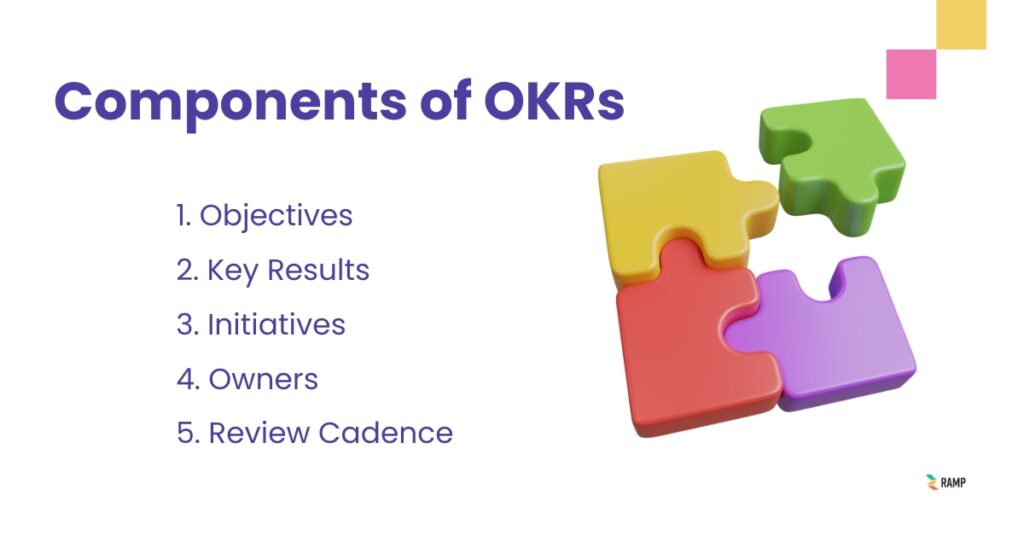
The components are explained in detail below.
1. Objectives
Objectives describe what an organization, team, or individual wants to achieve. They are qualitative, directional, and outcome-oriented.
Good objectives are:
- Clear
- Inspiring
- Action-oriented
- Strategically important
Example:
- Improve customer satisfaction experience.
An objective should communicate a meaningful business outcome rather than a task or activity.
2. Key Results
Key Results define how success will be measured. They are quantitative indicators that show whether the objective is being achieved.
Key Results should:
- Be measurable
- Include metrics
- Have a target value
- Include a timeframe
Example:
- Increase Net Promoter Score (NPS) from 40 to 60 by the end of Q3.
Metric Definition: Net Promoter Score (NPS) measures customer loyalty and satisfaction on a scale from -100 to +100.
A strong OKR usually contains 2–5 key results.
3. Initiatives
Initiatives are the projects, tasks, or actions performed to achieve key results.
This distinction is critical:
- Key Results = outcomes
- Initiatives = activities
Incorrect Key Result:
- Launch customer support chatbot.
Correct Approach:
- Initiative: Launch customer support chatbot
- Key Result: Reduce average response time from 24 hours to 6 hours by Q3
Many organizations confuse initiatives with key results, which weakens measurement accuracy.
4. Owners
Each OKR should have a clearly assigned owner responsible for:
- Coordination
- Progress tracking
- Reporting
- Accountability
Ownership does not mean the individual completes every task personally. It means they ensure progress is maintained.
5. Review Cadence
OKRs require regular review cycles to remain effective.
Common review intervals include:
- Weekly check-ins
- Mid-quarter reviews
- Quarterly evaluations
Without a consistent cadence, OKRs often become static documents rather than operational tools.
Characteristics of Effective OKRs
Well-designed OKRs (Objectives and Key Results) share several defining characteristics. The diagram below shows the characteristics of effective OKRs.
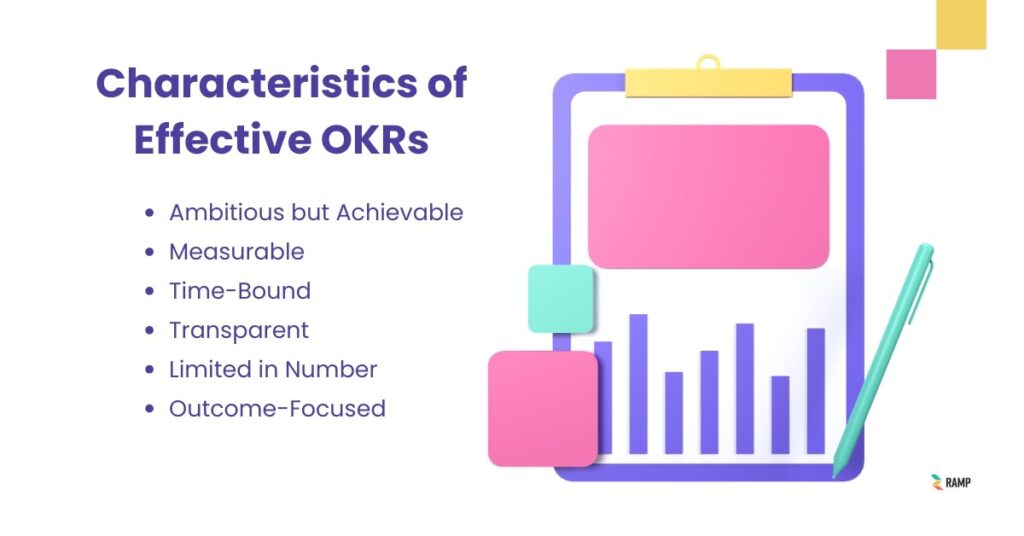
The characteristics are explained in detail below.
Ambitious but Achievable
OKRs should stretch performance while remaining realistic. The purpose is to encourage growth, innovation, and improvement.
Measurable
Every key result must include quantifiable metrics.
Weak:
- Improve marketing performance
Strong:
- Increase website conversion rate from 2.5% to 4% by Q2.
Metric Definition: Conversion rate measures the percentage of website visitors who complete a desired action.
Time-Bound
Most OKRs operate on a quarterly cycle, though annual OKRs may also exist for long-term strategy.
Typical timeframes:
- Quarterly OKRs
- Annual strategic OKRs
Transparent
OKRs are typically visible across the organization to encourage:
- Alignment
- Accountability
- Collaboration
Transparency helps teams understand how their work contributes to broader organizational goals.
Limited in Number
Organizations generally maintain:
- 3–5 objectives per level
- 2–5 key results per objective
Too many OKRs dilute focus and reduce execution quality.
Outcome-Focused
Effective OKRs measure business impact rather than activity completion.
Bad Key Result:
- Conduct 10 training sessions.
Better Key Result:
- Increase employee certification completion rate from 55% to 85% by Q4.
OKR Hierarchy & Cascading
OKRs typically cascade through multiple organizational levels. The diagram below shows the OKR hierarchy.
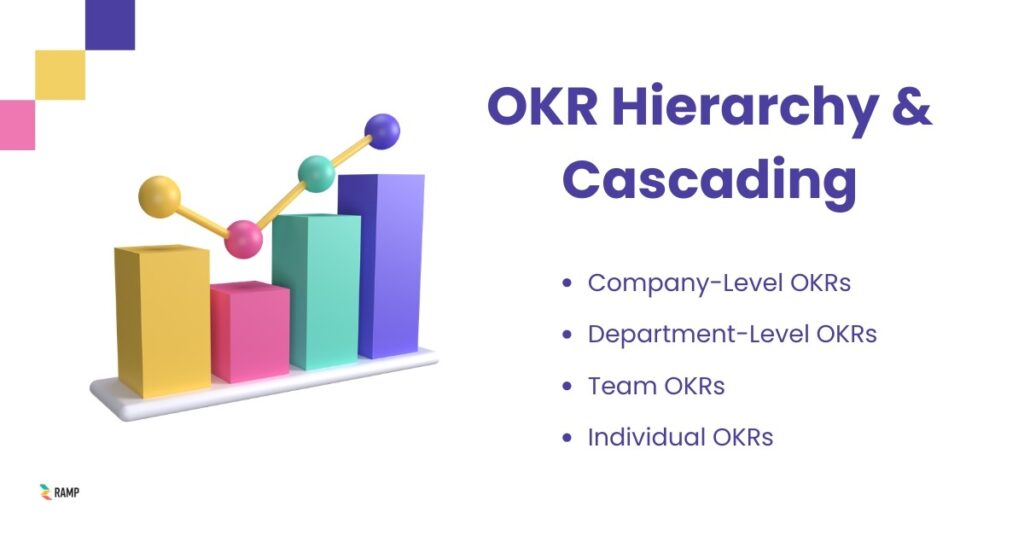
The OKR levels are discussed in detail below.
Company-Level OKRs
These represent major strategic priorities.
Example:
- Expand market share in Southeast Asia.
Department-Level OKRs
Departments create OKRs aligned with company priorities.
Example:
- Marketing increases regional lead generation.
- Sales improve conversion performance.
Team OKRs
Teams focus on operational execution tied to departmental goals.
Example:
- The customer success team reduces onboarding time.
Individual OKRs
Employees may maintain personal OKRs aligned with team objectives.
Example:
- Improve customer ticket resolution efficiency.
Vertical Alignment and Transparency
Cascading ensures:
- Strategic alignment
- Shared accountability
- Clear prioritization
- Organizational visibility
Well-structured OKR systems help employees understand how their daily work contributes to the company's larger goals.
OKR Cycle & Process
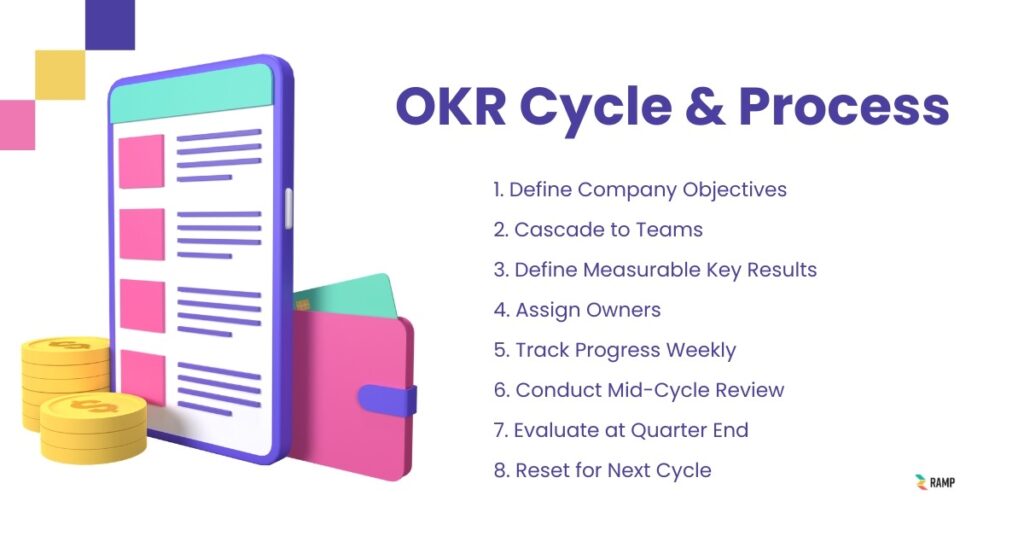
A standard OKR lifecycle usually follows a repeating quarterly process. The diagram below shows the OKRs (Objectives and Key Results) cycle and process.
The OKR process is explained in detail below.
1. Define Company Objectives
Leadership identifies strategic priorities.
2. Cascade to Teams
Departments and teams align their OKRs with organizational direction.
3. Define Measurable Key Results
Each objective receives quantifiable success indicators.
4. Assign Owners
Ownership is clearly established for accountability.
5. Track Progress Weekly
Weekly reviews help teams:
- Identify blockers
- Update progress
- Adjust execution
6. Conduct Mid-Cycle Review
Organizations assess:
- Performance trends
- Resource allocation
- Risk areas
7. Evaluate at Quarter End
Teams score results and analyze outcomes.
8. Reset for Next Cycle
Insights from the previous cycle inform the next quarter’s OKRs.
Scoring & Evaluation
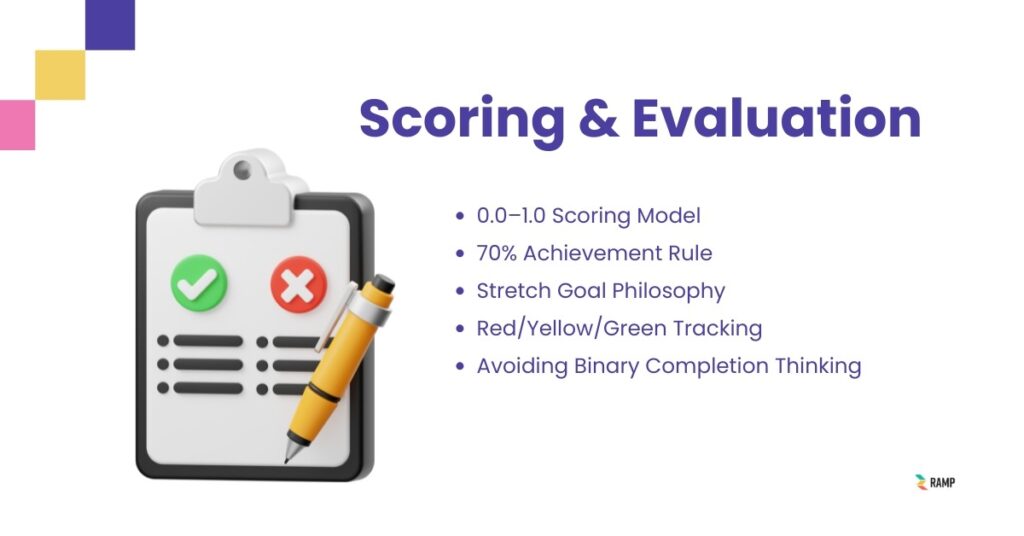
The illustration below highlights the key methods organizations use to measure OKRs (Objectives and Key Results) progress and performance, including scoring models, stretch goals, achievement benchmarks, and visual status-tracking systems.
The methods are discussed in detail below.
0.0–1.0 Scoring Model
Many organizations use a scoring scale between:
- 0.0 = no progress
- 1.0 = fully achieved
Example:
- 0.7 = substantial achievement
- 1.0 = complete achievement
70% Achievement Rule
In many OKR systems, achieving around 70% is considered successful because OKRs are intentionally ambitious.
This encourages stretch performance rather than conservative target-setting.
Stretch Goal Philosophy
Stretch goals push teams beyond their comfort zones to encourage innovation and growth.
Red/Yellow/Green Tracking
Organizations often use status indicators:
- Green = on track
- Yellow = at risk
- Red = off track
This visual system improves visibility and reporting.
Avoiding Binary Completion Thinking
OKRs are not simply "done" or "not done." Partial progress still provides strategic value and learning opportunities.
Benefits of OKRs
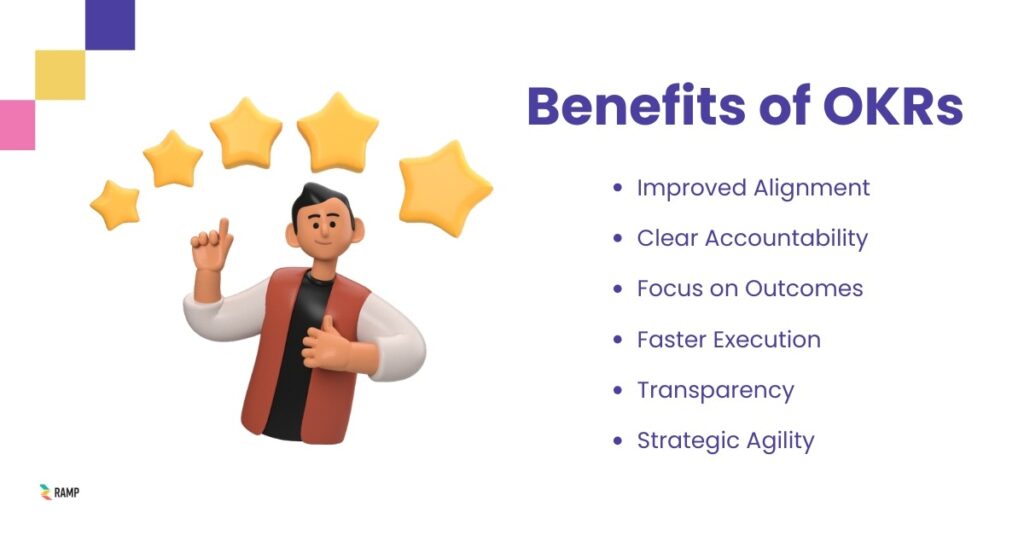
The benefits of OKRs extend beyond simple goal tracking, helping organizations improve alignment, accountability, focus, execution speed, and strategic decision-making through clearly measurable outcomes. The diagram below shows the benefits of OKRs.
The benefits are discussed in detail below.
- Improved Alignment: Teams work toward shared organizational priorities.
- Clear Accountability: Defined ownership improves responsibility and follow-through.
- Focus on Outcomes: Organizations measure business impact rather than task completion.
- Faster Execution: OKRs help prioritize work and reduce distractions.
- Transparency: Visibility across departments improves collaboration and communication.
- Strategic Agility: Quarterly cycles allow organizations to adapt quickly to changing conditions.
Common OKR Mistakes
Even though OKRs are designed to improve focus and execution, many organizations struggle with implementation because of common mistakes such as unclear objectives, poor measurement, lack of alignment, and inconsistent progress tracking.
The common OKR mistakes are discussed in detail below.
- Too Many OKRs: Excessive objectives reduce focus and execution quality.
- Writing Tasks as Key Results: Activities should not replace measurable outcomes.
- Lack of Measurable Metrics: Vague goals create ambiguity and weaken accountability.
- No Tracking Cadence: Without regular reviews, OKRs lose operational relevance.
- No Ownership: Unassigned OKRs often lack momentum and accountability.
- Treating OKRs as Performance Ratings: OKRs should encourage ambitious execution, not punish stretch attempts.
- Not Aligning With Strategy: Disconnected OKRs create fragmented priorities and wasted effort.
OKR Examples
Company-Level OKR Example
Objective
Improve customer satisfaction across all support channels during Q3.
Key Results
- Increase Net Promoter Score (NPS) from 40 to 60 by the end of Q3.
- Reduce average customer response time from 24 hours to 6 hours by September 30.
- Increase the annual customer retention rate from 78% to 93% by Q3 end.
Initiatives
- Launch AI-assisted support routing
- Expand customer support staffing
- Implement live chat support
Department-Level OKR Example (Customer Support Department)
Objective
Deliver faster and more consistent customer support experiences during Q3.
Key Results
- Reduce ticket resolution time from 18 hours to 5 hours by quarter-end.
- Increase first-contact resolution rate from 62% to 85% by Q3.
- Achieve a customer satisfaction score (CSAT) of 90% by September.
Metric Definition: CSAT (Customer Satisfaction Score) measures customer satisfaction through post-interaction surveys and is typically expressed as a percentage.
Individual OKR Example
Objective
Improve personal customer service efficiency during Q3.
Key Results
- Resolve at least 95 support tickets per week during Q3.
- Maintain an average customer satisfaction score above 92% throughout the quarter.
- Reduce the average ticket escalation rate from 14% to 5% by quarter-end.
Initiatives
- Complete advanced troubleshooting training
- Use standardized response templates
- Improve product knowledge documentation