
Constructive feedback is a professional communication approach that helps improve performance through specific, respectful, and actionable guidance focused on observable behavior and future improvement.
Unlike criticism, constructive feedback supports learning, accountability, and development instead of assigning blame or punishment. It helps employees understand what needs improvement while also encouraging progress and confidence.
Why Does Constructive Feedback Matter?
Constructive feedback plays an important role in workplace performance, communication, and employee development. Without feedback, employees may continue making the same mistakes or remain unclear about expectations.
Effective constructive feedback helps:
- Improve employee performance
- Correct problems early
- Strengthen communication
- Increase accountability
- Support skill development
- Build stronger teamwork
- Encourage continuous improvement
Organizations with healthy feedback practices often experience better employee engagement and stronger workplace relationships.
Research on effective feedback and constructive criticism explains that feedback helps close the gap between current performance and desired outcomes. The paper highlights that constructive criticism is most effective when it is specific, timely, ongoing, and delivered in a way that encourages reflection rather than defensiveness. This supports the value of constructive feedback as a respectful, actionable process for improving performance, learning, confidence, and professional growth.
The SBI Framework: Situation–Behavior–Impact
One of the most effective methods for delivering constructive feedback is the SBI framework.
Situation: Describe when and where the behavior occurred.
Behavior: Explain the specific action or behavior you observed.
Impact: Describe the result or effect of that behavior on the team, work, or organization.
The SBI structure keeps feedback focused, objective, and easier for employees to understand, without making them feel personally criticized.
SBI Example
Situation: During last week's team meeting
Behavior: You interrupted several coworkers while they were presenting updates.
Impact: The discussion became less organized, and some team members were unable to share important information.
Example Using the Required Sentence Starters
In yesterday’s project discussion, I observed the team addressing several client concerns before the clients fully explained the issues.
"The impact was confusion during the meeting and slower decision-making."
Characteristics of Constructive Feedback
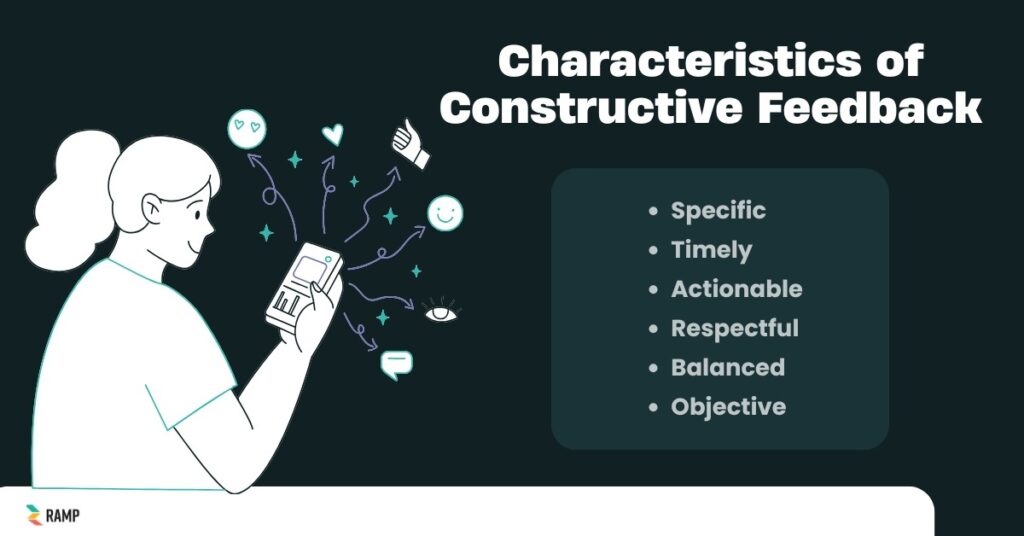
Effective constructive feedback shares several important characteristics that make it more helpful and productive. The diagram below portrays the characteristics of constructive feedback.
The following section explains each characteristic.
- Specific: Feedback should focus on clear actions or behaviors rather than vague statements.
Weak Example: "You need to improve communication."
Better Example: "Your email updates would be more effective if deadlines and responsibilities were explained more clearly."
- Timely: Constructive feedback should be given close to the actual situation so employees can remember the context and improve quickly.
- Actionable: Employees should clearly understand what they can do differently moving forward. Good feedback includes practical suggestions rather than simply identifying problems.
- Respectful: Feedback should focus on professional behavior and outcomes rather than personal criticism. Respectful communication reduces defensiveness and encourages improvement.
- Balanced: Constructive feedback works best when it recognizes strengths while also addressing areas for improvement. Balanced discussions help maintain employee confidence and motivation.
- Objective: Feedback should be based on observable behavior, evidence, and measurable outcomes instead of assumptions or emotions. Objective feedback improves fairness and credibility.
When to Use Constructive Feedback
Constructive feedback should be used when organizations want to improve performance, solve problems, and support employee development.
Use Constructive Feedback When:
- Performance falls below expectations
- Mistakes occur repeatedly
- Communication or teamwork issues appear
- Employees need coaching or guidance
- Workplace behavior affects productivity
- Employees are developing new skills
Constructive feedback is most effective when the goal is improvement rather than punishment.
When Not to Use Constructive Feedback
There are situations in which constructive feedback may become ineffective or even harmful if delivered improperly.
Avoid Constructive Feedback When:
- Emotions are highly intense or uncontrolled
- Feedback is based on assumptions instead of facts
- Employees are publicly embarrassed
- The issue is outside the employee's control
- The conversation is driven by frustration or anger
- There is insufficient evidence to support the discussion
Managers should prepare carefully before having difficult feedback conversations.
The diagram below shows when to and when not to use constructive feedback.
| When to Use Constructive Feedback | When Not to Use Constructive Feedback |
| Performance falls below expectations | Emotions are highly intense or uncontrolled |
| Mistakes occur repeatedly | Feedback is based on assumptions instead of facts |
| Communication or teamwork issues appear | Employees are publicly embarrassed |
| Employees need coaching or guidance | The issue is outside the employee’s control |
| Workplace behavior affects productivity | The conversation is driven by frustration or anger |
| Employees are developing new skills | There is insufficient evidence to support the discussion |
Sentence Starters for Constructive Feedback
Using clear sentence starters helps feedback remain professional, respectful, and focused.
Recommended Examples
- "In [situation], I observed…"
- "The impact was…"
- "One area that could be improved is…"
- "A more effective approach may be…"
- "Going forward, it would help if…"
These phrases encourage evidence-based communication instead of emotional judgment.
Common Mistakes to Avoid
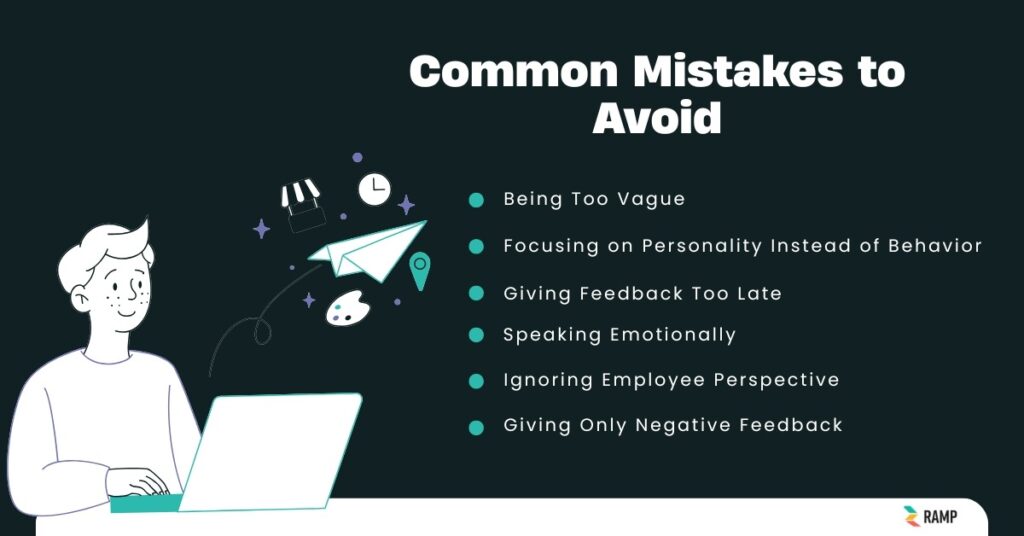
Many feedback discussions become ineffective because of avoidable communication mistakes. The diagram below shows the common mistakes to avoid while giving constructive feedback.
The details are given below.
- Being Too Vague: Unclear feedback creates confusion and limits opportunities for improvement.
- Focusing on Personality Instead of Behavior: Constructive feedback should focus on actions and outcomes, not on personal traits.
- Giving Feedback Too Late: Delayed conversations reduce relevance and learning effectiveness.
- Speaking Emotionally: Feedback driven by anger or frustration often damages trust and communication.
- Ignoring Employee Perspective: Employees should have opportunities to explain challenges, ask questions, and discuss solutions.
- Giving Only Negative Feedback: Constant criticism without recognition may reduce motivation and engagement.
Balanced communication creates better long-term results.
Constructive feedback is an essential tool for improving employee performance, strengthening communication, and supporting professional growth. When delivered respectfully and supported by structured methods such as the SBI framework, feedback becomes clearer, fairer, and more effective.
Organizations that encourage constructive feedback create stronger accountability, healthier workplace relationships, and continuous improvement cultures where employees feel supported rather than criticized.