
Different organizations develop different cultural models based on leadership philosophy, business strategy, industry demands, and workforce structure. Below are several common workplace culture types.
The types of workplace culture are discussed in detail below.
Collaborative Culture
A collaborative culture emphasizes teamwork, open communication, and shared problem-solving.
Characteristics
- Cross-functional teamwork
- Knowledge sharing
- Mutual support
- Open discussions
- Group accountability
Advantages
- Strong employee relationships
- Better innovation through shared ideas
- Improved team morale
Challenges
- Slower decision-making
- Difficulty handling conflict if consensus is prioritized excessively
Collaborative cultures are common in creative industries, consulting firms, and modern technology companies.
Innovative Culture
Innovative cultures prioritize creativity, experimentation, and adaptability.
Characteristics
- Encouragement of new ideas
- Acceptance of calculated risk
- Continuous learning
- Rapid change adaptation
Advantages
- High innovation potential
- Faster product development
- Competitive advantage
Challenges
- Increased uncertainty
- Risk of burnout from constant change
- Possible lack of structure
Startups and technology-driven organizations often operate with innovative cultures.
Competitive Culture
Competitive cultures focus heavily on results, achievement, and performance metrics.
Characteristics
- Aggressive targets
- Individual achievement
- Performance rankings
- High-pressure environments
Advantages
- Strong productivity
- Goal-driven employees
- Fast business growth
Challenges
- Stress and burnout
- Internal rivalry
- Reduced collaboration
Sales organizations and high-growth firms commonly develop competitive cultures.
Hierarchical Culture
Hierarchical cultures rely on formal structures, procedures, and clearly defined authority levels.
Characteristics
- Clear reporting lines
- Structured processes
- Rule-based operations
- Strong managerial control
Advantages
- Stability
- Operational consistency
- Risk reduction
Challenges
- Slower adaptability
- Reduced employee autonomy
- Bureaucratic complexity
Government institutions, manufacturing companies, and traditional corporations often use hierarchical structures.
Remote-First Culture
Remote-first cultures are designed around distributed workforces where remote work is treated as the standard rather than an exception.
Characteristics
- Digital collaboration tools
- Flexible schedules
- Asynchronous communication
- Outcome-focused performance
Advantages
- Access to global talent
- Improved flexibility
- Reduced operational costs
Challenges
- Isolation
- Communication barriers
- Maintaining team connection
Successful remote-first organizations intentionally build communication systems and virtual engagement practices.
Inclusive Culture
Inclusive cultures prioritize belonging, fairness, diversity, and equal participation.
Characteristics
- Respect for diverse perspectives
- Equal opportunities
- Anti-discrimination practices
- Inclusive leadership
Advantages
- Higher employee trust
- Better creativity through diverse viewpoints
- Stronger employer reputation
Challenges
- Requires continuous leadership commitment
- Demands active policy enforcement
Inclusive cultures are increasingly recognized as essential for long-term organizational health and innovation.
High-Performance Culture
High-performance cultures emphasize excellence, productivity, accountability, and continuous achievement.
Characteristics
- Ambitious goals
- Strong performance standards
- Continuous feedback
- Results-driven management
Advantages
- Exceptional productivity
- Strong business outcomes
- High employee capability development
Challenges
- Burnout risk
- Pressure-related stress
- Work-life balance concerns
When balanced properly, high-performance cultures can drive both employee growth and organizational success.
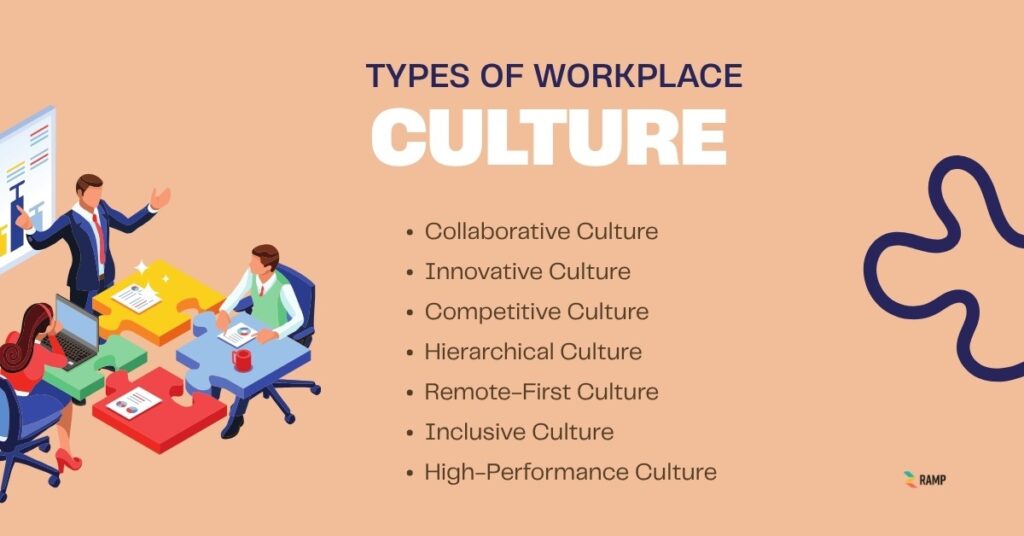
The diagram below summarizes the types of workplace cultures.
Workplace Culture and the Competing Values Framework
One widely recognized model for understanding workplace culture is the Competing Values Framework (CVF). This framework categorizes organizational cultures into four broad types:
| Culture Type | Primary Focus | Key Characteristics |
| Clan Culture | Collaboration | Teamwork, participation, employee-development |
| Adhocracy Culture | Innovation | Creativity, agility, experimentation |
| Market Culture | Competition | Results, achievement, performance |
| Hierarchy Culture | Control | Structure, efficiency, formal processes |
The framework helps organizations identify their dominant culture and evaluate whether it aligns with strategic goals.
Research on organizational culture explains that workplace culture shapes employee behavior, interactions, and overall organizational effectiveness. The review highlights several cultural orientations and connects them with the Competing Values Framework, which groups cultures into types such as clan, adhocracy, market, and hierarchy. This underscores the importance of understanding different workplace cultures, as each culture model influences teamwork, innovation, competition, structure, employee experience, and business performance in distinct ways.