
Succession planning is a structured process organizations use to identify, prepare, and develop employees who can fill important roles in the future. It helps businesses maintain leadership continuity, reduce operational disruption, and ensure critical positions are filled quickly when vacancies occur.
Organizations use succession planning to prepare for:
- Retirements
- Promotions
- Resignations
- Organizational growth
- Unexpected leadership changes
- Business expansion and transformation
Succession planning is not limited to CEO replacement planning. It also applies to:
- Department managers
- Technical specialists
- Operational leaders
- Business-critical contributors
- Future leadership pipelines
Modern succession planning focuses on building long-term organizational stability rather than reacting only when a role becomes vacant.
Why Succession Planning Matters?
Succession planning is a strategic workforce and business continuity practice. It helps organizations remain stable during periods of transition and strengthens long-term talent readiness.
Leadership Continuity
Organizations can maintain stable leadership transitions without major operational interruptions.
Reduced Disruption From Employee Exits
When experienced employees leave unexpectedly, prepared successors help reduce workflow disruption and knowledge loss.
Lower Vacancy Risk
Critical roles are less likely to remain vacant for long periods when internal candidates are already identified and developed.
Internal Promotion Readiness
Succession planning improves internal mobility by preparing employees for advancement before opportunities arise.
Retention of High-Potential Talent
Employees are more likely to stay when they see visible growth opportunities and leadership investment in their development.
Stronger Workforce Resilience
Organizations become more adaptable when leadership capability is distributed across multiple levels rather than relying on a few individuals.
Faster Leadership Transitions
Prepared successors can step into roles more efficiently with less onboarding and adjustment time.
Reduced Dependence on External Hiring
Developing internal talent lowers recruitment costs, shortens hiring timelines, and preserves institutional knowledge.
Succession planning is ultimately about protecting organizational capability while building future leadership strength.
Research on succession planning best practices for large and small organizations explains that succession planning is important for developing future leaders, supporting employee retention, and preparing internal talent for critical roles. The article highlights succession planning as a structured practice that helps organizations reduce leadership gaps and maintain continuity when key employees leave or move into new roles. This underscores the importance of succession planning, as organizations need prepared successors, clear development plans, and regular talent reviews to protect long-term business stability.
Core Components of Succession Planning
An effective succession planning system includes several connected components.
Identifying Critical Roles
Organizations first determine which positions are essential to operational stability, strategy execution, and leadership continuity.
Critical roles may include:
- Senior leadership positions
- Department heads
- Specialized technical roles
- Revenue-driving positions
- Operationally essential functions
Not every role requires formal succession planning, but business-critical roles usually do.
Identifying High-Potential Talent
Organizations identify employees who demonstrate:
- Strong performance
- Leadership capability
- Learning agility
- Adaptability
- Growth potential
These employees may become future successors with the right development support.
Readiness Assessment
Succession planning should evaluate how prepared employees are for future roles.
Readiness levels often include:
- Ready now
- Ready in 1–2 years
- Ready in 3–5 years
This helps organizations understand current bench strength.
Skills and Competency Mapping
Organizations compare future role requirements with employee capabilities.
This includes evaluating:
- Leadership competencies
- Technical expertise
- Decision-making ability
- Communication capability
- Strategic thinking
Competency mapping identifies development needs before advancement occurs.
Development Plans
Successors need structured development support to prepare for future responsibilities.
Development plans may include:
- Leadership training
- Coaching
- Certifications
- Stretch assignments
- Cross-functional exposure
Leadership Exposure
Potential successors should gain visibility into broader organizational operations and decision-making.
Examples include:
- Executive meetings
- Strategic projects
- Leadership committees
- Cross-department collaboration
Mentoring and Coaching
Experienced leaders help prepare successors through:
- Guidance
- Feedback
- Career discussions
- Leadership coaching
This accelerates leadership readiness and organizational understanding.
Succession Slates
Organizations often identify multiple potential successors for key roles rather than relying on a single individual.
This reduces risk and improves flexibility.
Review Cadence
Succession planning should be reviewed regularly because:
- Employees develop at different rates
- Business priorities change
- Organizational structures evolve
Most organizations review succession plans annually or semiannually.
Documentation and Governance
Succession plans should be documented clearly to ensure consistency, transparency, and organizational accountability.
The Process of Succession Planning
Succession planning usually follows a structured sequence. The diagram below shows the succession planning process.
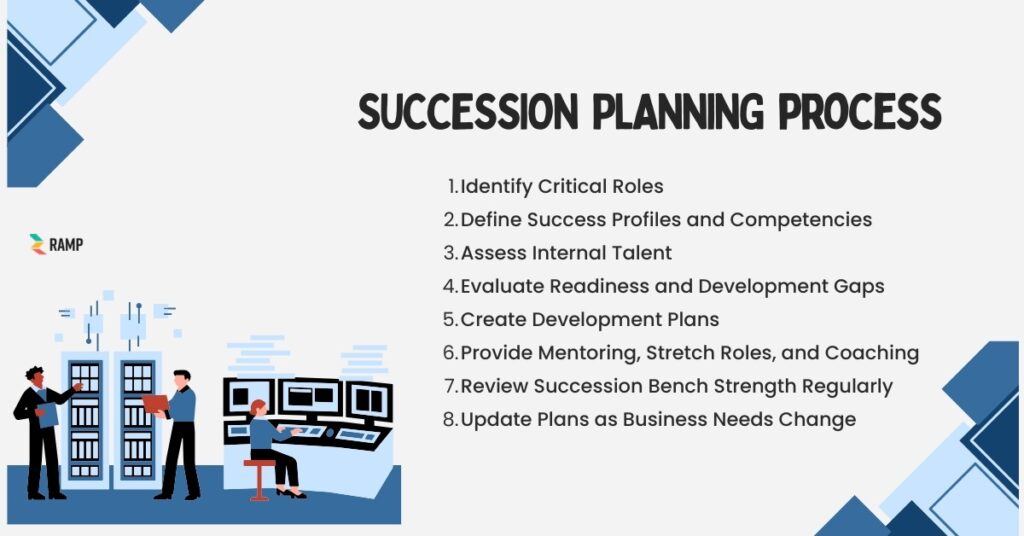
The details of the succession planning process are given below.
Step 1: Identify Critical Roles
Organizations determine which positions have the greatest impact on operations, leadership continuity, and strategic execution.
Step 2: Define Success Profiles and Competencies
Each critical role should have a clearly defined:
- Responsibilities
- Skills
- Leadership behaviors
- Experience requirements
- Performance expectations
This creates objective readiness criteria.
Step 3: Assess Internal Talent
Organizations evaluate employees who may have the potential to move into future roles.
Assessment methods may include:
- Performance reviews
- Leadership evaluations
- Talent discussions
- Skills assessments
Step 4: Evaluate Readiness and Development Gaps
Organizations compare current capability against future role expectations to identify readiness levels and missing competencies.
Step 5: Create Development Plans
Development plans are designed to close readiness gaps through targeted learning and experience-building opportunities.
Step 6: Provide Mentoring, Stretch Roles, and Coaching
Potential successors gain development through:
- Leadership mentoring
- Cross-functional projects
- Temporary leadership assignments
- Executive exposure
- Coaching support
Step 7: Review Succession Bench Strength Regularly
Organizations evaluate whether there are enough capable successors for critical roles.
Step 8: Update Plans as Business Needs Change
Succession planning should evolve alongside:
- Organizational growth
- Workforce changes
- Strategic shifts
- Technology changes
How Successors Are Identified?
Strong succession planning depends on evidence-based talent evaluation rather than personal opinion alone.
Organizations typically use multiple methods to identify potential successors.
Performance Reviews
Consistent performance data helps identify employees who deliver strong results over time.
Leadership Assessments
Leadership evaluations measure qualities such as:
- Decision-making
- Communication
- Strategic thinking
- Team leadership
- Adaptability
Potential Assessments
Potential assessments evaluate whether employees can grow into larger or more complex responsibilities.
Manager Recommendations
Managers provide insight into:
- Work ethic
- Readiness signals
- Leadership behaviors
- Learning capability
However, recommendations should be balanced with objective evaluation methods.
Competency Evaluations
Organizations compare employee capabilities against role-specific competency frameworks.
Career Aspiration Discussions
Employees may not always want leadership or advancement roles.
Career conversations help determine:
- Interest levels
- Motivation
- Long-term goals
Talent Review Meetings
Leadership teams often conduct calibration discussions to ensure talent is consistently evaluated across departments.
People Analytics
Organizations increasingly use workforce data to identify:
- Leadership trends
- Readiness patterns
- Retention risks
- Skill gaps
Evidence-based evaluation improves fairness and succession accuracy.
Succession Planning and Employee Development
Succession planning depends heavily on employee development systems.
Potential successors cannot become future leaders without structured growth opportunities.
Succession planning typically connects to:
- Leadership development programs
- Technical and managerial training
- Stretch assignments
- Coaching and mentoring
- Cross-functional exposure
- Development plans
- Promotion readiness discussions
Development activities help employees gain:
- Leadership experience
- Strategic capability
- Broader organizational understanding
- Confidence for larger responsibilities
Succession planning is most effective when development is continuous rather than reactive.
Succession Planning and High-Potential (HiPo) Development
High-potential employees often enter succession pipelines because they demonstrate strong growth potential and leadership promise.
However, HiPo status alone does not automatically mean succession readiness.
Organizations must evaluate:
- Role readiness
- Leadership capability
- Business fit
- Career aspirations
- Emotional maturity
- Performance consistency
An employee may have strong potential but still require significant development before becoming ready for a critical role.
Succession planning should focus on evidence-based readiness rather than labels alone.
Role of HR, Leadership, and Managers
Succession planning requires collaboration across multiple organizational levels.
HR and People Operations Responsibilities
HR and People Ops teams typically:
- Design succession planning frameworks
- Facilitate talent reviews
- Maintain succession data and documentation
- Support leadership development initiatives
- Align succession planning with workforce strategy
Leadership Responsibilities
Senior leaders are responsible for:
- Identifying future organizational needs
- Sponsoring talent development
- Participating in calibration discussions
- Supporting succession reviews
- Building leadership pipelines intentionally
Leadership involvement is essential for succession planning, credibility, and effectiveness.
Manager Responsibilities
Managers help succession systems succeed by:
- Identifying readiness signals
- Supporting employee growth
- Providing performance feedback
- Recommending development opportunities
- Helping employees prepare for advancement
Managers often have the most direct visibility into employee capability and growth potential.
Common Challenges and Mistakes
Many organizations struggle with succession planning because systems lack structure, consistency, or leadership commitment.
Common mistakes include:
- Focusing only on executive roles
- Confusing strong performance with future leadership potential
- Failing to follow through on development plans
- Using unclear readiness criteria
- Allowing bias in talent identification
- Maintaining weak documentation
- Limited leadership involvement
- Outdated succession plans
- Lack of visibility into succession bench strength
Without ongoing review and development support, succession plans quickly lose value.
Metrics and Indicators in Succession Planning
Organizations often use workforce metrics to evaluate the effectiveness of their succession planning.
Important indicators include:
- Succession bench strength
- Readiness level by critical role
- Internal promotion rate
- Time required to fill critical positions
- Leadership pipeline coverage
- Retention of high-potential talent
- Development-plan completion rates
- Critical-role vacancy risk
These metrics help organizations evaluate whether succession pipelines are strong enough to support future workforce needs.
Succession Planning in Remote and Modern Workforces
Remote and hybrid work environments create new succession planning challenges.
Distributed teams may face:
- Reduced leadership visibility
- Limited informal networking opportunities
- Greater risk of proximity bias
- Inconsistent visibility into readiness signals
Organizations can improve succession planning in modern workplaces through:
- Digital talent review systems
- Structured competency documentation
- Virtual leadership assessments
- Skills mapping platforms
- Remote mentoring programs
- Data-driven readiness evaluations
Leadership readiness should be evaluated based on capability, results, and influence rather than physical office presence.
Best Practices for Effective Succession Planning
Organizations can strengthen succession planning systems through several best practices:
- Plan beyond top executive roles
- Define critical roles clearly
- Separate performance from leadership potential
- Build development directly into succession planning
- Review succession plans regularly
- Involve senior leaders actively
- Measure bench strength and readiness consistently
- Align succession planning with business strategy and workforce needs
Succession planning is a structured and strategic process that helps organizations prepare future talent for critical roles while ensuring leadership continuity and workforce stability. Effective succession planning goes beyond executive replacement and supports broader organizational resilience through development, readiness assessment, mentoring, and leadership pipeline building. When organizations connect succession planning with employee development, workforce strategy, and data-driven talent evaluation, they create stronger internal mobility, faster transitions, and long-term organizational sustainability.