
A 360-degree performance review is a multi-source evaluation process that collects feedback from different workplace relationships to provide a broader and more balanced understanding of an employee's performance, behavior, and collaboration skills.
In a typical 360-degree review, feedback comes from:
- The employee (self-assessment)
- The direct manager
- Peers or coworkers
- Direct reports or team members
- Sometimes clients or cross-functional colleagues
Unlike traditional reviews that focus mainly on results and manager observations, 360-degree performance reviews measure workplace behaviors, communication style, teamwork, leadership ability, collaboration, and interpersonal effectiveness from multiple perspectives.
360-degree feedback plays an important role in performance management by providing a more complete view of an employee's work, not just from the manager's perspective but also from peers, subordinates, and, in some cases, clients. It helps organizations identify strengths, uncover development needs, and support more balanced and fair performance discussions. When used effectively, it turns performance management into a more continuous and development-focused process.
A related study on 360-degree feedback to leaders shows that this review method can influence more than individual self-awareness. The study found that when leaders improved their behavior after receiving 360-degree feedback, employees reported higher engagement and satisfaction, along with reduced intentions to leave. This supports the idea that 360-degree reviews can contribute to both leadership development and a healthier workplace environment.
How 360-Degree Performance Reviews Work?
A successful 360-degree review process follows a structured sequence to maintain fairness and reliability. The diagram below shows the process of a 360-degree performance review.
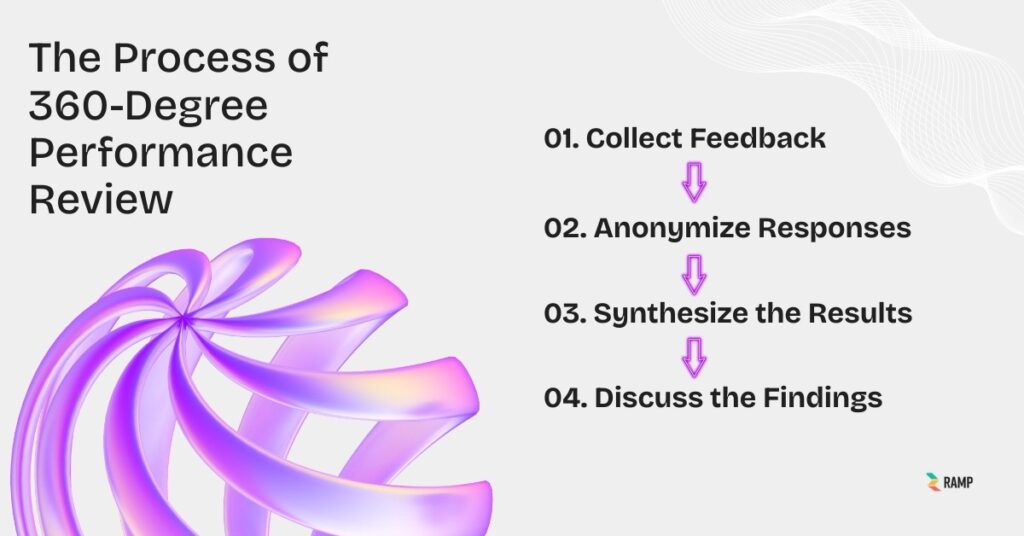
The details of the process are given below.
Collect Feedback
Organizations first gather feedback from selected participants who work closely with the employee. Feedback usually focuses on:
- Communication
- Teamwork
- Leadership
- Accountability
- Conflict management
- Problem-solving
- Professional behavior
Employees often complete self-assessments to compare self-perception with external feedback.
Anonymize Responses
Most organizations anonymize peer and subordinate feedback to encourage honesty and reduce fear of retaliation. Anonymous feedback helps participants:
- Speak openly
- Provide realistic observations
- Avoid workplace tension
- Share constructive criticism safely
However, anonymity should still be managed carefully to prevent irresponsible or emotionally driven comments.
Synthesize the Results
After collection, feedback is organized into patterns and themes instead of isolated opinions. Managers or HR teams review:
- Common strengths
- Repeated concerns
- Behavioral trends
- Rating consistency
- Development opportunities
The goal is to identify reliable patterns rather than react to a single comment.
Discuss the Findings
The final step involves a structured discussion between the employee and the reviewer or manager. The conversation should focus on:
- Key strengths
- Development areas
- Behavioral impact
- Growth opportunities
- Future goals
Constructive discussion is critical. Employees should leave the review with clarity, not confusion or frustration.
Advantages of 360-Degree Performance Reviews
Like any performance evaluation method, 360-degree reviews have both advantages and limitations. The diagram below shows the advantages of 360-degree reviews.
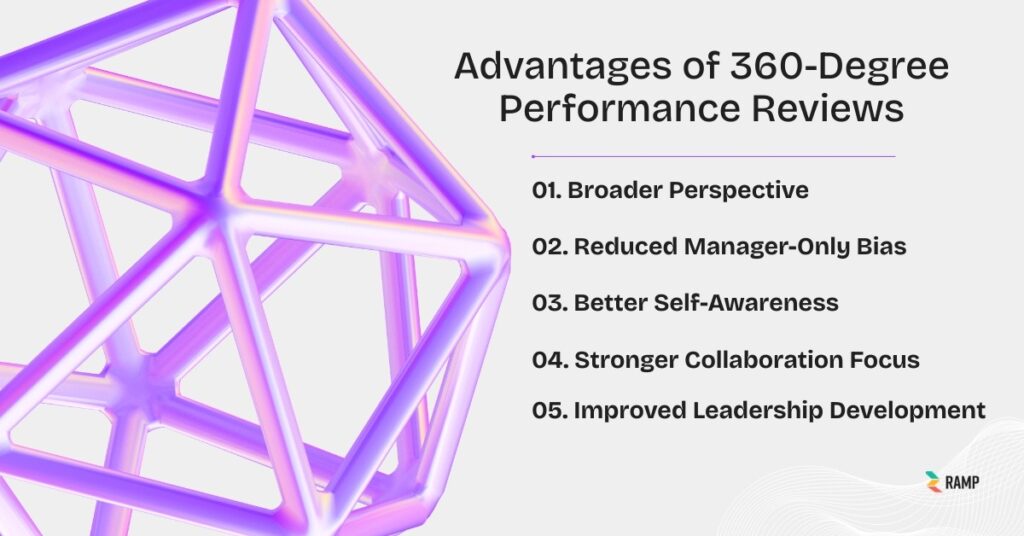
The details of the advantages include:
- Broader Perspective: Multiple viewpoints create a more complete understanding of employee performance.
- Reduced Manager-Only Bias: Feedback is not limited to one supervisor's opinion.
- Better Self-Awareness: Employees often discover strengths or weaknesses they did not fully recognize.
- Stronger Collaboration Focus: The process highlights communication, teamwork, and leadership behaviors that traditional reviews may overlook.
- Improved Leadership Development: Organizations commonly use 360-degree reviews to prepare future leaders.
Disadvantages of 360-Degree Performance Reviews
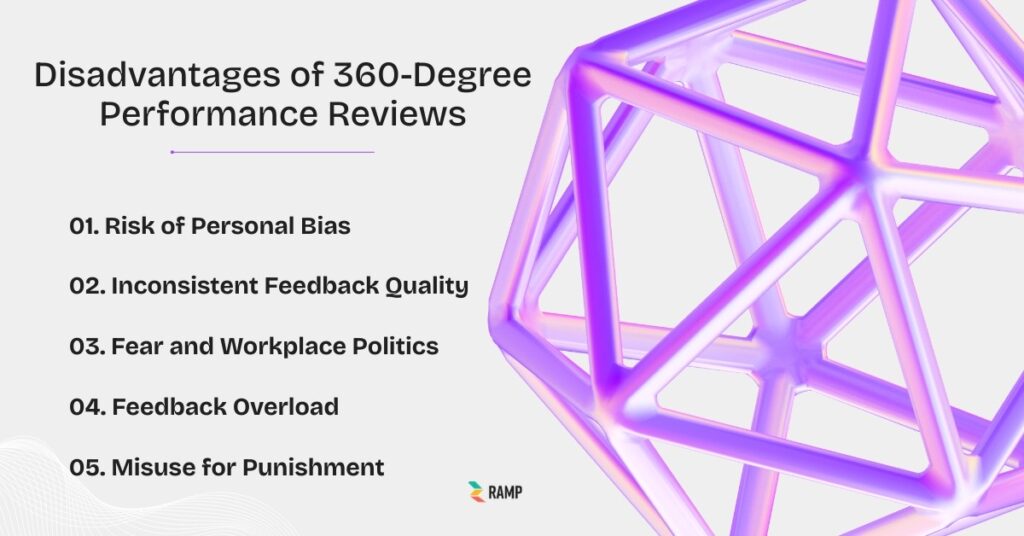
The disadvantages of 360-degree performance reviews include:
- Risk of Personal Bias: Peers or team members may allow personal relationships or conflicts to influence feedback.
- Inconsistent Feedback Quality: Some participants provide thoughtful input, while others may give vague or inaccurate responses.
- Fear and Workplace Politics: Employees may hesitate to give honest feedback if trust is low.
- Feedback Overload: Too much information without proper interpretation can overwhelm employees.
- Misuse for Punishment: If organizations use the process only for criticism or ranking, employees may lose trust in the system.
The diagram below shows the disadvantages of a 360-degree performance review.
Common Bias Risks in 360-Degree Reviews
Although 360-degree reviews provide broader feedback from multiple sources, they are still vulnerable to personal and organizational biases that can affect fairness and accuracy. If these biases are not controlled properly, feedback may become emotionally influenced, inconsistent, or misleading rather than constructive and development-focused.
The diagram below shows the common bias risks in a 360-degree review.
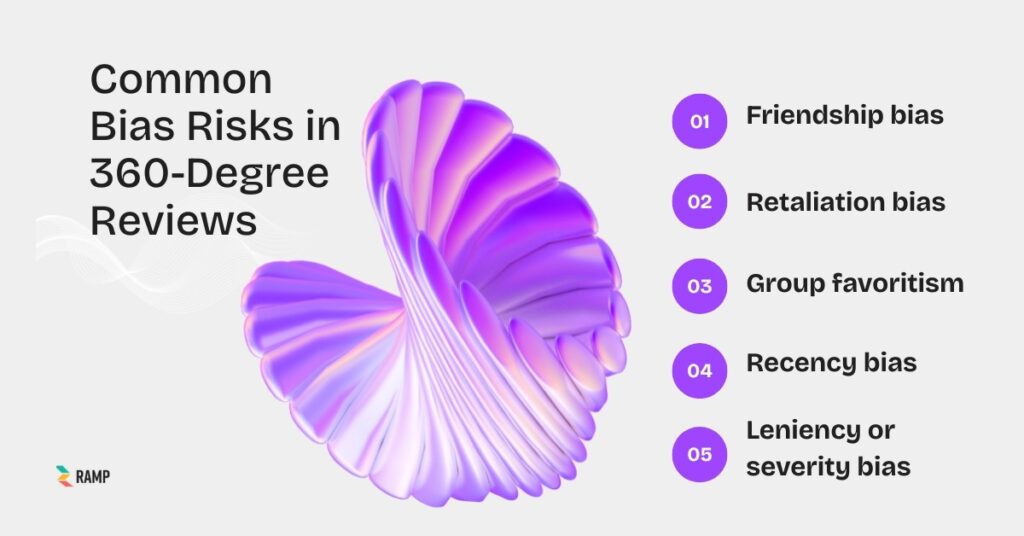
The details of the common bias risks in 360-degree reviews are given below.
- Friendship Bias: Reviewers may give overly positive feedback to coworkers they personally like or have close relationships with, regardless of actual performance.
- Retaliation Bias: Some individuals may intentionally provide unfair negative feedback due to personal conflicts, disagreements, or workplace tension.
- Group Favoritism: Employees belonging to certain teams, departments, or social groups may receive more favorable evaluations than those outside the group.
- Recency Bias: Reviewers may focus too heavily on recent events or mistakes, rather than evaluating performance across the entire review period.
- Leniency or Severity Bias: Some reviewers consistently rate everyone too generously, while others are excessively strict regardless of performance.
Organizations must actively manage these risks by selecting raters appropriately, establishing anonymity rules, implementing calibration processes, and setting clear evaluation guidelines to maintain fairness and credibility.
Safeguards for Effective 360-Degree Reviews
A strong 360-degree review process requires clear safeguards and a structured approach.
Mini Checklist
- Use anonymity rules for peer and subordinate feedback
- Design clear and behavior-focused questions
- Select raters who regularly work with the employee
- Include multiple perspectives to reduce bias
- Calibrate feedback across departments when possible
- Remove emotional or inappropriate comments
- Focus discussions on development, not punishment
- Train managers on interpreting feedback responsibly
These safeguards improve trust, consistency, and usefulness.
When to Use 360-Degree Performance Reviews
360-degree reviews are most effective when organizations want deeper insight into how employees interact, lead, and collaborate within teams. The diagram below shows when 360-degree performance reviews are commonly used.
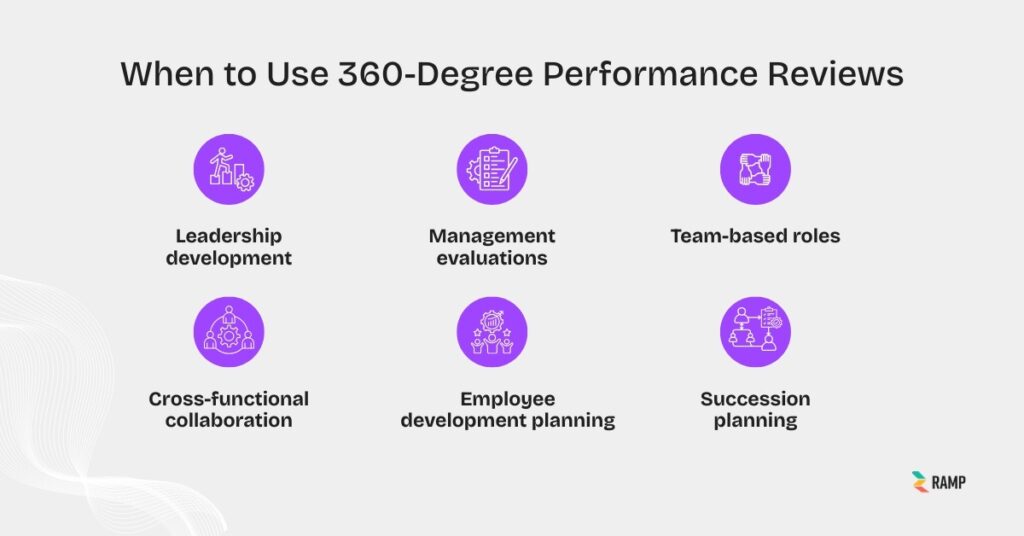
The points are listed below.
- Leadership development
- Management evaluations
- Team-based roles
- Cross-functional collaboration
- Employee development planning
- Succession planning
This review method works especially well in organizations where employees regularly interact with different departments, clients, or teams.
Best Roles for 360-Degree Reviews
360-degree reviews are particularly valuable for:
- Managers and supervisors
- Team leaders
- Project managers
- HR professionals
- Customer-facing roles
- Senior executives
For example, a project manager may receive feedback from team members, department heads, and clients to evaluate communication, leadership, and coordination effectiveness across projects.
Situations Where It May Not Work Well
This approach may be less effective when:
- Teams are too small
- Employees rarely collaborate
- Workplace trust is weak
- Feedback culture is underdeveloped
- Raters lack regular interaction with the employee
Without trust and proper structure, feedback may become inaccurate or overly personal.
How is 360-degree feedback different from a 360-degree review?
360-degree feedback usually focuses on developmental input and informal improvement suggestions gathered from multiple sources. A 360-degree review is a more structured and formal evaluation process that may include ratings, documentation, performance discussions, and organizational decision-making.