
A probationary performance review is conducted during or at the end of a new employee's probation period to determine whether the employee meets the organization's expectations for permanent employment. The review typically assesses adaptability, learning ability, attendance, work quality, communication, and overall fit within the company culture. Probationary reviews help organizations make informed hiring decisions while providing new employees with clear feedback on their early performance.
A related study on probationary periods explains that probation can serve as an important final step in the employee selection process by helping organizations evaluate actual job performance after hiring. The study also notes that probationary periods must be used carefully, with proper tracking and fair evaluation, because they can affect both employment decisions and employee rights. This supports the value of probationary performance reviews as a structured way to assess early performance, job fit, and long-term suitability.
How Probationary Performance Reviews Work?
Probationary performance reviews usually follow a structured evaluation process during an employee's initial period of employment.
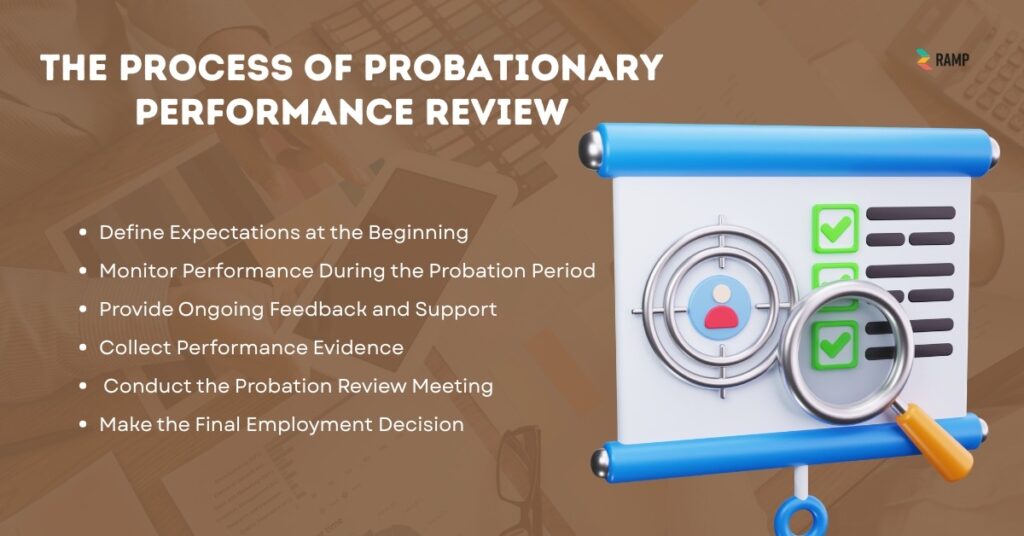
1. Define Expectations at the Beginning
At the start of employment, managers explain the employee's responsibilities, goals, workplace policies, and expected performance standards.
These expectations may include:
- Job responsibilities
- Productivity targets
- Attendance requirements
- Communication standards
- Teamwork expectations
- Behavioral guidelines
Clear expectations help new employees understand what success looks like.
2. Monitor Performance During the Probation Period
Managers observe employee performance regularly throughout the probation period.
Performance monitoring may include:
- Work quality
- Task completion
- Learning ability
- Adaptability
- Communication skills
- Professional behavior
- Team collaboration
- Attendance and punctuality
Frequent observation helps managers identify strengths and challenges early.
3. Provide Ongoing Feedback and Support
Managers usually conduct regular check-ins during probation instead of waiting until the final review.
Feedback may focus on:
- Progress made
- Areas needing improvement
- Training needs
- Workplace behavior
- Adjustment to company culture
Early feedback helps employees improve before the final decision is made.
4. Collect Performance Evidence
Before the final probation review, managers gather performance-related information.
This may include:
- KPI results
- Work samples
- Attendance records
- Supervisor observations
- Team feedback
- Customer feedback
- Training completion records
Evidence-based evaluation improves fairness and accuracy.
5. Conduct the Probation Review Meeting
The manager meets with the employee to discuss overall performance during the probation period.
The discussion may include:
- Strengths and achievements
- Challenges faced
- Skill development progress
- Areas requiring improvement
- Future expectations
Managers should communicate clearly and professionally during this stage.
6. Make the Final Employment Decision
After the evaluation, the organization decides whether to:
- Confirm permanent employment
- Extend the probation period
- Provide a performance improvement plan
- End employment
The final outcome is usually documented officially. In addition, the diagram below summarizes the process of probationary performance review.
Advantages of Probationary Performance Reviews
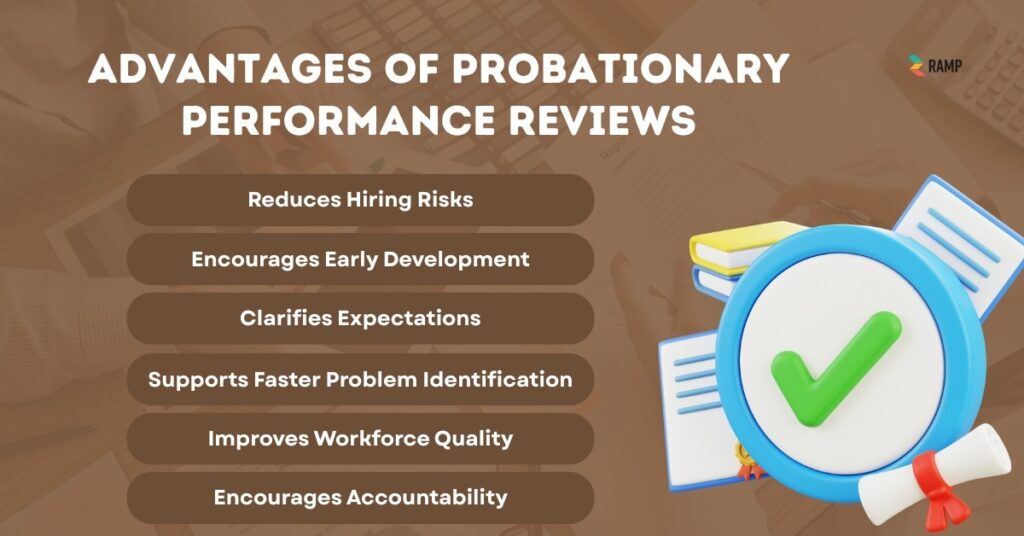
Probationary reviews offer several important benefits for organizations and employees. The diagram below shows the advantages of probationary performance review.
The advantages are explained further below.
- Reduces Hiring Risks: Organizations can evaluate whether the employee is truly suitable for the role before long-term confirmation.
- Encourages Early Development: New employees receive guidance and support during the critical adjustment period.
- Clarifies Expectations: Employees understand workplace standards, responsibilities, and performance requirements more clearly.
- Supports Faster Problem Identification: Managers can detect performance or behavioral issues early.
- Improves Workforce Quality: Organizations can maintain stronger hiring standards through structured evaluation.
- Encourages Accountability: Employees often remain more focused and motivated during the probation period.
Disadvantages of Probationary Performance Reviews
Despite their benefits, probationary reviews also have limitations.
- High Pressure for New Employees: The probation period can create stress and anxiety for employees adjusting to a new workplace.
- Limited Evaluation Time: Managers may not have enough time to fully assess long-term potential.
- Risk of Incomplete Performance Assessment: New employees may still be learning systems and processes during evaluation.
- Potential Managerial Subjectivity: Personal opinions or first impressions may unfairly influence decisions.
- Adjustment Challenges: Employees adapting slowly to new environments may be judged too quickly.
Common Bias Risks
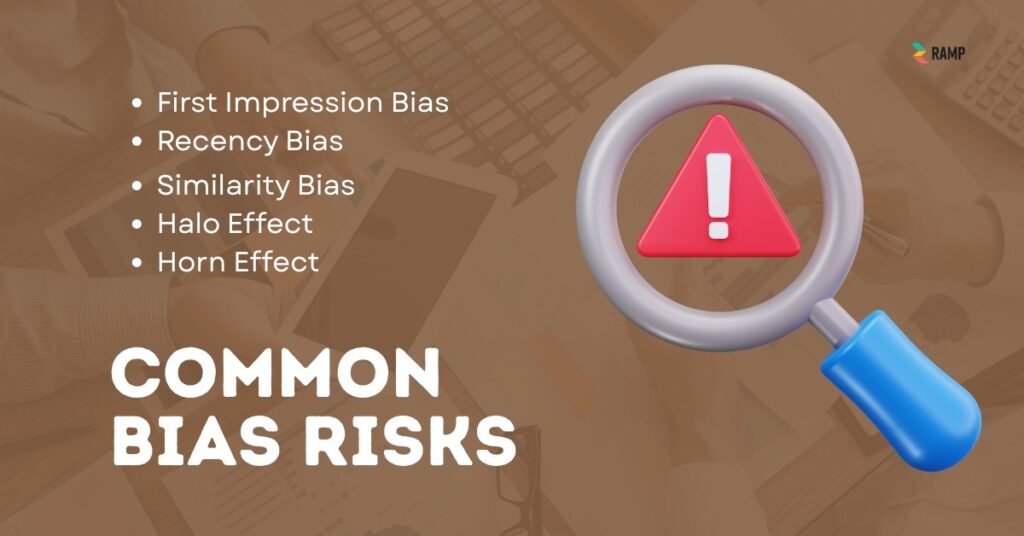
Several biases can affect the fairness of probationary performance reviews. The diagram below shows the common bias risks of probationary performance review.
The details of the biases are given below.
- First Impression Bias: Managers may rely too heavily on early opinions formed during the first few weeks.
- Recency Bias: Recent performance may overshadow earlier progress or challenges.
- Similarity Bias: Managers may favor employees with similar personalities or communication styles.
- Halo Effect: One strong positive quality may unfairly influence the overall evaluation.
- Horn Effect: A single mistake or weakness may negatively affect the entire review.
Organizations should actively monitor these risks to maintain fair evaluation practices.
Safeguards for Effective Probationary Performance Reviews
Strong safeguards improve fairness, consistency, and employee development.
- Set Clear Expectations from Day One: Employees should fully understand job responsibilities and evaluation criteria.
- Conduct Regular Check-Ins: Frequent discussions help employees improve before the final review.
- Use Measurable Performance Standards: Evaluation should rely on work quality, task completion, and observable behaviors.
- Document Performance Consistently: Managers should maintain records throughout the probation period rather than relying solely on memory.
- Provide Training and Support: Employees should receive guidance, onboarding support, and necessary resources.
- Focus on Development as Well as Evaluation: Managers should help employees improve rather than only judge performance.
- Apply Consistent Review Standards: Organizations should use standardized evaluation forms and processes for all probationary employees.
When to Use Probationary Performance Reviews
Probationary reviews are most useful during the early stages of employment. The diagram below shows when probationary performance reviews are commonly used.
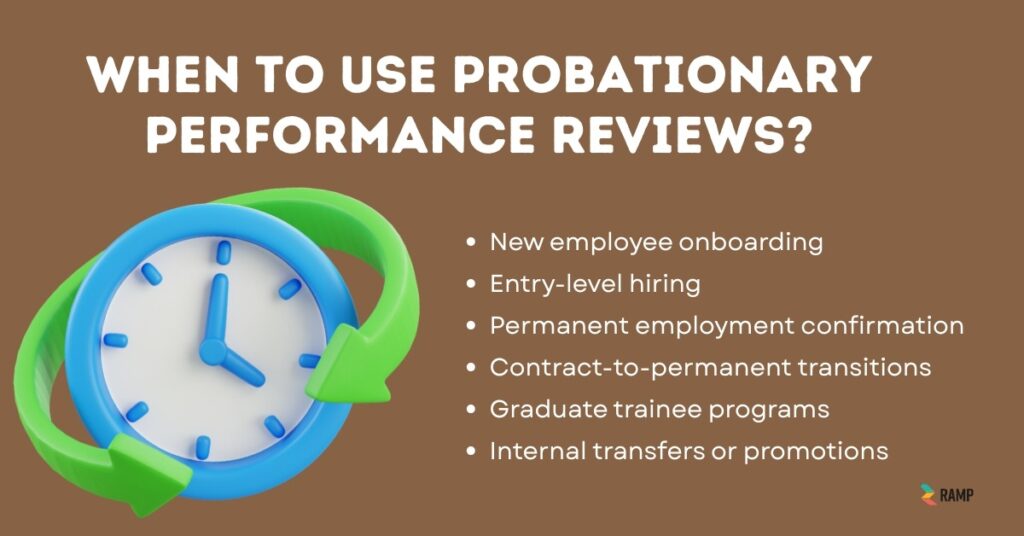
They are commonly used for:
- New employee onboarding
- Entry-level hiring
- Permanent employment confirmation
- Contract-to-permanent transitions
- Graduate trainee programs
- Internal transfers or promotions
Most organizations use probationary reviews as part of their hiring and workforce management process.
Best Roles for Probationary Performance Reviews
Probationary reviews work especially well for roles requiring adaptation, training, and workplace integration.
Common Examples
- Entry-level employees
- Administrative staff
- Customer service representatives
- Retail employees
- Operations staff
- Graduate trainees
- Junior technical professionals
- Healthcare support staff
These roles often require early evaluation of performance, learning ability, and cultural fit.
Situations Where Probationary Performance Reviews May Not Work Well
Probationary reviews may be less effective in certain situations.
- Highly Complex Roles: Some jobs require lengthy training periods before performance can be fairly evaluated.
- Long-Term Research or Development Projects: Employees may not show measurable outcomes within a short probation period.
- Poor Onboarding Systems: Weak training and onboarding can make employees appear less capable than they actually are.
- Organizations with Inconsistent Evaluation Standards: Different managers may apply probation rules unfairly or inconsistently.
- Fast-Changing Work Environments: Frequent organizational changes may make expectations unclear during probation.
In these situations, organizations may need longer probation periods or additional support systems.
Probationary performance reviews provide organizations with an important opportunity to evaluate new employees during the early stages of employment. They help employers confirm job fit, identify development needs, reduce hiring risks, and maintain workforce quality through structured evaluation and feedback.
However, successful probationary reviews require clear expectations, consistent communication, fair evaluation standards, and supportive management practices. When conducted properly, they create a smoother transition for employees while helping organizations build stronger and more reliable teams.