Teams communicate in different ways depending on the purpose, urgency, and nature of the interaction. Understanding the types of team communication helps organizations improve collaboration, reduce misunderstandings, and choose the most effective communication method for different situations. Each type plays a unique role in supporting coordination, information sharing, decision-making, relationship building, and overall team performance.
The article “Five Types of Communication for Effective Team Management” explains that teams use different forms of communication, including verbal, non-verbal, written, visual, and digital communication, to stay clear, connected, and productive. It highlights that each type serves a different purpose: spoken conversations support quick clarification, written messages create records, visual communication simplifies complex ideas, and digital tools help distributed teams collaborate. This underscores the importance of understanding the types of team communication, as choosing the right method helps teams reduce confusion, improve collaboration, and strengthen overall performance.
The types of team communications are discussed in detail below.
Verbal Communication
Verbal communication involves spoken conversations between team members. It can happen during meetings, presentations, phone calls, or informal discussions.
Examples include:
- Team meetings
- Brainstorming sessions
- One-on-one discussions
- Verbal feedback
Verbal communication is valuable because it allows immediate clarification and emotional connection.
Written Communication
Written communication includes all text-based exchanges used to document information and maintain records.
Examples include:
- Emails
- Reports
- Chat messages
- Project documentation
- Task updates
Written communication improves consistency and creates a reference point for future use.
Nonverbal Communication
Nonverbal communication refers to body language, facial expressions, tone of voice, eye contact, and gestures. These signals often influence how messages are interpreted.
Strong nonverbal communication can:
- Reinforce trust
- Show engagement
- Communicate confidence
- Improve understanding
Poor nonverbal cues may create confusion or tension.
Synchronous Communication
Synchronous communication refers to real-time interaction where participants communicate simultaneously and receive immediate responses. This model is designed for fast discussion, live collaboration, and instant clarification.
Common examples include:
- Face-to-face meetings
- Video conferences
- Phone calls
- Live chat discussions
- Team standups
Synchronous communication works best when speed, emotional context, and rapid collaboration are important.
Advantages and Disadvantages of Synchronous Communication
| Advantages of Synchronous Communication | Disadvantages of Synchronous Communication |
| Faster Decision-Making | Interruptions |
| Immediate Clarification | Meeting Fatique |
| Emotional Nuance | Scheduling Friction |
| Better Brainstorming | Weaker Documentation |
| Stronger Conflict Resolution | |
| Relationship Building |
Best Use Cases for Synchronous Communication
Synchronous communication works best when speed, context, and emotional clarity are important.
Use sync communication for:
- Urgent decisions
- Sensitive feedback
- Conflict resolution
- Brainstorming sessions
- High-context discussions
- Live collaboration
- Crisis management
These situations benefit from immediate interaction and rapid clarification.
Asynchronous Communication
Asynchronous communication refers to communication that does not require participants to respond immediately. Team members can review messages and reply at different times based on availability and workload.
Common examples include:
- Shared documents
- Project management comments
- Recorded video updates
- Knowledge bases
- Task boards
Asynchronous communication supports flexibility, documentation, and distributed collaboration.
Advantages and Disadvantages of Asynchronous Communication
| Advantages of Asynchronous Communication | Disadvantages of Asynchronous Communication |
| Deep Work Protection | Slower Decisions |
| Time Zone Flexibility | Delayed Clarification |
| Better Documentation | Misinterpretation Risk |
| Lower Meeting Load | Less Human Connection |
| More Thoughtful Responses | |
| Scalable Communication |
Best Use Cases for Asynchronous Communication
Asynchronous communication is most effective for structured information sharing and distributed teamwork.
Use async communication for:
- Project updates
- Documentation
- Status reporting
- Routine collaboration
- Knowledge sharing
- Distributed teamwork
- Process communication
These tasks benefit from flexibility, written records, and reduced interruptions.
Core Differences Between Async and Sync Communication
The chart below compares synchronous and asynchronous communication across key workplace communication factors, highlighting how each model differs in speed, flexibility, collaboration style, and overall team coordination.
| Communication Factor | Synchronous Communication | Asynchronous Communication |
| Response Time | Immediate responses | Delayed responses |
| Flexibility | Requires simultaneous availability | Allows flexible participation |
| Documentation Quality | Requires simultaneous availability | Naturally creates written records |
| Collaboration Speed | Faster collaboration and discussion | Slower but more deliberate collaboration |
| Interruption Level | High interruption potential | Lower interruption risk |
| Decision-Making Style | Fast and discussion-driven | Thoughtful and reflection-driven |
| Time Zone Compatibility | Difficult across global teams | Ideal for distributed teams |
Formal Communication
Formal communication follows structured organizational channels and professional standards.
Examples include:
- Official announcements
- Performance reviews
- Policy updates
- Scheduled meetings
Formal communication supports consistency and accountability.
Informal Communication
Informal communication happens naturally through casual conversations and social interactions.
Examples include:
- Casual chats
- Social discussions
- Informal check-ins
- Workplace conversations
Informal communication helps strengthen relationships and team cohesion.
Upward, Downward, and Peer-to-Peer Communication
Upward Communication
Employees communicate information, concerns, or feedback to managers and leadership.
Examples:
- Employee feedback
- Status reports
- Suggestions
- Escalations
Downward Communication
Leaders communicate expectations, goals, and instructions to employees.
Examples:
- Strategic updates
- Assignments
- Policies
- Performance expectations
Peer-to-Peer Communication
Colleagues communicate directly to coordinate work and collaborate.
Examples:
- Team collaboration
- Knowledge sharing
- Problem-solving discussions
Internal Communication
Internal communication refers to the structured exchange of information, ideas, updates, and feedback within an organization. It includes all forms of communication among leadership, managers, teams, and employees to support daily operations and long-term business objectives.
It is not limited to emails or meetings. Internal communication also includes:
- Team discussions
- Company announcements
- Project updates
- Policies and procedures
- Feedback systems
- Collaboration tools
- Training communication
- Performance conversations
- Crisis or change-related messaging
In simple terms, internal communication is the system that keeps employees informed, connected, aligned, and engaged with the organization's goals and culture.
Internal communication tools may include:
- Messaging platforms
- Video conferencing systems
- Email software
- Intranets
- Knowledge bases
- Project collaboration systems
- Employee feedback platforms
- Recognition and engagement tools
Together, these systems create the communication infrastructure that supports everyday operations and long-term organizational alignment.
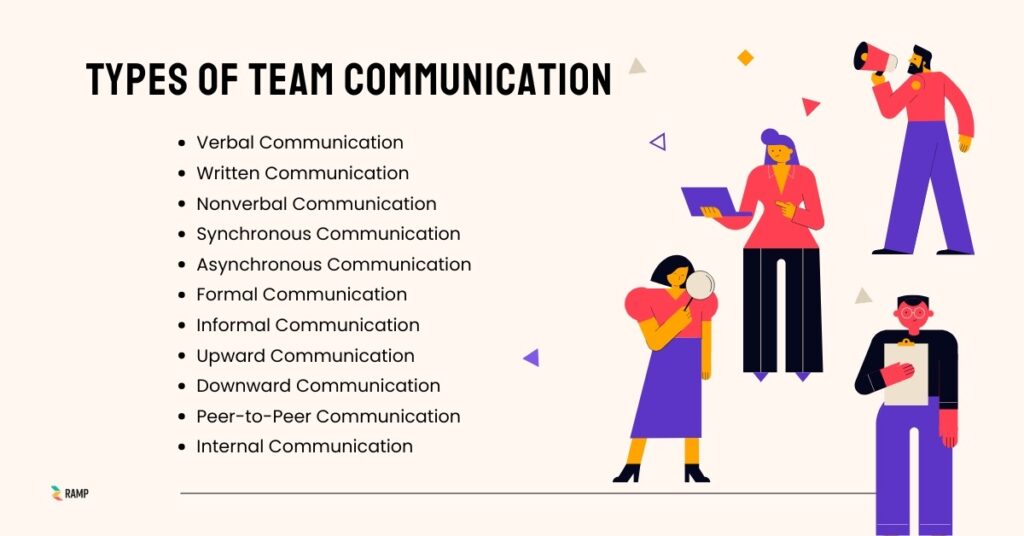
The diagram below summarizes the types of team communication.