

360-degree feedback is a performance evaluation method in which feedback about an employee is collected from multiple sources, including managers, coworkers, team members, subordinates, and, sometimes, clients. It provides a broader and more balanced view of an individual's behavior, communication, leadership, and overall workplace performance.
Unlike traditional feedback systems that rely only on managers, 360-degree feedback gathers perspectives from people who interact with the employee in different situations.
Why Does It Matter?
360-degree feedback matters because it helps individuals understand how their actions affect others across the workplace. Since feedback comes from multiple viewpoints, it often reveals strengths and areas for improvement that may not appear in a standard performance review.
It matters because it:
- Increases self-awareness
- Improves communication and teamwork
- Supports leadership development
- Encourages accountability
- Identifies behavioral patterns
- Provides balanced performance insights
- Promotes professional growth
Organizations use 360-degree feedback to create a more complete and accurate understanding of employee performance.
A practical guide on 360-degree feedback explains that this method gathers input from people who work closely with an employee, such as managers, peers, direct reports, and other relevant stakeholders. It highlights that 360-degree feedback provides a well-rounded view of strengths and development areas, making it useful for personal growth, leadership development, and supplementing performance reviews. This supports the value of 360-degree feedback as a multi-source, development-focused process that improves self-awareness, communication, and workplace effectiveness.
Core Structure of 360 Feedback Using the SBI Framework
A common way to structure 360 feedback is through the SBI Framework, which stands for:
- Situation — Describe the specific event or context.
- Behavior — Explain the observable action.
- Impact — Describe the result of that behavior.
This method helps feedback remain objective, professional, and focused on actions rather than personality.
Short Example
"In the quarterly strategy meeting, I observed that you encouraged quieter team members to share their opinions during discussions. The impact was that the meeting became more collaborative and several useful ideas were introduced."
The SBI structure makes feedback easier to understand and more useful for improvement.
Characteristics of 360-Degree Feedback
360-degree feedback has several important characteristics that set it apart from traditional performance evaluations, especially because it gathers insights from multiple perspectives across the workplace.
The diagram below shows the characteristics of 360-degree feedback.
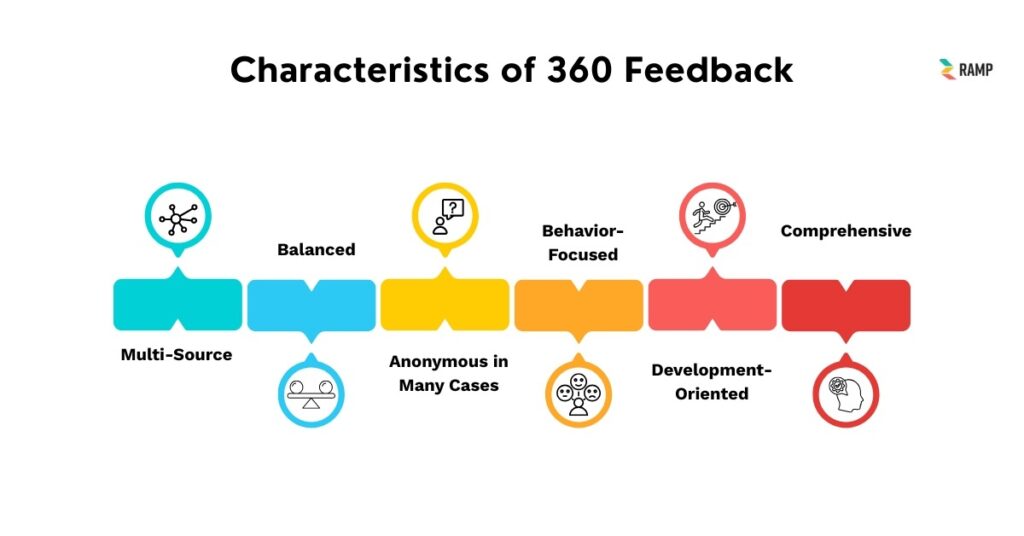
Effective 360-degree feedback usually has the following characteristics:
- Multi-Source: Feedback from several individuals who regularly work with the employee.
- Balanced: It includes both strengths and areas for improvement.
- Anonymous in Many Cases: Many organizations keep responses confidential to encourage honest input.
- Behavior-Focused: The feedback concentrates on observable actions and workplace interactions.
- Development-Oriented: The goal is growth and improvement, not punishment.
- Comprehensive: It provides insights from different working relationships and responsibilities.
When to Use It?
360-degree feedback is most effective in situations such as:
- During leadership development programs
- For performance and career development discussions
- When evaluating teamwork and communication skills
- During organizational development initiatives
- When preparing employees for management roles
- To identify strengths and behavioral improvement areas
- During annual or mid-year performance review cycles
It is especially useful in collaborative work environments where employees interact with many different people.
When Not to Use It?
360-degree feedback may be less effective in certain situations, including:
- When there is low trust within the organization
- If feedback is used mainly for punishment rather than development
- During active workplace conflicts or tension
- When participants are not trained to provide constructive feedback
- If responses are based on personal opinions instead of observations
- In highly competitive environments where bias may influence responses
In these situations, 360-degree feedback can become inaccurate, emotionally driven, or unfair.
The chart below outlines the situations where 360-degree feedback is most effective, along with conditions where the process may become biased, unproductive, or difficult to manage properly.
| When to Use It | When Not to Use It |
| During leadership development programs | When there is low trust within the organization |
| For performance and career development discussions | If feedback is used mainly for punishment rather than development |
| When evaluating teamwork and communication skills | During active workplace conflicts or tension |
| During organizational development initiatives | When participants are not trained to provide constructive feedback |
| When preparing employees for management roles | If responses are based on personal opinions instead of observations |
| To identify strengths and behavioral improvement areas | In highly competitive environments where bias may influence responses |
| During annual or mid-year performance review cycles | In highly competitive environments where bias may influence responses |
| It is especially useful in collaborative work environments where employees interact with many different people. | In these situations, 360-degree feedback can become inaccurate, emotionally driven, or unfair. |
Sentence Starters for Effective 360 Feedback
The following sentence starters help keep feedback professional and structured:
- "In [situation], I observed…"
- "The impact was…"
Example
"In the recent client onboarding project, I observed that you responded quickly to team concerns and clarified responsibilities clearly. The impact was that the project moved forward smoothly and communication delays were reduced."
These sentence starters encourage clear, objective feedback that is easier to act on.
Common Mistakes to Avoid
Organizations and employees often make avoidable mistakes when using 360-degree feedback.
The diagram below shows the common mistakes to avoid during 360-degree feedback.
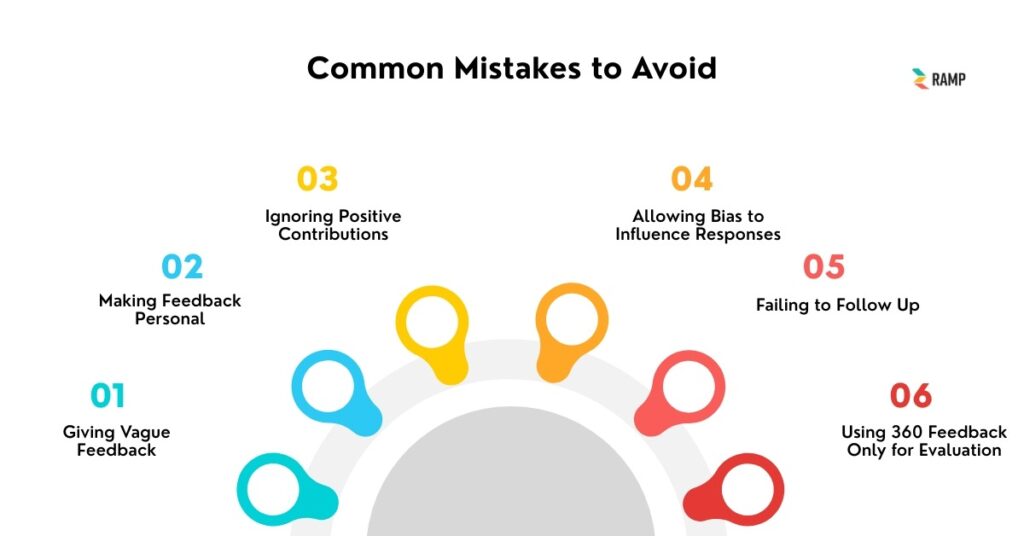
Details of the common issues are provided below.
- Giving Vague Feedback: General comments without examples provide little value.
- Making Feedback Personal: Feedback should focus on workplace behavior, not personality traits.
- Ignoring Positive Contributions: Focusing only on weaknesses can lower morale and motivation.
- Allowing Bias to Influence Responses: Personal relationships should not affect professional feedback.
- Failing to Follow Up: Feedback becomes ineffective if improvement plans are never discussed.
- Using 360 Feedback Only for Evaluation: The process should support development, not function only as a scoring system.
360-degree feedback is a valuable method for understanding employee performance from multiple perspectives. By collecting input from managers, peers, team members, and others, organizations can gain a more balanced and accurate picture of workplace behavior and professional effectiveness.
When used properly, 360-degree feedback strengthens communication, improves self-awareness, and supports long-term development. Structured approaches like the SBI framework help keep feedback objective, constructive, and focused on meaningful improvement rather than criticism alone.