
Self-feedback, also known as self-assessment, is the process of evaluating your own performance, behavior, decisions, and progress. It involves honestly reflecting on what went well, what needs improvement, and how future performance can be strengthened.
Unlike external feedback, self-feedback comes from personal observation and reflection. It helps individuals become more aware of their strengths, weaknesses, habits, and professional growth areas.
Why Does It Matter?
Self-feedback plays an important role in both personal and professional development. People who regularly assess their own performance tend to improve faster because they actively identify problems and adjust their behavior before issues grow larger.
It matters because it:
- Builds self-awareness
- Encourages continuous improvement
- Helps identify strengths and weaknesses
- Improves decision-making
- Increases accountability
- Supports career and skill development
- Strengthens confidence through reflection
Self-assessment also prepares individuals to receive external feedback more openly and professionally.
Research on feedback in the context of self-assessment explains that self-assessment becomes more effective when individuals use self-feedback to judge their own work, recognize gaps, and adjust future actions. The chapter connects self-feedback with self-regulated learning and evaluative judgment, showing that reflection is not just about scoring oneself but about understanding performance more accurately. This supports the value of self-feedback as a structured practice for building self-awareness, accountability, and continuous professional growth.
Core Structure of Self-Feedback Using the SBI Framework
A useful way to structure self-feedback is the SBI Framework, which stands for:
- Situation — Explain the context or event.
- Behaviour — Describe the action you took.
- Impact — Explain the result of that action.
This framework keeps self-assessment focused on facts instead of emotions or assumptions.
Short Example
"In last week’s client presentation, I observed that I rushed through several important slides without explaining the details clearly. The impact was that the client asked multiple follow-up questions, which showed that some information was not fully understood."
This method encourages honest reflection while remaining constructive.
Characteristics of Self-Feedback or Self-Assessment
Effective self-feedback usually includes the following characteristics:
- Honest: It requires truthful reflection without exaggerating strengths or weaknesses.
- Specific: It focuses on specific actions, behaviors, or situations rather than vague opinions.
- Balanced: A good self-assessment recognizes both successes and areas for improvement.
- Reflective: It encourages deeper thinking about decisions, habits, and outcomes.
- Growth-Oriented: The purpose is improvement and learning, not self-criticism.
- Action-Focused: It provides clear steps for future development and improved performance.
The diagram below shows when to use self-assessment and when not to.
| When to Use It | When Not to Use It |
| After completing projects or assignments | When emotions are extremely high after failure or conflict |
| During performance review periods | If the reflection becomes overly self-critical |
| When learning a new skill | When decisions must be made immediately without time for analysis |
| After presentations, meetings, or interviews | If there is not enough information to evaluate performance accurately |
| While setting personal or professional goals | When self-assessment replaces necessary external feedback completely |
| When trying to improve productivity or communication | If the focus becomes perfection rather than improvement |
| During leadership or career development |
When to Use It?
Self-feedback is most useful in situations such as:
- After completing projects or assignments
- During performance review periods
- When learning a new skill
- After presentations, meetings, or interviews
- While setting personal or professional goals
- When trying to improve productivity or communication
- During leadership or career development
It is especially valuable when individuals want to track their progress and improve consistently over time.
When Not to Use It?
Self-feedback may be less effective in certain situations, including:
- When emotions are extremely high after failure or conflict
- If the reflection becomes overly self-critical
- When decisions must be made immediately without time for analysis
- If there is not enough information to evaluate performance accurately
- When self-assessment replaces necessary external feedback completely
- If the focus becomes perfection rather than improvement
In these situations, self-feedback can become biased, emotional, or unproductive.
Sentence Starters for Effective Self-Feedback
The following sentence starters help organize thoughts clearly during self-assessment:
- "In [situation], I observed…"
- "The impact was…"
Example
"In the monthly team meeting, I observed that I spoke very little during discussions and did not share my ideas confidently. The impact was that some useful suggestions were never considered by the team."
These sentence starters help keep self-feedback structured, objective, and easier to understand.
Common Mistakes to Avoid
Many people struggle with self-assessment because they approach it the wrong way.
The diagram below shows the common mistakes to avoid during self-assessment.
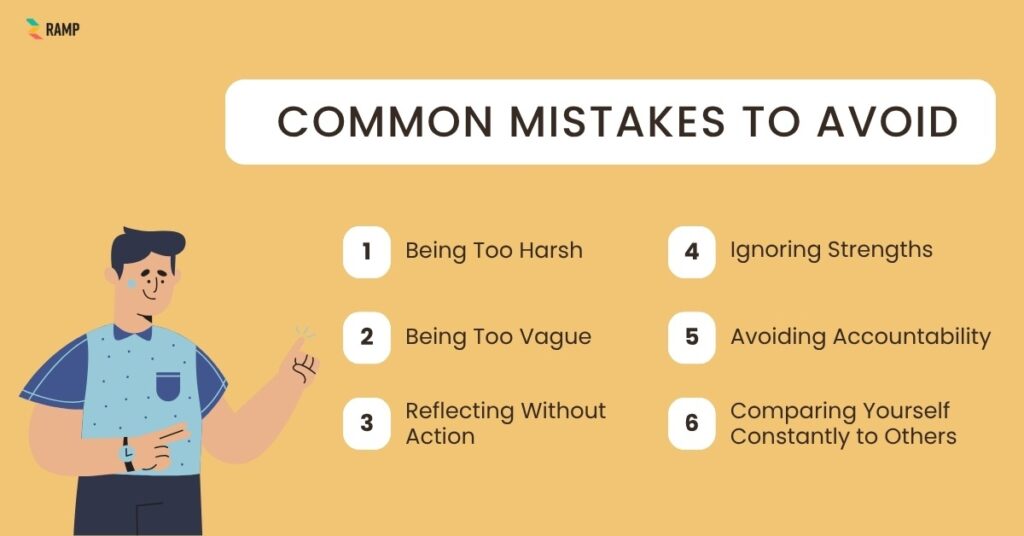
Common mistakes in the diagram include:
- Being Too Harsh: Constant self-criticism can damage confidence and reduce motivation.
- Ignoring Strengths: Focusing only on mistakes creates an unbalanced evaluation.
- Being Too Vague: General statements like "I need to improve" provide no clear direction.
- Avoiding Accountability: Blaming circumstances or other people prevents genuine growth.
- Reflecting Without Action: Self-feedback is ineffective if no improvements are applied afterward.
- Comparing Yourself Constantly to Others: The goal of self-assessment is personal growth, not competition.
Self-feedback or self-assessment is a valuable practice that helps individuals improve performance, increase self-awareness, and develop stronger professional habits. When done honestly and consistently, it creates a clearer understanding of strengths, weaknesses, and growth opportunities.
Using structured methods, such as the SBI framework, makes reflection more focused and productive. Effective self-feedback is balanced, specific, and action-oriented, allowing individuals to learn from experience and continuously improve over time.