
Goals are defined as performance targets that describe what an employee, team, or organization intends to achieve within a specific period. In performance management, goals function as directional commitments that connect daily work with broader business priorities. They clarify expectations, guide employee effort, support accountability, and provide measurable standards for evaluating progress, productivity, and outcomes across operational and strategic activities.
Research on Goal-Setting Theory in employee performance management shows that clear, challenging goals play a central role in improving employee performance. The article highlights that goal-setting helps direct employee attention, increase effort, support persistence, and connect individual work with organizational priorities. This underscores the importance of goals in performance management, as well-defined goals create clarity, accountability, motivation, and measurable standards for evaluating progress.
Characteristics of Effective Goals
Effective goals create clarity, focus, and measurable direction. A well-structured goal should define the expected outcome, the performance standard, and the completion period. Strong goals are realistic enough to be achievable while still demanding improvement and commitment from employees or teams.
The diagram below includes the characteristics of effective goals.
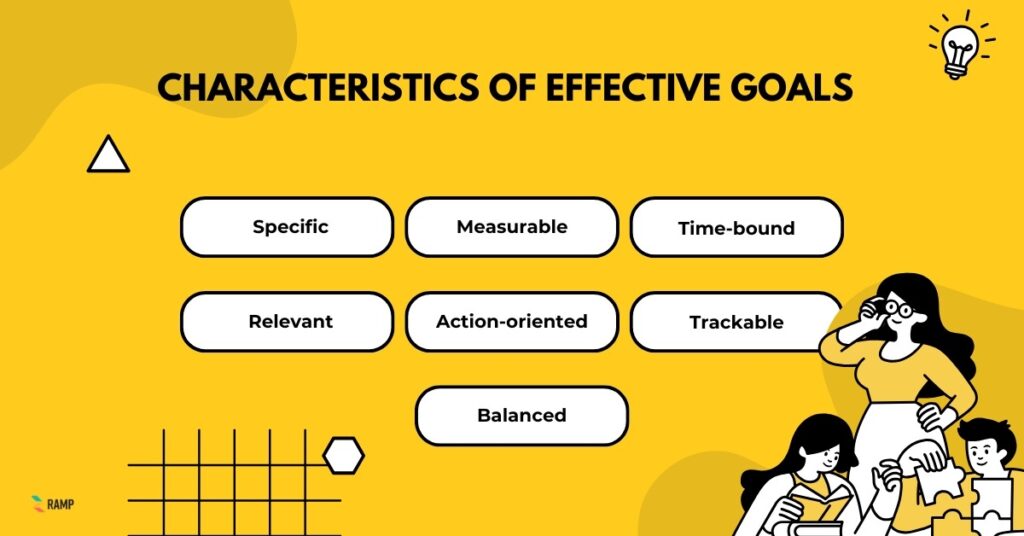
The details of the characteristics include:
- Specific: Clearly explains what must be achieved.
- Measurable: Includes quantifiable indicators such as percentage growth, response time, customer retention rate, or project completion status.
- Time-bound: Establishes a defined deadline or review period.
- Relevant: Supports departmental and organizational priorities.
- Action-oriented: Encourages execution rather than vague intention.
- Trackable: Allows managers and employees to monitor progress regularly.
- Balanced: Combines short-term operational targets with long-term development objectives.
For example, "Increase customer satisfaction score from 78% to 85% within six months" is more effective than "Improve customer service."
Types of Goals
Organizations use different goal categories depending on business priorities, employee roles, and performance expectations. The diagram below shows the types of goals.
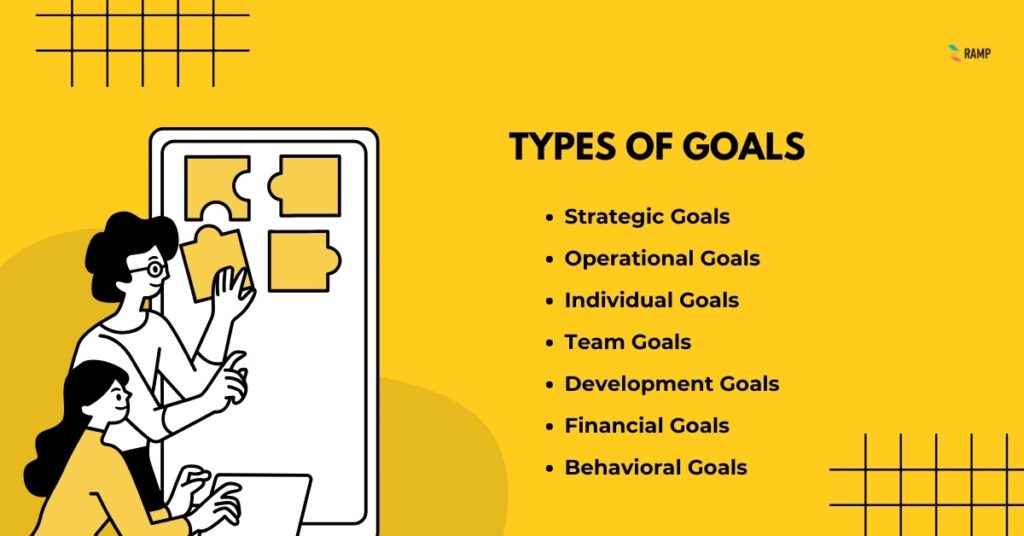
The details are given below.
- Strategic Goals: Long-term goals connected to organizational growth, market expansion, profitability, or innovation.
- Operational Goals: Short-term goals focused on daily efficiency, workflow improvement, and departmental execution.
- Individual Goals: Performance expectations assigned to a specific employee based on role responsibilities.
- Team Goals: Shared objectives requiring collaboration across a group or department.
- Development Goals: Goals designed to improve skills, leadership ability, technical expertise, or professional growth.
- Financial Goals: Targets related to revenue, profit margin, cost reduction, or budget performance.
- Behavioral Goals: Goals connected to workplace conduct, communication, leadership, adaptability, or teamwork.
Goals vs Objectives vs KPIs
Although these terms are closely related, they serve different functions in performance management.
| Element | Meaning | Purpose |
| Goals | Broad desired outcomes | Define what should be achieved |
| Objectives | Specific actions or milestones supporting goals | Explain how the goal will be achieved |
| KPIs (Key Performance Indicators) | Measurable performance metrics | Track whether progress is being made |
For example:
- Goal: Improve customer retention.
- Objective: Launch a customer follow-up program within three months.
- KPI: Customer retention rate measured as the percentage of retained customers over a 12-month period.
KPIs provide evidence of performance, while objectives organize execution steps that support the overall goal.
Popular Goal-Setting Frameworks
Organizations often use structured frameworks to improve goal quality and consistency. The diagram below shows the popular goal-setting frameworks.
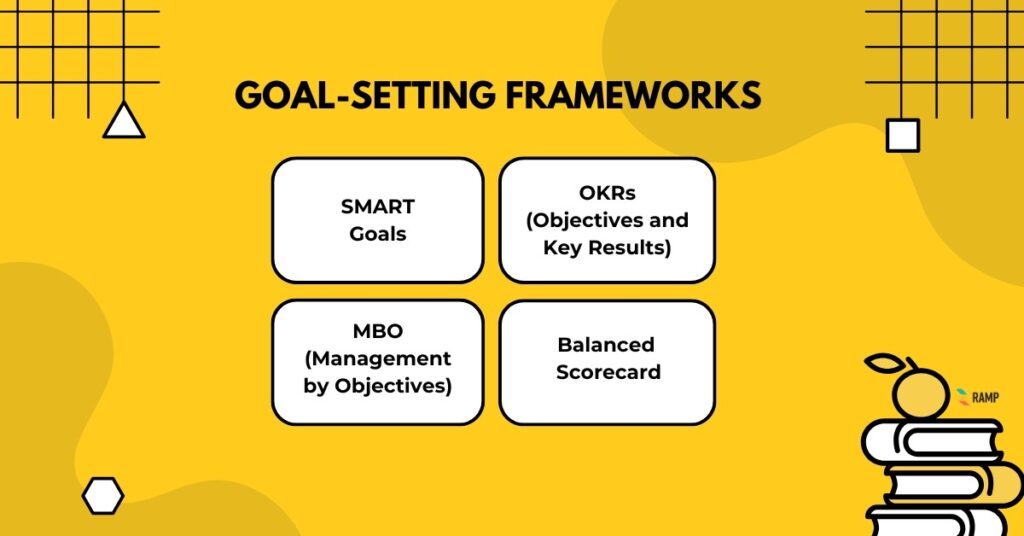
The details of the frameworks are given below.
SMART Goals
SMART stands for:
- Specific
- Measurable
- Achievable
- Relevant
- Time-bound
This framework improves clarity and accountability.
OKRs (Objectives and Key Results)
OKRs combine ambitious objectives with measurable key results.
- Objective: Defines the desired achievement.
- Key Results: Quantifiable outcomes used to evaluate success.
Example:
- Objective: Improve employee engagement.
- Key Result 1: Raise engagement survey score from 70% to 82% within one year.
- Key Result 2: Reduce voluntary turnover rate by 10% over 12 months.
Balanced Scorecard
This framework evaluates performance from multiple perspectives:
- Financial
- Customer
- Internal process
- Learning and growth
MBO (Management by Objectives)
Managers and employees jointly establish measurable goals and review performance against agreed expectations.
How Goals Drive Performance Management?
Goals provide the operational structure behind performance management systems. Without goals, organizations struggle to measure contribution, evaluate productivity, or align employee effort with business priorities.
Goals support performance management by:
- Clarifying employee expectations
- Improving accountability
- Guiding decision-making
- Prioritizing important work
- Increasing motivation and engagement
- Supporting fair performance evaluations
- Identifying performance gaps
- Encouraging continuous improvement
- Connecting employee contributions to organizational outcomes
Clear goals also improve manager-employee communication because progress discussions become evidence-based rather than opinion-based.
Common Goal-Setting Mistakes
Poorly designed goals reduce performance effectiveness and create confusion.
Common mistakes include:
- Setting vague or undefined goals
- Creating unrealistic expectations
- Using too many goals simultaneously
- Ignoring deadlines or review periods
- Failing to measure progress consistently
- Setting goals unrelated to business priorities
- Focusing only on short-term results
- Neglecting employee involvement during goal creation
- Using metrics without defining the measurement method
For example, saying "increase productivity" without defining the productivity metric, unit, or timeframe creates ambiguity and weakens accountability.
How to Measure Goal Achievement?
Goal achievement should be evaluated using clearly defined performance indicators, review periods, and measurable outcomes. The measurement methods are discussed in detail in the article on measuring goal achievement.
Measurement methods may include:
- Percentage growth
- Revenue generated
- Customer satisfaction scores
- Project completion rates
- Employee retention rates
- Quality improvement metrics
- Productivity ratios
- Error reduction percentages
- Training completion rates
Every metric should define:
- What is being measured
- The unit of measurement
- The evaluation timeframe
Example:
- "Reduce average customer response time to 4 hours per request within the next quarter."
In this example:
- Metric: Customer response time
- Unit: Hours per request
- Timeframe: One quarter
Regular progress reviews improve visibility and allow adjustments before performance problems become severe.
Goal Alignment
Goal alignment is the structured process of ensuring that individual, team, departmental, and organizational goals consistently support the organization's overall strategic direction.
Vertical Alignment
Vertical alignment connects goals across organizational levels.
- Executive leadership defines strategic priorities.
- Departments translate those priorities into operational targets.
- Managers assign role-specific performance goals to employees.
This ensures that individual work contributes directly to organizational success.
Example:
- Company goal: Increase market share by 15% within one year.
- Sales team goal: Increase regional sales conversions by 12% within 12 months.
- Individual goal: Generate 40 qualified leads per month for the next two quarters.
Horizontal Alignment
Horizontal alignment ensures that departments and teams work cooperatively rather than pursuing conflicting priorities.
It improves:
- Cross-functional collaboration
- Resource coordination
- Communication consistency
- Operational efficiency
For example, if the marketing department launches a campaign that increases demand, the operations and customer support teams must align their goals to handle higher order volume and service requests effectively.
Goals are foundational to performance management because they translate organizational priorities into measurable actions and expected outcomes. Effective goals improve focus, accountability, communication, and employee performance while helping organizations systematically monitor progress. When goals are clearly defined, measurable, aligned, and regularly reviewed, they foster stronger coordination among employees, departments, and the long-term business strategy.