
Leadership and team management refer to the combined process of guiding people toward shared goals while organizing and coordinating the work required to achieve them. Leadership focuses on vision, influence, motivation, and culture, while team management centers on structure, execution, accountability, and operational efficiency. Together, they help teams perform effectively, communicate clearly, and achieve sustainable success.
Leadership
Leadership is the ability to guide individuals or groups toward a common objective. A strong leader provides direction, inspires confidence, and helps people stay focused even in the face of uncertainty or change. Leadership is not only about authority; it is about influence, trust, and the ability to bring people together around a shared purpose.
Research on team management explains that organizational success depends on combining effective leadership with structured team management. The study emphasizes that leaders inspire, motivate, and build trust, while managers coordinate tasks, monitor performance, and ensure accountability. It also highlights that balancing vision with execution improves collaboration, communication, and overall team performance, helping organizations achieve sustainable long-term success.
Key Functions of Leadership
The functions of leadership are given below.
- Setting Direction: Leaders define where the team or organization is heading. They establish goals, priorities, and long-term objectives so everyone understands the bigger picture.
- Influencing People: Leadership involves influencing behavior, attitudes, and decisions. Effective leaders encourage commitment rather than forcing compliance.
- Creating Alignment: A leader ensures that team members work toward the same mission. Alignment reduces confusion and keeps efforts coordinated across departments and individuals.
- Motivating Teams: Strong leaders inspire people to perform at their best. They recognize strengths, encourage growth, and create an environment where employees feel valued.
- Shaping Vision, Trust, and Culture: Leadership heavily affects workplace culture. Leaders build trust through consistency, communication, fairness, and integrity. Their behavior often sets the tone for the entire team.
Characteristics of Effective Leaders
Successful leaders often demonstrate:
- Clear communication
- Emotional intelligence
- Confidence and accountability
- Decision-making ability
- Adaptability
- Empathy and active listening
- Strategic thinking
These qualities help leaders build strong relationships and maintain team confidence during both success and difficulty.
Team Management
Team management focuses on organizing people, resources, and tasks to achieve specific objectives efficiently. While leadership emphasizes inspiration and direction, management ensures that daily operations run smoothly.
A team manager creates systems, monitors progress, and ensures responsibilities are completed correctly and on time.
Key Functions of Team Management
The key functions of team management are:
- Organizing Work: Managers structure workflows, prioritize tasks, and create processes that improve efficiency and clarity.
- Setting Expectations: Clear expectations help employees understand performance standards, deadlines, and responsibilities.
- Assigning Responsibilities: Managers distribute work based on skills, experience, and team capacity. Proper delegation improves productivity and accountability.
- Monitoring Progress: Tracking performance allows managers to identify problems early, measure success, and maintain momentum.
- Providing Feedback: Regular feedback helps employees improve performance, correct mistakes, and continue developing professionally.
- Ensuring Coordination and Accountability: Managers keep team members connected and ensure everyone contributes to shared goals. Accountability helps maintain consistency and reliability.
The Difference Between Leadership and Team Management
Leadership and team management are closely connected, but they are not the same.
| Leadership | Team Management |
| Focuses on vision and influence | Focuses on execution and coordination |
| Inspires and motivates people | Organizes and supervises work |
| Builds culture and trust | Maintains systems and accountability |
| Encourages innovation and growth | Ensures efficiency and consistency |
| Guides long-term direction | Handles daily operations |
In many workplaces, effective professionals combine both skills. A manager who cannot lead may struggle to inspire people, while a leader without management skills may fail to deliver consistent results.
Different situations require different leadership and management approaches. Style affects communication, trust, execution speed, employee satisfaction, and overall team performance.
Leadership Styles
Leadership styles refer to the different approaches leaders use to guide, influence, communicate with, and motivate teams to achieve organizational goals effectively. The diagram below shows the leadership styles.
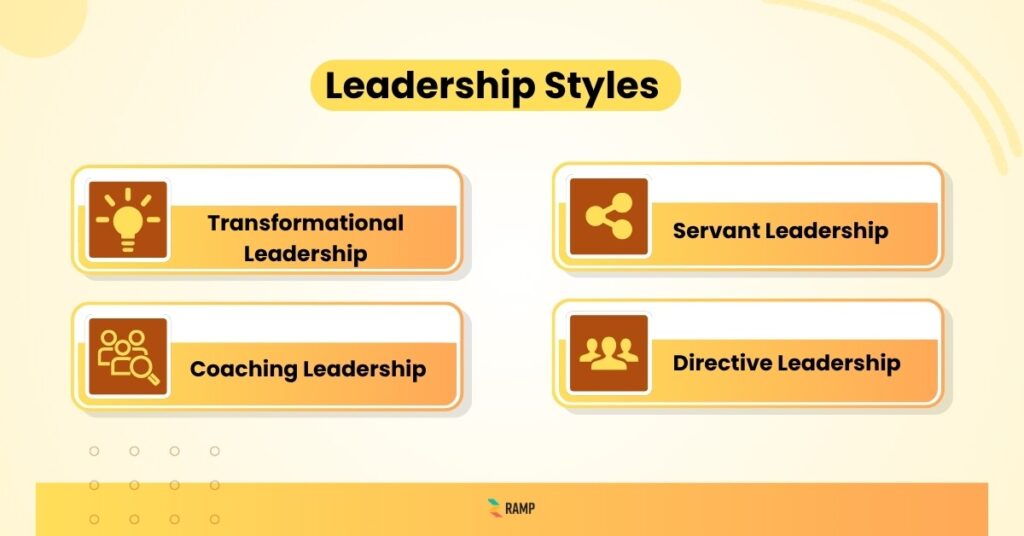
The leadership styles are explained in detail below.
Transformational Leadership
Transformational leaders inspire people through vision, innovation, and personal growth. They encourage employees to think creatively and contribute beyond basic job responsibilities.
Best for:
- Organizational change
- Innovation-focused teams
- Long-term growth environments
Servant Leadership
Servant leaders prioritize the needs and development of their team members. They focus on support, empathy, and collaboration.
Best for:
- People-centered cultures
- Employee development
- High-trust environments
Coaching Leadership
Coaching leaders focus on learning, feedback, and skill development. They guide employees through mentoring and continuous improvement.
Best for:
- Talent development
- Skill-building environments
- Long-term employee growth
Directive Leadership
Directive leaders provide clear instructions and closely guide decision-making. This approach emphasizes structure and control.
Best for:
- Crisis situations
- Inexperienced teams
- High-pressure environments
Team Management Styles
Management styles refer to the different methods managers use to organize work, supervise employees, make decisions, and ensure teams achieve goals efficiently and effectively. The diagram below shows the management styles.
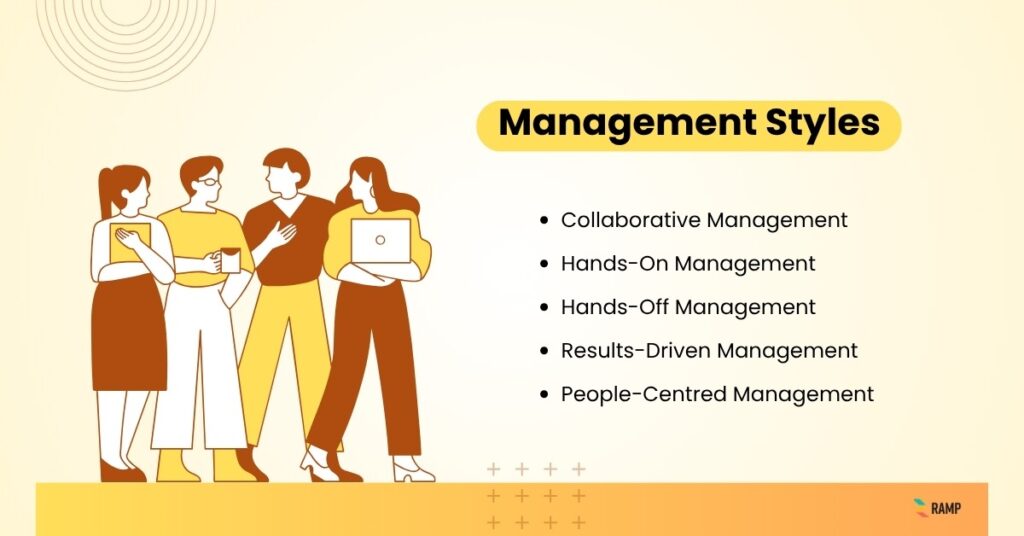
The management styles are discussed in detail below.
Collaborative Management
Collaborative managers involve team members in planning and decision-making. This style improves communication and strengthens teamwork.
Advantages:
- Encourages participation
- Improves trust
- Builds stronger team relationships
Hands-On Management
Hands-on managers closely supervise work and remain heavily involved in daily operations.
Useful when:
- Teams require guidance
- Processes are complex
- Quality control is critical
Hands-Off Management
Hands-off managers allow employees greater independence and decision-making freedom.
Useful when:
- Teams are experienced
- Creativity is important
- Employees work independently
Results-Driven Management
This approach focuses strongly on performance targets, efficiency, and measurable outcomes.
Strengths:
- Improves productivity
- Increases focus on goals
- Supports fast execution
People-Centered Management
People-centered managers prioritize employee well-being, communication, and long-term development.
Strengths:
- Builds loyalty
- Improves morale
- Strengthens workplace culture
The most effective managers usually balance performance expectations with employee support rather than relying on a single approach.
Leadership and team management are closely connected functions that help organizations achieve goals, maintain structure, and support employee performance. Leadership provides vision, influence, and motivation, while team management ensures coordination, accountability, and operational efficiency. When both are combined effectively, teams communicate better, collaborate more successfully, and perform at a higher level over the long term.
Leadership and Team Management: Manager vs. Leader Differences
A manager is responsible for maintaining operational efficiency by controlling processes, organizing tasks, monitoring performance, and ensuring that organizational objectives are completed on time. A leader, on the other hand, focuses on creating vision, influencing people, motivating teams, and guiding long-term organizational direction. While managers ensure that work is done correctly, leaders inspire people to achieve meaningful goals and continuous growth.
Differences between a Manager and a Leader
The chart below summarizes the key differences between managers and leaders.
| Aspect | Manager | Leader |
| Authority vs influence | Relies on formal authority and position within the organization. | Relies on influence, trust, and credibility. People follow because they feel inspired. |
| Task control vs vision creation | Focuses on controlling tasks, organizing workflows, and ensuring execution. | Focuses on creating vision, shaping the future, and providing team direction. |
| Process management vs people inspiration | Manages systems, processes, and procedures to maintain consistency and efficiency. | Inspires people, builds trust, encourages collaboration, and creates a positive culture. |
| Short-term execution vs long-term execution | Prioritizes short-term execution, daily targets, and immediate business needs. | Focuses on long-term direction, growth, innovation, and future opportunities. |
| Role-based power vs trust-based power | Uses role-based power that comes from hierarchy and job position. | Builds trust-based power through relationships, communication, and consistency. |
| Primary focus | Systems, structure, efficiency, performance management, and operational stability. | People, culture, motivation, adaptability, organizational leadership, and change. |
| Key responsibilities | Plan, organize, assign tasks, monitor performance, ensure accountability, and solve operational problems. | Set vision, influence people, motivate teams, encourage innovation, and drive long-term growth. |
| Main goal | Ensure work is done correctly, efficiently, and on time. | Inspire people to achieve meaningful goals and continuous improvement. |
| Impact on the team | Creates order, consistency, and discipline within the team. | Creates engagement, inspiration, and commitment within the team. |
In modern workplaces, leadership often becomes visible through coaching behaviors such as guidance, feedback, employee development, and support. This connection between leadership and people development naturally leads to the discussion of coaching versus managing in professional environments.