
Aligning Individual Goals with Company Strategy means connecting each employee's work, targets, and performance expectations to the organization's broader business objectives. This alignment ensures that daily activities directly contribute to strategic priorities, improving accountability, execution efficiency, employee engagement, and overall organizational performance across all levels of the business.
Strategy Translation Framework
For a strategy to succeed, organizations must convert high-level business direction into measurable actions across departments, teams, and individuals. This process creates a structured alignment system where every employee understands how their responsibilities support company-wide objectives.
1. Corporate Vision
The corporate vision defines the organization's long-term purpose and future direction.
Example:
- Become the leading digital banking platform in Southeast Asia within five years.
The vision provides strategic direction but is not operational on its own.
2. Strategic Objectives
Strategic objectives translate vision into measurable business priorities.
Examples:
- Increase market share
- Improve customer retention
- Accelerate product innovation
- Expand regional operations
These objectives guide organizational decision-making.
3. Department-Level Goals
Each department converts strategic objectives into functional targets.
Examples:
- Marketing increases brand awareness
- Sales improve conversion rates
- HR strengthens employee retention
- Operations reduce delivery time
Departments focus on outcomes directly connected to business strategy.
4. Team-Level Goals
Teams create operational goals aligned with departmental priorities.
Example:
- The customer support team reduces average response time from 18 hours to 4 hours by Q3.
Metric Definition: Response time measures the average time between a customer's inquiry submission and the first support response.
5. Individual KPIs
Employees receive measurable performance indicators tied to team goals.
Example:
- Resolve at least 95 customer tickets per week during Q3.
This cascading structure ensures strategic consistency throughout the organization.
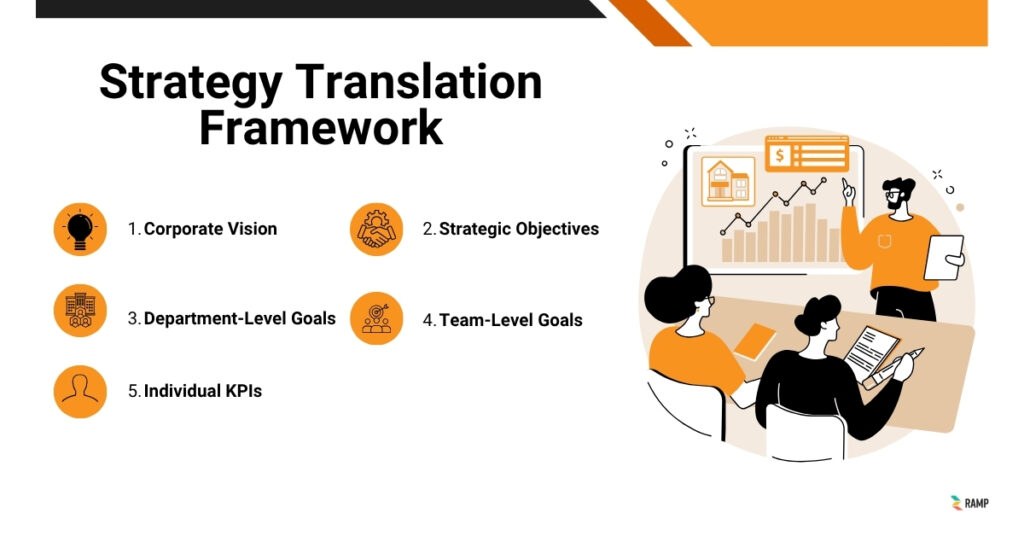
The diagram below explains the strategy translation framework, showing how organizations convert high-level business vision into measurable department goals, team objectives, and individual KPIs to ensure company-wide alignment and execution.
Research on aligning team goals with organizational business objectives explains that stronger performance occurs when team activities directly support the company’s strategy and vision. The article emphasizes clear goal communication, employee feedback, collaborative goal-setting frameworks, and recognition of team achievements. It also shows that alignment creates shared purpose, strengthens teamwork, and helps organizations improve productivity and achieve long-term growth.
Leadership & Manager Responsibilities
Leadership communication is one of the strongest drivers of strategic alignment.
Managers Must Translate Strategy Clearly
Employees need practical explanations of:
- Business priorities
- Department expectations
- Performance objectives
A complex strategy without operational clarity creates confusion.
Conduct Regular 1:1 Alignment Conversations
Managers should frequently discuss:
- Progress
- Priorities
- Obstacles
- Resource needs
Regular communication strengthens accountability.
Adjust Goals During Strategic Pivots
Business priorities can change because of:
- Market conditions
- Economic shifts
- Product changes
- Competitive pressure
Managers must adjust goals accordingly.
Remove Execution Barriers
Leaders should actively resolve:
- Resource constraints
- Workflow inefficiencies
- Communication gaps
- Dependency conflicts
Alignment fails when employees lack operational support.
Communication Systems
Strong communication systems improve strategic clarity across the organization.
Town Halls
Leadership shares:
- Business updates
- Strategic priorities
- Performance progress
- Organizational direction
Strategy Briefings
Departments receive detailed explanations of:
- Strategic goals
- Operational expectations
- Performance priorities
Transparent Goal Dashboards
Shared dashboards improve visibility across teams and departments.
Written Documentation
Clear documentation helps employees understand:
- Objectives
- KPIs
- Responsibilities
- Review processes
Feedback Channels
Organizations should encourage upward and cross-functional feedback.
Strategic clarity improves employee confidence and engagement.
Common Alignment Mistakes
- Vague Strategic Objectives: Unclear strategy creates confusion throughout the organization.
- Too Many Priorities: Excessive goals reduce focus and execution quality.
- Misaligned KPIs: Teams may optimize metrics that do not support strategic outcomes.
- Lack of Communication: Poor communication weakens organizational coordination.
- No Tracking System: Without measurable tracking, alignment becomes subjective and inconsistent.
- Strategy Shifts Without Goal Updates: When business priorities change but employee goals remain unchanged, alignment breaks down quickly.
Organizational Benefits
Effective alignment creates measurable business advantages.
- Increased Productivity: Employees focus on high-impact priorities instead of disconnected activities.
- Reduced Wasted Effort: Clear direction minimizes duplicated work and conflicting priorities.
- Higher Engagement: Employees become more motivated when they understand the importance of their contributions.
- Faster Execution: Alignment improves coordination and decision-making speed.
- Better Performance Reviews: Measurable goals improve fairness and evaluation accuracy.
- Improved Accountability: Defined ownership increases responsibility and execution consistency.
Step-by-Step Implementation Framework
The step-by-step implementation framework is given below.
1. Define Strategic Objectives: Leadership establishes clear business priorities.
2. Break Down Into Departmental Targets: Departments convert strategy into operational goals.
3. Convert Into Measurable Team Goals: Teams create actionable, measurable objectives.
4. Assign Individual KPIs: Employees receive role-specific performance indicators aligned with team priorities.
5. Establish Tracking Systems: Organizations implement:
- Dashboards
- Reporting systems
- Review cadences
- Progress metrics
6. Conduct Regular Alignment Reviews: Managers evaluate:
- Progress
- KPI movement
- Strategic consistency
- Execution risks
7. Adjust Goals as Strategy Evolves: Goals should adapt when organizational priorities change.