
Remote performance management is a structured approach to managing employee performance when people work from home, different offices, or multiple locations. It combines clear goals, digital tools, regular feedback, measurable outcomes, and a culture of trust to ensure employees stay productive, engaged, and aligned with business priorities.
In hybrid environments, it also helps managers compare performance fairly between remote and in-office employees. The goal is not to monitor every action, but to understand whether employees are delivering meaningful results.
An academic research paper, "Hybrid Work Is Here to Stay. Here Are 7 Ways to Manage Your Workforce", by Kara Baskin of MIT Management Sloan School, offers seven pieces of advice for leading teams that are partially or fully remote. She also advised looking at the outcomes, not just the output.
Core Attributes of Remote Performance Management
Remote performance management has four core attributes as illustrated in the diagram.
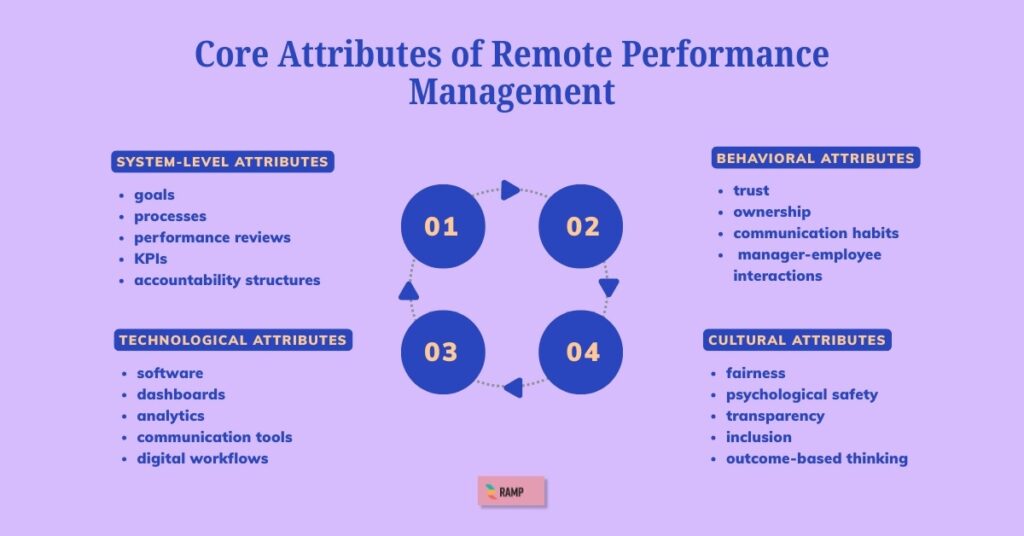
The attributes include System-level, Behavioral, Technological, and Cultural. Together, these attributes create a performance system that works even when employees are not physically visible.
System-level Attributes
1. Goal Alignment in Remote Teams
Goal alignment is essential because remote teams can easily become disconnected from company priorities. Managers must translate organizational goals into team-level and individual responsibilities.
Effective goal alignment includes:
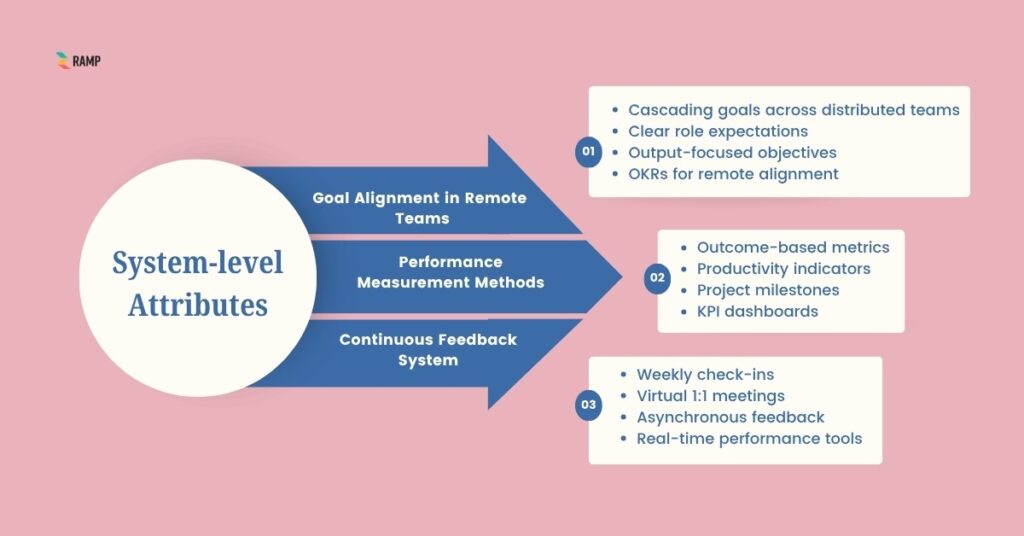
- Cascading goals across distributed teams: Company objectives should flow down to departments, teams, and individual employees.
- Clear role expectations: Every employee should understand what they own, what decisions they can make, and how their work supports the business.
- Output-focused objectives: Goals should focus on completed work, quality, customer impact, revenue contribution, or operational improvement.
- OKRs for remote alignment: Objectives and Key Results help remote teams connect daily work to larger business priorities.
For example, instead of saying, "Be available during working hours," a remote-ready goal would say, "Deliver the Q2 customer onboarding report by May 15 with recommendations based on support data."
2. Performance Measurement Methods
It is vital to understand how to measure employee performance. Managers should measure remote performance by outcomes rather than online presence. Activity tracking can show work patterns, but it should not replace meaningful performance evaluation.
Key measurement methods include:
- Outcome-based metrics: Results such as completed projects, resolved tickets, sales closed, customer satisfaction, or quality scores.
- Productivity indicators: Work completed within a defined timeframe, such as tasks closed per week or projects delivered per quarter.
- Project milestones: Progress checkpoints that show whether work is moving on schedule.
- KPI dashboards: Visual tools that track performance against agreed business indicators.
A strong system balances quantitative data with qualitative judgment. For example, managers may evaluate a customer support employee based on response time, resolution quality, customer feedback, and team collaboration.
3. Continuous Feedback System
Remote employees need frequent feedback because they do not receive the same informal signals that happen naturally in offices. Without regular feedback, small issues can grow into performance problems.
A continuous feedback system includes:
- Weekly check-ins: Short conversations focused on priorities, blockers, and progress.
- Virtual 1:1 meetings: Deeper discussions about performance, development, workload, and engagement.
- Asynchronous feedback: Written feedback through project tools, documents, chat platforms, or performance systems.
- Real-time performance tools: Platforms that allow managers and employees to track goals, comments, recognition, and progress continuously.
The diagram summarizes the System-level Attributes.
Feedback should be timely, specific, and tied to expectations. Remote feedback works best when managers document important points to reduce confusion later.
Technology Attributes: Digital Infrastructure
Remote performance management relies heavily on tools because teams manage work, communication, and performance data across digital systems.
The important technology components are included in the following diagram.
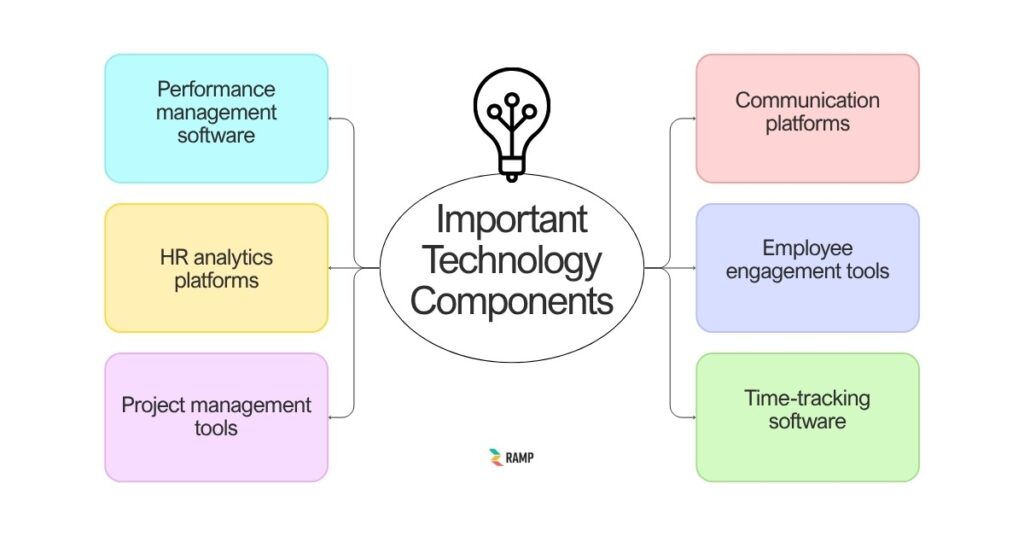
The technology components are explained in detail below.
- Performance management software: Performance management software is used for goal setting, reviews, feedback, development plans, and performance history.
- HR analytics platforms: Help HR and leadership identify performance trends, engagement patterns, turnover risks, and workforce gaps.
- Project management tools: Task tracking systems help teams assign work, monitor deadlines, manage dependencies, and review progress.
- Communication platforms: Chat, video, and collaboration tools support meetings, updates, decisions, and team communication.
- Employee engagement tools: Pulse surveys and feedback tools help measure morale, belonging, workload, and satisfaction.
- Time-tracking software: useful for billing, compliance, workload analysis, and capacity planning, but should be used carefully.
Advanced systems may also include:
- AI-driven performance analytics: Tools that identify patterns in productivity, engagement, goal progress, or performance risk.
- Dashboard reporting: Centralized views of KPIs, project status, team progress, and employee performance indicators.
- Data transparency: Employees should understand what data is collected, how it is used, and how it affects performance decisions.
However, technology can create risks if used poorly. Excessive monitoring can damage trust, create anxiety, and encourage employees to appear busy rather than do meaningful work.
Major risks include:
- Over-surveillance: Tracking clicks, screenshots, keystrokes, or online status too aggressively.
- Privacy concerns: Collecting personal or sensitive data without clear boundaries.
- Employee trust impact: Employees may feel controlled instead of supported.
- False performance signals: Digital activity does not always equal productivity or quality.
The best remote performance systems use technology to support clarity and fairness, not to create a culture of surveillance.
Behavioral and Cultural Attributes
Remote environments amplify management weaknesses. Poor communication, unclear expectations, weak trust, and inconsistent feedback become more visible when teams are distributed. The diagram below shows the behavioral and cultural attributes.
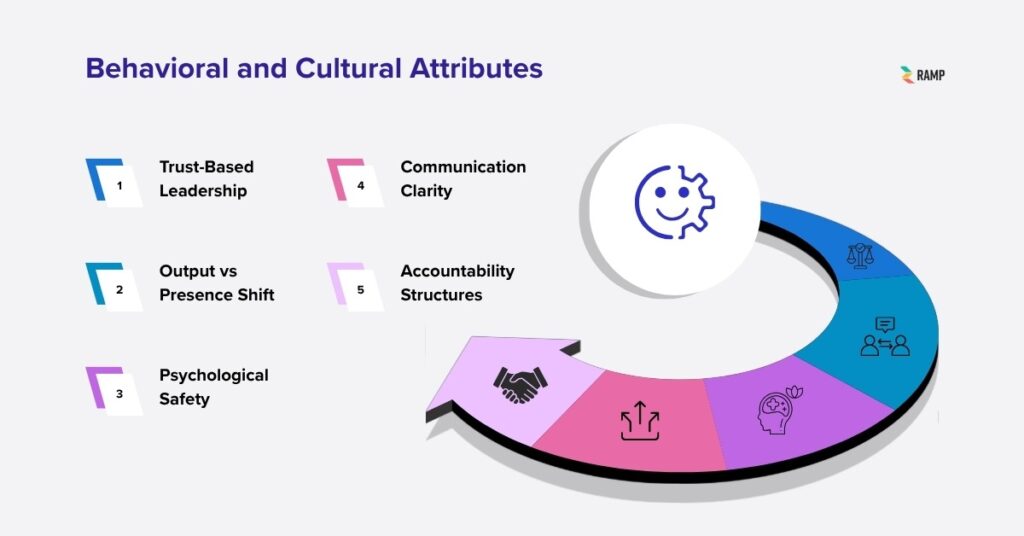
The behavioral and cultural attributes are explained in detail below.
1. Trust-Based Leadership
Remote performance relies on trust, not visibility. Managers should trust employees to manage their work while still holding them accountable for results. Trust-based leadership does not mean a lack of control; it means clear expectations, regular follow-up, and respect for autonomy.
2. Output vs Presence Shift
Remote work requires a shift from measuring presence to measuring results. Employees should not be judged mainly by how many hours they appear online. Performance should be evaluated by deliverables, quality, deadlines, collaboration, and business impact.
3. Psychological Safety
Psychological safety means employees feel safe speaking honestly, asking questions, admitting mistakes, and sharing concerns. In remote teams, this is especially important because misunderstandings can easily happen through written communication.
Managers can support psychological safety by encouraging questions, responding calmly to problems, and creating space for quieter employees to contribute.
4. Communication Clarity
Remote teams need clear documentation and written expectations. Important decisions, deadlines, responsibilities, and feedback should not exist only in scattered chats or verbal conversations.
Good communication clarity includes:
- Written goals
- Documented decisions
- Clear deadlines
- Defined ownership
- Meeting summaries
- Accessible project updates
5. Accountability Structures
Accountability in remote teams depends on clear deliverables and deadlines. Employees should know what they are responsible for, when it is due, and how success will be measured.
Strong accountability structures reduce confusion and prevent managers from relying on micromanagement.
Managerial Challenges
Remote and hybrid performance management poses several challenges for managers, as shown in the diagram below.
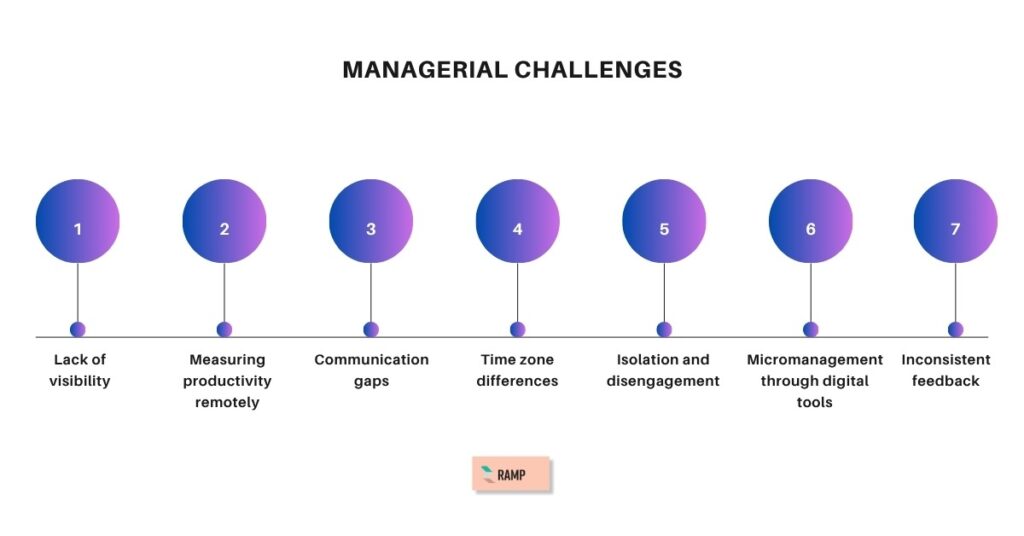
Common problems include:
- Lack of visibility: Managers may feel unsure about what employees are doing.
- Measuring productivity remotely: It can be difficult to separate real output from visible activity.
- Communication gaps: Missing context, unclear messages, or delayed responses can slow work.
- Time zone differences: Distributed teams may struggle with meeting schedules and response times.
- Isolation and disengagement: Employees may feel disconnected from the team or company culture.
- Micromanagement through digital tools: Managers may overuse tracking software to compensate for a lack of physical visibility.
- Inconsistent feedback: Some employees may receive regular coaching while others are overlooked.
These challenges usually come from weak systems, not from remote work itself. Thus, it's important to know the proper implementation of the manager's role in performance management. When goals, communication, and accountability are clear, remote performance becomes easier to manage.
Remote-Specific Performance Risks
Remote and hybrid work introduces performance risks that are less common or less visible in traditional office environments.
The diagram shows all the possible key remote-specific performance risks.
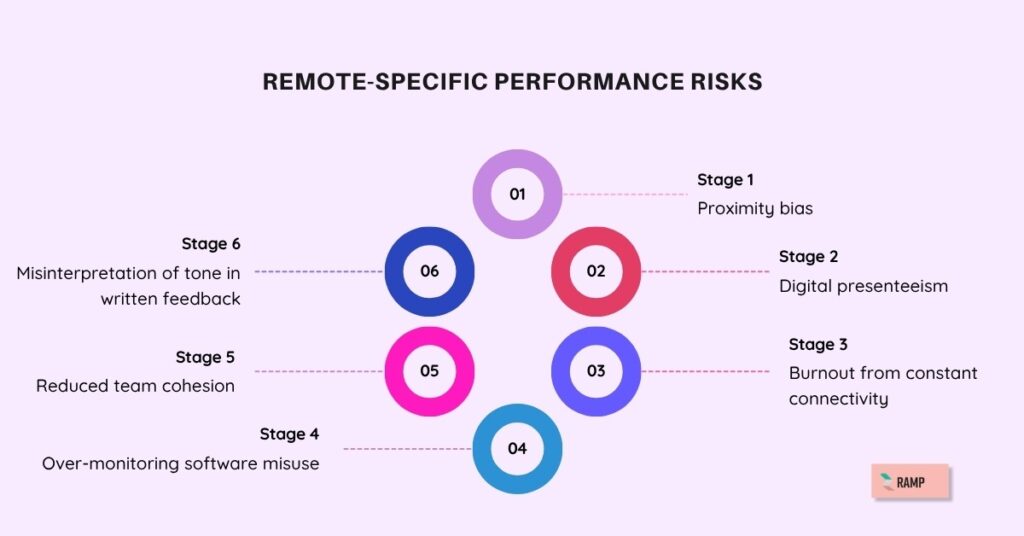
The details of the key risks include:
- Proximity bias: Managers may favor employees they see in person more often.
- Digital presenteeism: Employees may stay online longer to appear productive.
- Burnout from constant connectivity: Remote employees may struggle to disconnect from work.
- Over-monitoring software misuse: Surveillance tools may create fear and reduce trust.
- Reduced team cohesion: Employees may feel less connected to coworkers and the company culture.
- Misinterpretation of tone in written feedback: Messages can sound harsher or colder than intended.
To reduce these risks, organizations should train managers, standardize review processes, document performance criteria, and create equal opportunities for remote and in-office employees. Thus, they can ensure a healthy remote work culture.
Process Lifecycle of Remote Performance Management
Remote performance management should follow a structured lifecycle. The diagram shows the following structured lifecycle.
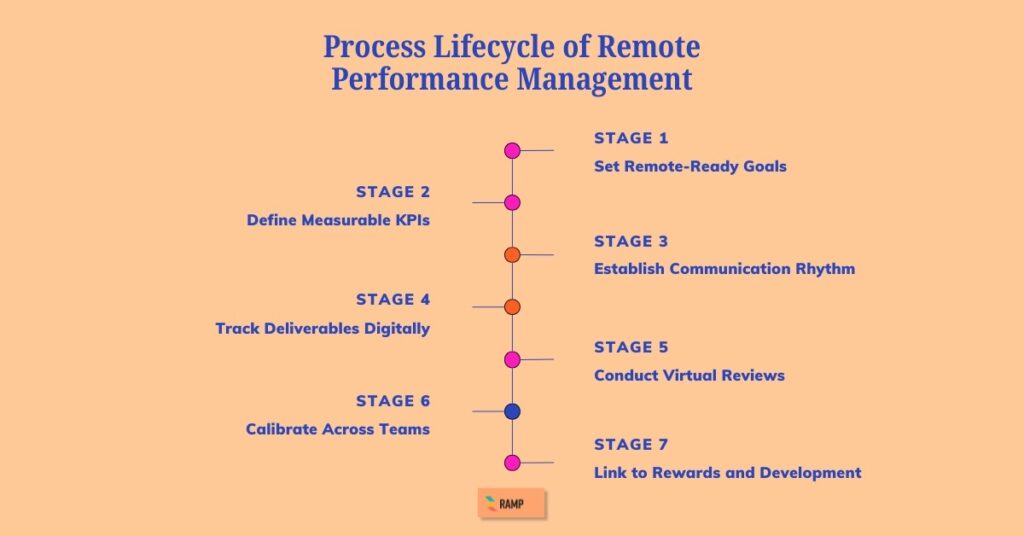
The lifecycle of remote performance management is explained in detail below.
1. Set Remote-Ready Goals
Goals should be specific, measurable, and realistic for remote work. They should focus on outcomes rather than activity.
2. Define Measurable KPIs
Managers should define the key performance indicators to evaluate success. A KPI is a measurable performance indicator, such as customer satisfaction score per quarter, project completion rate per month, or sales revenue per quarter.
3. Establish Communication Rhythm
Teams should agree on how often they meet, which channels they use, and how quickly people are expected to respond. This may include weekly team meetings, biweekly 1:1s, daily async updates, or monthly performance reviews.
4. Track Deliverables Digitally
Work should be visible through project management tools, shared documents, dashboards, or task boards. This creates transparency without requiring constant check-ins.
5. Conduct Virtual Reviews
Performance reviews should be structured, evidence-based, and supported by documented goals, feedback, and results. Virtual reviews should allow enough time for discussion, reflection, and development planning.
6. Calibrate Across Teams
Managers should compare performance standards across teams to reduce bias. Calibration helps ensure that remote, hybrid, and in-office employees are evaluated fairly.
7. Link to Rewards and Development
Performance results should connect to promotions, compensation, recognition, training, coaching, and career development. Remote employees should have the same access to growth opportunities as in-office employees.
Differences from Traditional Performance Management
Remote performance management differs from traditional performance management because it depends less on physical observation and more on structured goals, digital communication, and measurable outcomes.
The chart below shows the differences between Traditional Performance Management and Remote Performance Management.
| Traditional Performance Management | Remote Performance Management |
| Observation-based | Output-based |
| Physical presence | Digital visibility |
| In-person feedback | Virtual feedback |
| Informal check-ins | Scheduled digital touchpoints |
| Manager sees daily behavior directly | Manager reviews deliverables, updates, and results |
| Office interactions support alignment | Documentation and tools support alignment |
| Feedback may happen casually | Feedback must be intentionally scheduled or documented |
The biggest difference is that remote performance management requires managers to be more deliberate. Expectations, feedback, and accountability cannot depend on hallway conversations or physical presence.
Outcomes and Business Impact
Remote performance management matters because it helps organizations maintain productivity, fairness, and employee engagement across distributed teams.
Key business impacts include:
- Higher productivity: Employees can focus on meaningful outputs when goals and priorities are clear.
- Improved engagement: Regular feedback and communication help employees feel connected and supported.
- Talent retention: Flexible work supported by fair performance systems can reduce employee turnover.
- Global workforce expansion: Companies can hire talent from different locations without weakening performance control.
- Reduced bias if managed correctly: Clear metrics, documented feedback, and calibration can reduce proximity bias.
- Cost efficiency: Remote and hybrid models can reduce office-related costs while maintaining business performance.
- Better management discipline: Managers must define expectations, communicate clearly, and evaluate results more objectively.
Remote performance management is not simply traditional performance management moved online. It is a more intentional system built around outcomes, trust, technology, communication, and fairness. When managed well, it helps organizations create productive, accountable, and engaged remote or hybrid teams.