

Employee engagement surveys are structured systems for collecting employee feedback that measure how employees feel about their work, leadership, workplace environment, and overall organizational experience. These surveys help organizations evaluate employee commitment, motivation, trust, communication quality, satisfaction with management, and connection to organizational goals.
Companies use employee engagement surveys to better understand workforce sentiment and identify factors that influence performance, retention, collaboration, and employee well-being. Unlike simple questionnaires, engagement surveys are designed as systematic listening tools that collect measurable data to support organizational decision-making, workforce planning, leadership development, and culture improvement.
Employee engagement surveys also strengthen employee listening practices by providing a formal channel for employees to share feedback, opinions, concerns, and workplace experiences. When organizations analyze and act on survey feedback effectively, surveys become an important part of strategic workforce management rather than only an HR activity.
Why Employee Engagement Surveys Matter?
Employee engagement surveys matter because they help organizations understand employee experiences at scale and make informed decisions based on workforce data rather than assumptions. Engagement data allows companies to identify workplace strengths, detect risks early, and improve organizational effectiveness.
Surveys help organizations:
- Understand employee sentiment and workplace morale
- Identify key engagement drivers and workplace challenges
- Detect problems early before they affect retention or performance
- Improve employee retention and reduce turnover risks
- Strengthen manager effectiveness through targeted feedback
- Build trust when leaders respond visibly to employee concerns
- Align people strategy with employee needs and expectations
- Improve collaboration, culture, communication, and organizational performance
When used effectively, employee engagement surveys function as strategic decision-making tools that guide leadership actions, workforce planning, and organizational improvement initiatives.
Research on employee engagement and performance explains that employee engagement is closely connected to organizational performance because engaged employees are emotionally attached to their organization, highly involved in their work, and willing to contribute beyond minimum expectations. The article highlights engagement as a stronger indicator of positive workplace outcomes than job satisfaction alone. This supports the value of employee engagement surveys, as they help organizations measure commitment, motivation, trust, communication, and other factors that influence performance.
What Employee Engagement Surveys Measure?
Employee engagement surveys commonly measure multiple dimensions of the employee experience to provide a comprehensive understanding of engagement levels across the organization.
- Commitment to the Organization: Measures employee loyalty, organizational attachment, and long-term willingness to contribute.
- Trust in Leadership: Evaluates employee confidence in leadership communication, transparency, decision-making, and organizational direction.
- Manager Support: Measures how effectively managers provide guidance, communication, feedback, coaching, and support.
- Recognition: Assesses whether employees feel appreciated, acknowledged, and rewarded for contributions and achievements.
- Career Growth Opportunities: Measures employee perceptions regarding advancement opportunities, development support, and long-term career potential.
- Workload and Well-Being: Evaluates workload balance, stress levels, burnout risk, and employee well-being support.
- Communication Clarity: Measures how clearly employees understand organizational goals, priorities, changes, and expectations.
- Team Collaboration: Assesses teamwork quality, cooperation, communication effectiveness, and cross-functional collaboration.
- Inclusion and Belonging: Measures whether employees feel respected, included, psychologically safe, and valued within the workplace.
- Purpose and Meaning in Work: Evaluates whether employees feel their work is meaningful and connected to organizational impact.
- Feedback Quality: Measures the effectiveness, frequency, and usefulness of workplace feedback conversations.
- Autonomy: Assesses employee independence, decision-making authority, and sense of ownership over work responsibilities.
- Intent to Stay: Measures the likelihood that employees plan to remain with the organization over time.
Types of Employee Engagement Survey Questions
The illustration below presents the major types of employee engagement survey questions organizations use to measure employee sentiment, workplace experience, leadership effectiveness, and overall engagement across different areas of the organization.
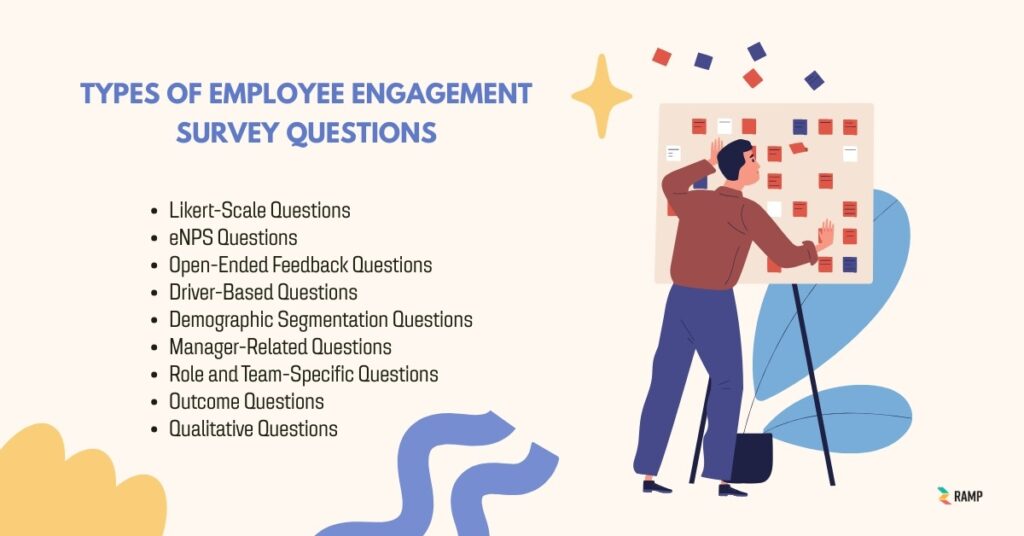
The types of employee engagement survey questions are explained in detail below.
Likert-Scale Questions
These questions ask employees to rate their agreement or satisfaction on scales such as 1–5 or 1–10.
Example:
- "I feel valued at work."
- "I trust organizational leadership."
eNPS Questions
Employee Net Promoter Score questions measure employee willingness to recommend the organization as a workplace.
Example:
- "How likely are you to recommend this company as a place to work?"
Open-Ended Feedback Questions
These questions allow employees to provide detailed written feedback in their own words.
Example:
- "What is one thing the organization could improve?"
Driver-Based Questions
Driver questions measure specific engagement factors such as recognition, communication, leadership, growth, or workload.
Demographic Segmentation Questions
These questions help organizations analyze engagement data by department, tenure, role level, location, or other workforce segments.
Manager-Related Questions
Manager-focused questions evaluate leadership support, communication quality, coaching effectiveness, and trust.
Role and Team-Specific Questions
These questions target issues unique to certain teams, functions, or employee groups.
Outcome Questions vs Driver Questions vs Qualitative Questions
- Outcome Questions: Measure overall engagement outcomes such as loyalty, motivation, or intent to stay.
- Driver Questions: Measure workplace factors that influence engagement.
- Qualitative Questions: Collect open-ended employee feedback and detailed insights.
Survey Design Best Practices
Effective employee engagement surveys require careful design to ensure accurate, actionable, and trustworthy feedback.
- Define Clear Survey Goals: Organizations should identify what they want to learn before creating survey questions.
- Choose the Right Survey Length: Surveys should be comprehensive enough to gather insights without causing survey fatigue.
- Write Unbiased Questions: Questions should remain neutral, clear, and easy to understand to avoid influencing responses.
- Measure Key Engagement Drivers: Surveys should focus on factors that directly influence engagement and organizational performance.
- Protect Anonymity Where Appropriate: Confidentiality encourages honest responses and improves trust in the survey process.
- Align Questions with Business Priorities: Survey topics should connect to organizational goals, workforce strategy, and operational challenges.
- Avoid Survey Overload: Excessive surveying can reduce participation rates and employee trust.
- Tailor Questions to Workforce Context: Survey design should reflect organizational structure, workforce demographics, remote work conditions, and industry-specific realities.
Survey Frequency and Cadence
Organizations use different survey schedules depending on business needs, workforce size, and engagement strategy. This visual highlights the different survey frequency and cadence models organizations use to gather continuous employee feedback, monitor engagement trends, and respond effectively to workforce needs throughout the employee lifecycle.
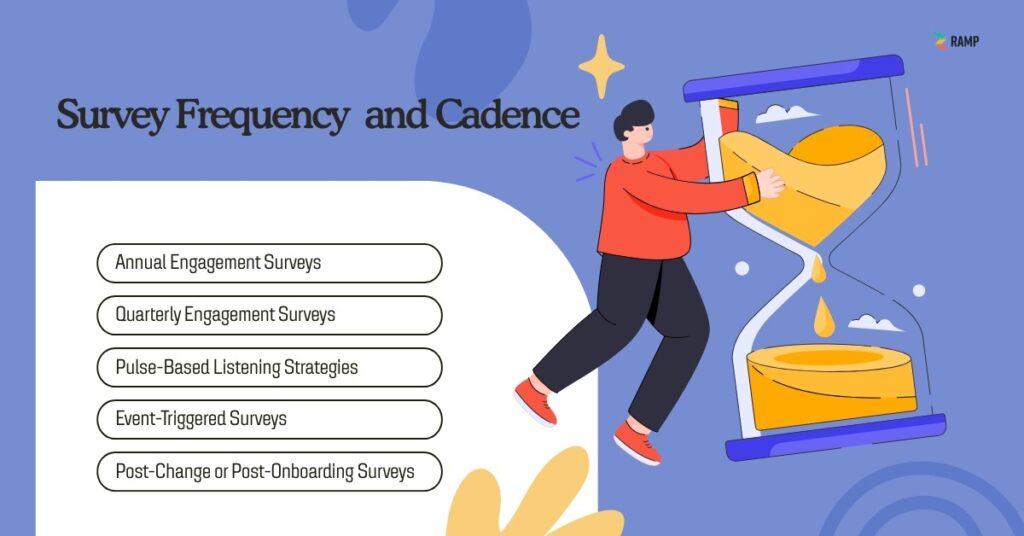
The details are given below.
- Annual Engagement Surveys: Comprehensive organization-wide surveys conducted once per year.
- Quarterly Engagement Surveys: Shorter recurring surveys are used to monitor trends and organizational changes more frequently.
- Pulse-Based Listening Strategies: Frequent, lightweight surveys used to gather real-time employee feedback.
- Event-Triggered Surveys: Surveys triggered after significant events such as restructuring, leadership changes, or policy updates.
- Post-Change or Post-Onboarding Surveys: Used to evaluate employee experiences after onboarding, training, or organizational transitions.
How Survey Data Should Be Analyzed?
Employee engagement data should be analyzed across multiple organizational dimensions to identify patterns, strengths, and risks.
Organizations commonly analyze results by:
- Team
- Department
- Role level
- Manager
- Tenure
- Location
- Demographic groups
- Trend over time
Driver Analysis: Identifies which workplace factors have the strongest impact on engagement outcomes.
Sentiment Interpretation: Analyzes employee attitudes, emotional tone, and feedback patterns.
Comparing Scores Against Previous Cycles: Helps organizations evaluate progress, decline, or consistency over time.
Identifying Root Causes: Organizations should investigate the underlying causes of low scores rather than focusing solely on numerical results.
Connecting Survey Results to Action Planning
Employee engagement surveys only create value when organizations take visible action after collecting feedback.
Effective follow-up includes:
- Sharing results transparently
- Identifying priority improvement areas
- Creating measurable action plans
- Involving managers in follow-up discussions
- Communicating what changes will occur
- Monitoring progress continuously over time
Employees are more likely to trust the survey process when they see meaningful organizational responses to feedback.
The Role of HR, Managers, and Leadership
HR / People Operations
HR teams typically:
- Design and manage the survey process
- Analyze engagement data
- Support managers and leaders
- Connect findings to workforce strategy and organizational priorities
Managers
Managers are responsible for:
- Reviewing team-level insights
- Holding follow-up conversations
- Creating local action plans
- Improving day-to-day engagement drivers
Leadership
Senior leadership should:
- Reinforce trust in the survey process
- Communicate the survey purpose clearly
- Act on organization-wide themes
- Support accountability and organizational improvement efforts
Tools and Technology for Engagement Surveys
Organizations use various technologies to manage employee listening and engagement analysis. The diagram below outlines the key tools and technologies organizations use to design, distribute, analyze, and manage employee engagement surveys to improve workforce feedback and decision-making.
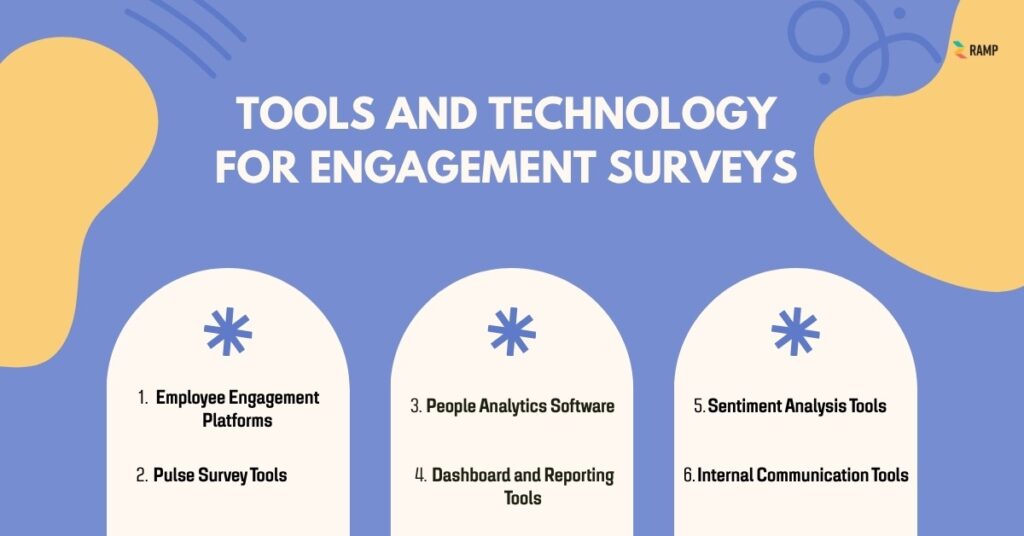
The details are given below.
- Employee Engagement Platforms: Centralized systems for surveys, analytics, reporting, and action planning.
- Pulse Survey Tools: Tools designed for short, frequent feedback collection.
- People Analytics Software: Platforms that analyze workforce trends, engagement drivers, turnover risks, and organizational patterns.
- Dashboard and Reporting Tools: Visualization systems that help leaders monitor engagement metrics and trends.
- Sentiment Analysis Tools: Technology that analyzes employee comments and written feedback using natural language processing.
- Internal Communication Tools: Platforms that support survey communication, updates, announcements, and feedback transparency.
Common Mistakes and Risks
Organizations can weaken engagement efforts when surveys are poorly managed or disconnected from action.
Common mistakes include:
- Surveying employees without taking action afterward
- Asking too many questions
- Using vague or biased wording
- Failing to protect anonymity
- Weak leadership support
- Poor manager follow-up
- Over-surveying employees
- Focusing only on scores instead of root causes
- Failing to communicate survey findings transparently
Employee Engagement Surveys in Remote and Hybrid Work
Remote and hybrid work environments create additional challenges for measuring engagement.
Organizations must consider:
- Engagement Measurement in Distributed Teams: Remote employees may experience different engagement patterns than in-office teams.
- Isolation and Belonging Signals: Surveys should measure connection, inclusion, and workplace belonging among remote employees.
- Remote Manager Communication: Manager accessibility and communication quality are critical engagement factors in distributed teams.
- Async Feedback Collection: Remote organizations often rely on asynchronous digital feedback systems to gather employee input.
- Location-Based Engagement Differences: Engagement levels may vary across office locations, remote groups, or hybrid work arrangements.
- Visibility and Inclusion Issues in Hybrid Teams: Hybrid environments can create unequal visibility, communication access, and participation experiences.
Employee Engagement Survey Best Practices
Effective employee engagement survey programs operate as continuous listening and improvement systems rather than isolated survey events.
Organizations should:
- Define clearly what they want to learn
- Ask relevant and unbiased questions
- Protect trust and employee anonymity
- Measure engagement consistently over time
- Analyze results thoughtfully and contextually
- Communicate findings transparently
- Take visible and meaningful action
- Track improvements and organizational progress continuously
When combined with strong leadership, communication, and follow-through, employee engagement surveys become powerful tools for improving workplace culture, employee experience, retention, and organizational performance.