
Calculating ROI in Performance Management Software is the process of measuring the financial value generated by a performance management system compared with the total cost of purchasing, implementing, maintaining, and operating the platform. Organizations use ROI analysis to determine whether performance improvements, efficiency gains, and workforce outcomes justify the investment.
ROI Formula
The diagram below shows the ROI formula.
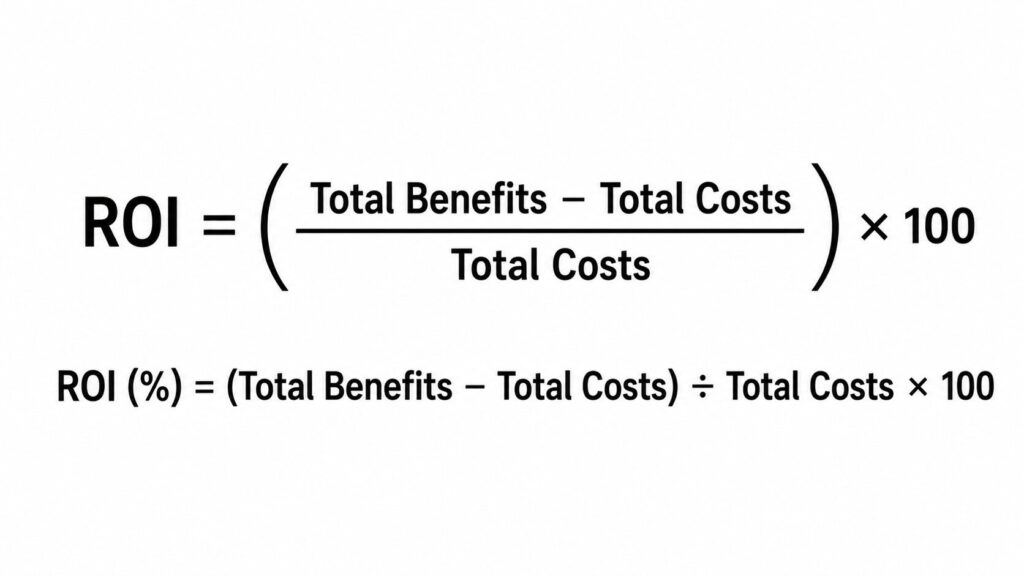
The formula in the diagram is:
ROI (%) = (Total Benefits − Total Costs) ÷ Total Costs × 100
Core Cost Attributes
Before calculating ROI, organizations must identify the total investment cost associated with the software. ROI calculations are only accurate when all direct and indirect costs are included.
Software Licensing Costs
Software licensing is typically the largest recurring expense.
Include:
- Subscription fees
- Per-employee pricing
- Tier-based plans
- Enterprise licensing
Purpose: Represents the ongoing cost of accessing and using the platform.
Implementation Costs
Implementation expenses occur during deployment and system setup.
Include:
- Setup fees
- Configuration costs
- Data migration
- Integration with HRIS systems
- Customization
Purpose: Covers the resources required to make the software operational within the organization.
Training & Adoption Costs
Organizations must invest in user adoption to achieve value from the system.
Include:
- Manager training
- Employee onboarding
- Change management programs
- Learning resources
Purpose: Ensures employees and managers can effectively use the platform.
Maintenance & Support Costs
Ongoing operational costs continue after implementation.
Include:
- Technical support
- System upgrades
- IT maintenance
- Vendor support services
Purpose: Keeps the platform functioning efficiently and securely over time.
Core ROI Benefit Drivers
This is the most important part of ROI analysis because benefits determine the value generated by the investment.
Productivity Improvement
Performance systems improve execution by providing:
- Clear goal alignment
- Reduced performance confusion
- Faster task completion
- Improved focus
Example Metric
Employee Productivity Growth (%)
Definition: Percentage increase in employee output over a defined period.
Unit: Percentage (%)
Timeframe: Quarterly or annually
ROI Impact: Higher productivity often translates directly into increased business output and revenue generation.
Reduced Employee Turnover
Effective performance management can improve:
- Employee engagement
- Career development
- Recognition
Turnover Savings Formula
Turnover Savings=Cost of Turnover×Reduction in AttritionTurnover\ Savings=Cost\ of\ Turnover\times Reduction\ in\ AttritionTurnover Savings=Cost of Turnover×Reduction in Attrition
Organizations often estimate turnover costs at 50–200% of an employee's annual salary, depending on role complexity and replacement costs.
ROI Impact: Even small reductions in attrition can create substantial savings.
Manager Efficiency Gains
Performance software reduces administrative work for managers.
Benefits include:
- Automated performance reviews
- Simplified documentation
- Less manual tracking
- Faster reporting
Example Metric
Manager Time Savings
Definition: Total management hours saved through automation.
Unit: Hours per year
Timeframe: Annual
ROI Impact: Saved managerial time can be redirected toward coaching, strategy, and team development.
Improved Goal Achievement
Performance systems improve organizational execution through:
- Better OKR tracking
- Strategic alignment
- Increased project completion rates
Example Metrics
Goal Completion Rate
Definition: Percentage of planned goals successfully achieved.
Unit: Percentage (%)
Timeframe: Quarterly or annually
ROI Impact: Higher goal achievement often contributes directly to revenue growth and business performance.
Reduced Administrative Work
Manual performance processes consume significant HR resources.
Performance software can automate:
- Feedback systems
- Self-service dashboards
- Performance documentation
Example Metric
HR Time Savings
Definition: Reduction in administrative hours spent managing performance processes.
Unit: Hours per year
Timeframe: Annual
ROI Impact: HR teams can focus more on strategic workforce initiatives.
Better Talent Development
Performance systems support workforce development through:
- Identifying high performers
- Succession planning
- Skill development tracking
Example Metric
Internal Promotion Rate
Definition: Percentage of open positions filled by internal candidates.
Unit: Percentage (%)
Timeframe: Annual
ROI Impact: Internal promotions often reduce hiring costs and improve retention.
Measurement Metrics
Organizations commonly track the following metrics when evaluating ROI, as shown in the chart below.
| Metric | Definition | Unit | Timeframe |
| Employee Productivity Growth | Increase in employee output | % | Quarterly/ Annual |
| Goal Completion Rate | Goals achieved vs Goals planned | % | Quarterly/ Annual |
| Engagement Score | Employee engagement measurement | Score or % | Quarterly/ Annual |
| Employee Retention Rate | Employees retained over the period | % | Annual |
| Manager Time Savings | Administrative hours reduced | Hours | Annual |
| Performance Review Completion Rate | Reviews completed on time | % | Review Cycle |
| Promotion Readiness | Employees prepared for advancement | % | Annual |
These metrics help quantify the business impact of performance management initiatives.
ROI Calculation Framework
Organizations can calculate ROI using the following process:
1️⃣ Identify Total Costs: Calculate all software, implementation, training, maintenance, and support expenses.
2️⃣ Measure Performance Improvements: Collect performance metrics before and after implementation.
3️⃣ Estimate Productivity Gains: Determine the financial value of increased employee productivity.
4️⃣ Calculate Turnover Reduction Savings: Measure reductions in attrition and estimate associated cost savings.
5️⃣ Quantify Time Savings: Calculate manager and HR hours saved through automation and process improvements.
6️⃣ Convert Improvements into Monetary Value: Translate productivity gains, retention improvements, and efficiency gains into financial terms.
7️⃣ Apply ROI Formula: Use the ROI formula to determine overall return on investment.
Research on calculating and improving ROI in software and system programs shows that software investments should be evaluated based on expected value and uncertainty, not only on upfront cost. The article highlights that ROI analysis should consider future benefits, costs, risks, and measurable business impact. This underscores the importance of calculating ROI for performance management software, as organizations need to compare licensing, implementation, training, and support costs with gains such as productivity improvements, reduced turnover, manager time savings, stronger goal achievement, and better talent development.
Real-World ROI Example
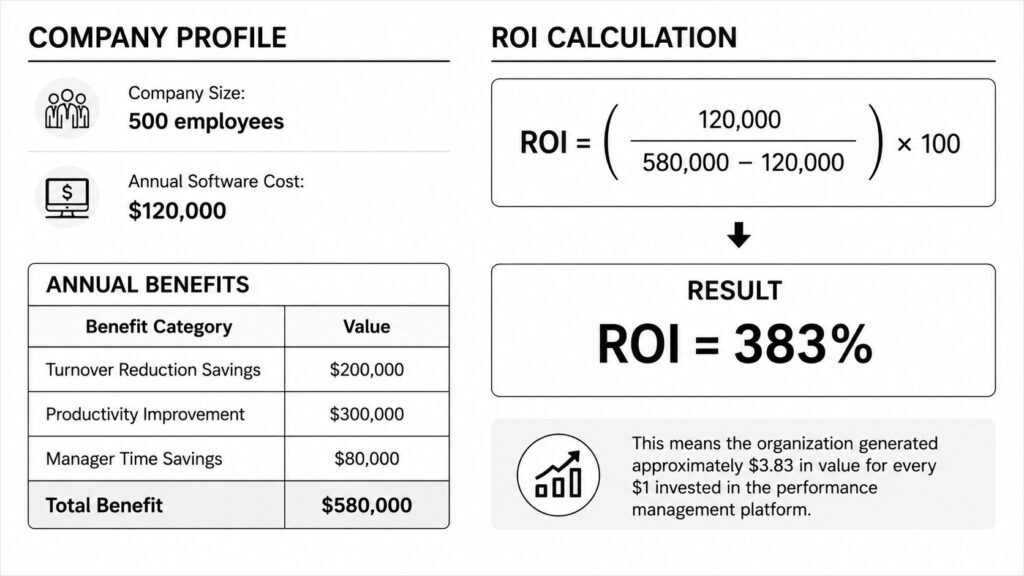
The infographic below presents a sample Return on Investment (ROI) analysis for a performance management platform, illustrating how software investments can generate measurable business value by improving productivity, reducing turnover, and increasing managerial efficiency.
Indirect ROI Benefits
Not all value generated by performance management software is immediately measurable in financial terms.
Examples include:
- Better employee engagement
- Stronger leadership accountability
- Improved transparency
- Reduced bias in evaluations
- Higher employee satisfaction
While these benefits may not appear directly in ROI calculations, they often contribute to long-term productivity, retention, and organizational effectiveness.
Common ROI Measurement Mistakes
Organizations often underestimate or miscalculate ROI due to several common errors.
- Ignoring Hidden Costs: Excluding implementation, training, or maintenance expenses can distort ROI results.
- Underestimating Productivity Gains: Small productivity improvements across large workforces can create significant value.
- Not Measuring Baseline Performance: Without pre-implementation benchmarks, it is difficult to accurately quantify improvement.
- Overlooking the Impact of Employee Engagement: Engagement improvements often influence retention, productivity, and performance outcomes.
- Treating Software as an HR Tool Only: Performance management software affects managers, employees, leadership teams, and business results, not just HR operations.
Technology & Analytics Integration
Modern performance management platforms provide built-in capabilities that improve the accuracy of ROI measurement.
Common tools include:
- Performance analytics dashboards
- Goal tracking systems
- People analytics insights
- Automated reports
These technologies help organizations monitor outcomes, measure workforce improvements, identify performance trends, and quantify the financial impact of performance initiatives with greater accuracy over time.
Calculating ROI in Performance Management Software requires a comprehensive assessment of both costs and benefits. By evaluating software expenses, productivity improvements, turnover reduction, efficiency gains, talent development outcomes, and workforce analytics, organizations can determine the true business value of their investment. Accurate ROI measurement helps justify technology spending, improve decision-making, and ensure performance management initiatives contribute to long-term organizational success.