
Performance management for small and medium-sized businesses (SMBs) is a structured yet practical approach to setting goals, measuring employee performance, and improving results in organizations with limited resources. It focuses on aligning individual performance with business objectives while maintaining flexibility, simplicity, and cost efficiency suited to SMB environments.
Core Attributes of Performance Management for SMBs
SMB-Specific Challenges
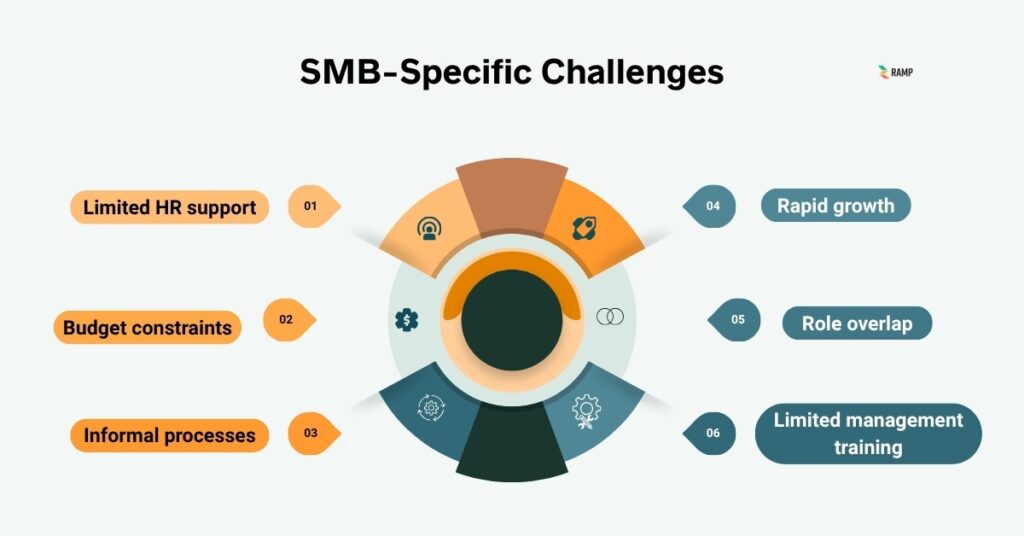
Small and medium-sized businesses operate under constraints that shape how performance management works. The diagram below illustrates key SMB-specific challenges.
The details of the challenges include:
- Limited HR support: Often, there is no dedicated HR team. Owners or general managers handle performance processes.
- Budget constraints: Investment in tools and training is minimal, requiring cost-conscious decisions.
- Informal processes: Many SMBs rely on verbal feedback rather than structured systems.
- Rapid growth: Expansion often outpaces the system's ability to keep up.
- Role overlap: Employees wear multiple hats, making evaluation complex.
- Limited management training: Managers may lack formal training in evaluating and coaching employees.
These factors make SMB performance management more hands-on and less system-driven than in large enterprises.
Goal Setting for SMBs
Clear goal alignment is often a weak point in SMBs. Effective approaches include:
- Translating overall business targets into team-level goals
- Breaking down objectives into simple, actionable tasks
- Balancing short-term goals (monthly revenue targets) with long-term plans (annual growth)
- Focusing on revenue-driven KPIs due to survival and growth priorities
- Ensuring each department understands its contribution
Avoid overly complex frameworks. Instead, keep goals practical and easy to track.
KPI Development
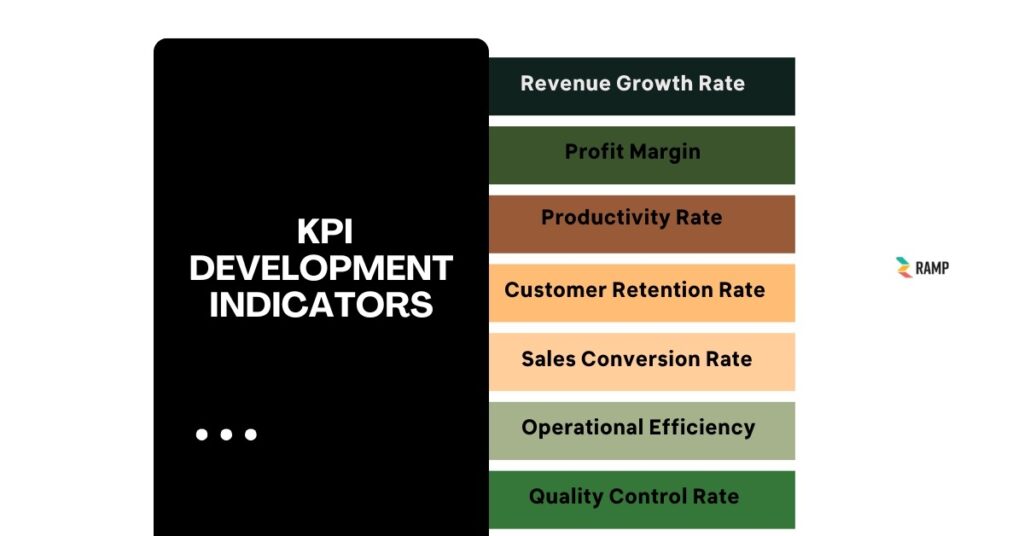
SMBs benefit from a focused set of measurable indicators. Each KPI should be clearly defined with a unit and a timeframe. The diagram shows the KPI development indicators.
The details include:
- Revenue Growth Rate: Percentage increase in revenue over a month or quarter
- Profit Margin: Percentage of profit from total revenue per month
- Productivity Rate: Output per employee per week or month
- Customer Retention Rate: Percentage of returning customers within a quarter
- Sales Conversion Rate: Percentage of leads converted into paying customers per month
- Operational Efficiency: Output relative to input costs over a defined period
- Quality Control Rate: Percentage of defect-free products or services per month
Keep KPIs simple, measurable, and directly tied to business outcomes.
Performance Review Structure
While SMBs often rely on informal feedback, structure is essential:
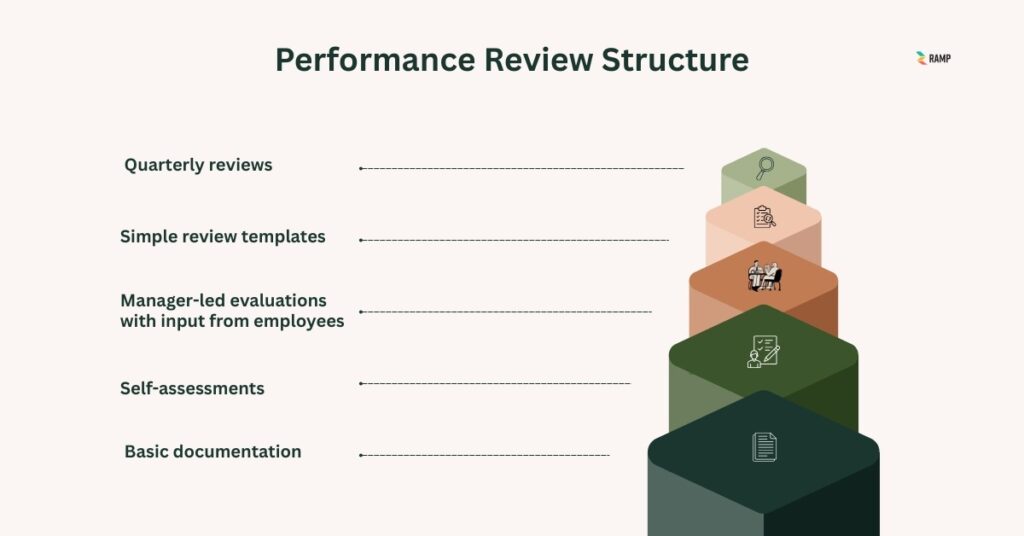
- Use quarterly reviews instead of relying only on annual evaluations
- Develop simple review templates to maintain consistency
- Conduct manager-led evaluations with input from employees
- Include self-assessments to encourage accountability
- Maintain basic documentation to track progress
Consistency matters more than complexity. The diagram below shows the essential structure of a performance review.
Continuous Feedback Culture
SMBs have an advantage in building close communication:
- Schedule regular 1:1 meetings (weekly or biweekly)
- Use a coaching mindset rather than a judgmental approach
- Implement recognition systems (even informal praise)
- Encourage open and clear communication
The diagram shows the components of an effective continuous feedback culture.
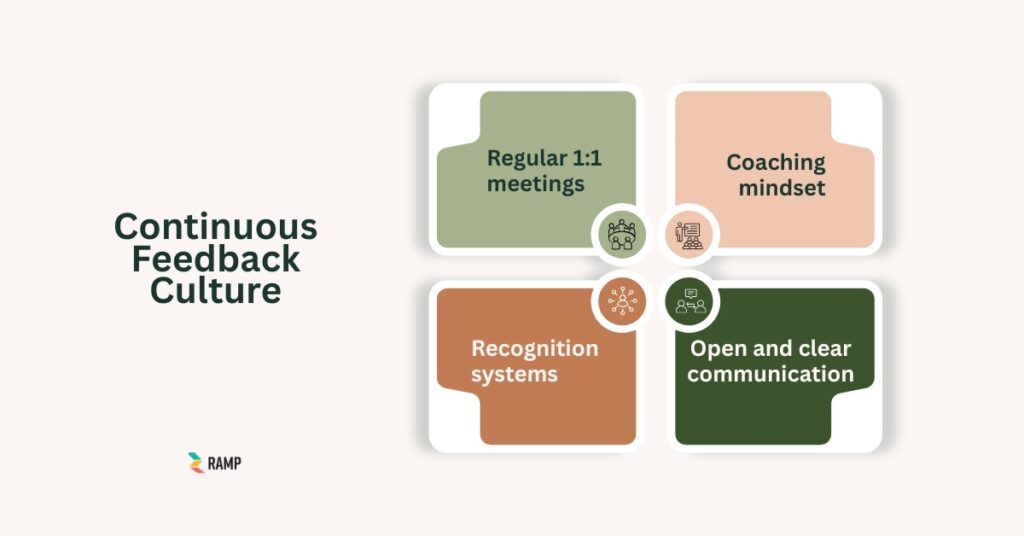
Frequent feedback helps SMBs stay agile and responsive.
Resource & Cost Considerations
Every investment must justify its value. The diagram shows the factors to consider for resources and costs.
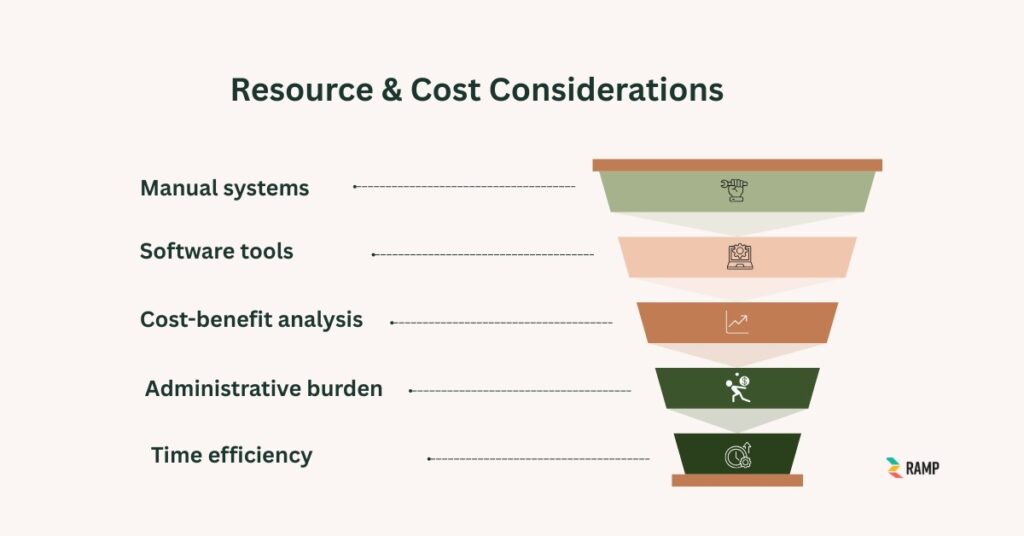
The factors to consider for resources and costs are explained in detail below.
- Manual systems: Spreadsheets and basic tracking tools are cost-effective
- Software tools: Affordable cloud-based solutions can improve efficiency
- Conduct a cost-benefit analysis before adopting tools
- Consider administrative burden vs. time saved
- Focus on time efficiency, not just cost reduction
The goal is to maximize output with minimal overhead.
Scalability & Growth Transition
As businesses grow, informal systems begin to fail:
Signs of breakdown:
- Inconsistent evaluations
- Lack of clear performance data
- Communication gaps
Transition steps:
- Move from spreadsheets to digital tracking systems
- Introduce standardized processes
- Prepare for a larger workforce management
Scaling requires gradual systemization without losing flexibility.
Legal & Compliance Considerations
Often overlooked but critical:
- Maintain documentation of performance discussions
- Ensure fair and consistent evaluations
- Reduce termination risks through documented evidence
- Avoid bias and discrimination
- Clearly define performance expectations
Inconsistent processes can expose SMBs to significant legal risks.
Common SMB Performance Management Mistakes
The common SMB performance management mistakes are shown in the diagram below.
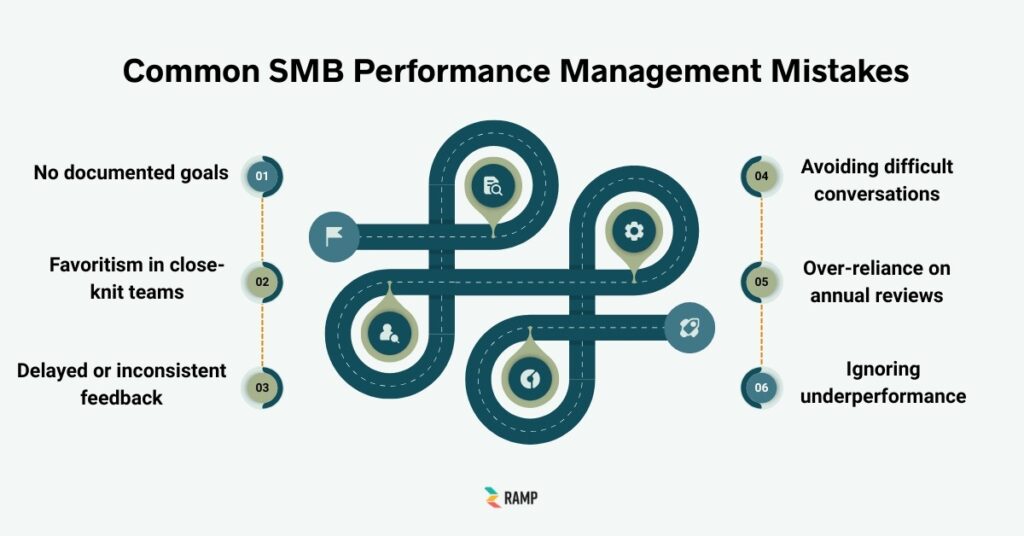
The common SMB performance management mistakes include:
- No documented goals
- Favoritism in close-knit teams
- Delayed or inconsistent feedback
- Avoiding difficult conversations
- Over-reliance on annual reviews
- Ignoring underperformance
These mistakes can quickly impact morale and productivity.
Performance Improvement in SMBs
Improving SMB performance requires practical action. The diagram below highlights effective measures.
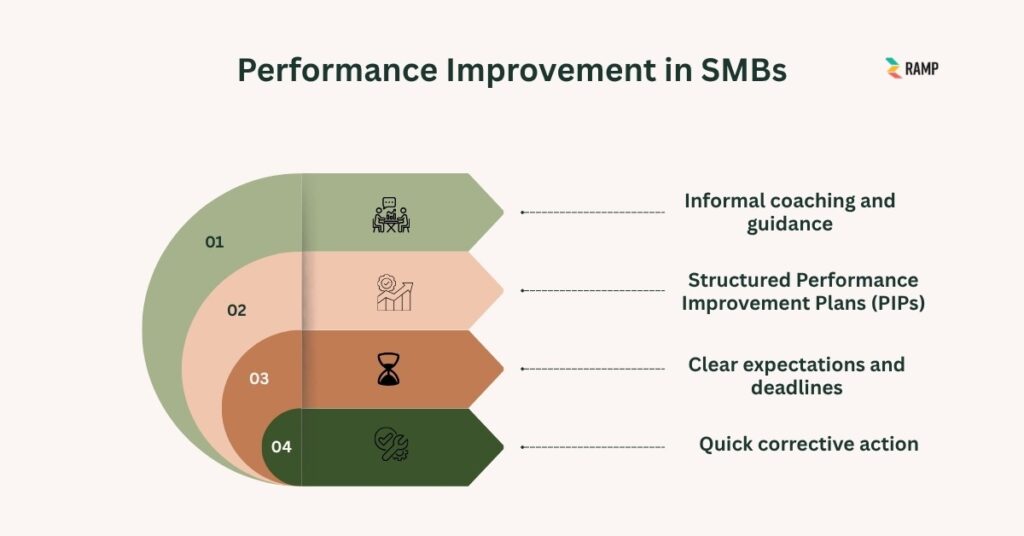
The details include:
- Start with informal coaching and guidance
- Use structured Performance Improvement Plans (PIPs) when necessary
- Set clear expectations and deadlines
- Take quick corrective action
In small teams, one underperformer can significantly affect outcomes.
Technology & Tools for SMBs
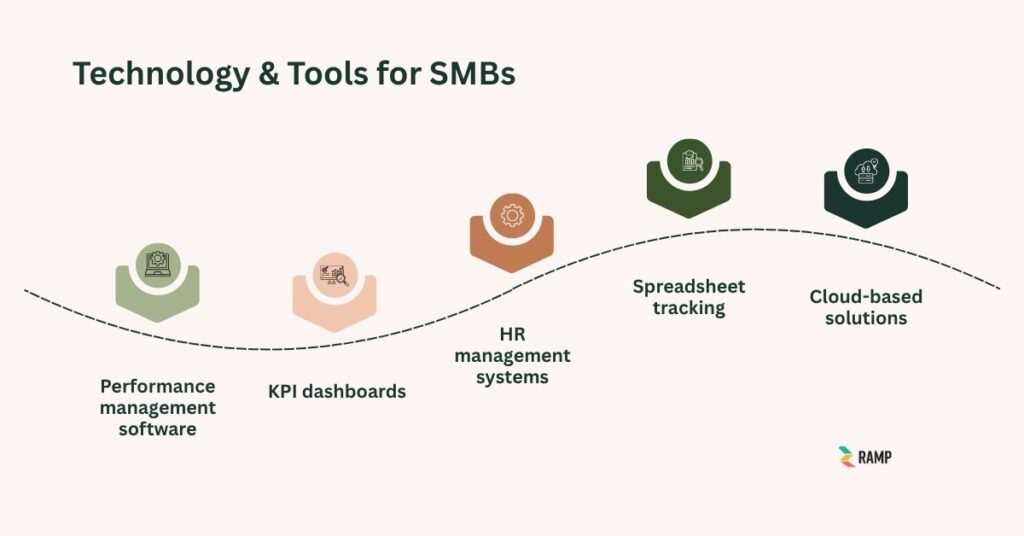
The diagram depicts affordable technology and tools that support SMB performance management.
The technology and tools for SMBs include:
- Lightweight performance management software
- Simple KPI dashboards
- Basic HR management systems
- Spreadsheet tracking for early-stage businesses
- Affordable cloud-based solutions
The key is balancing cost with operational efficiency.
Cultural Advantages of SMBs
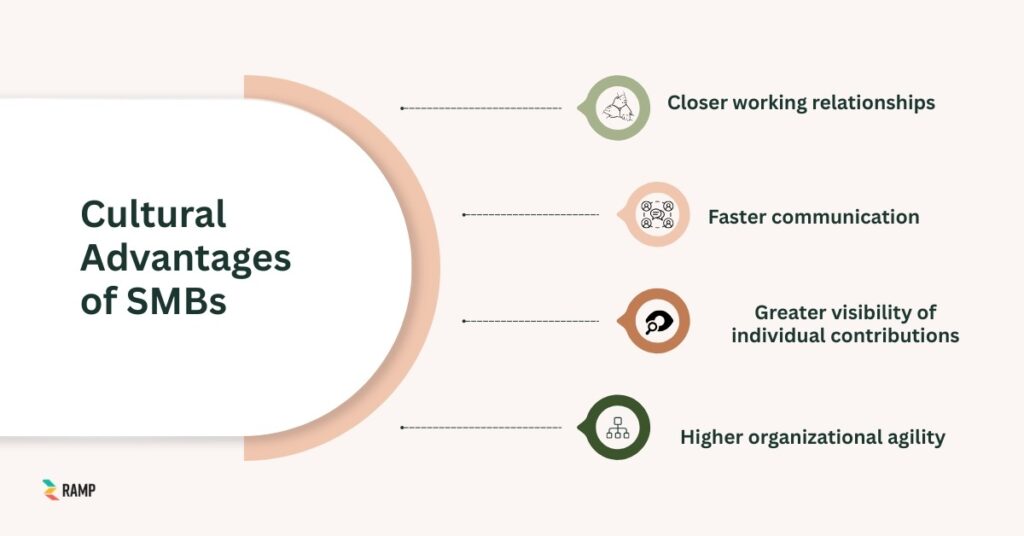
SMBs possess inherent cultural strengths. The diagram below outlines how to leverage these advantages effectively.
The cultural advantages in the diagram are listed below.
- Closer working relationships
- Faster communication
- Greater visibility of individual contributions
- Higher organizational agility
These advantages can compensate for limited resources if used effectively.
Research on performance management for SMEs in Thailand offers a useful process-based perspective. The study identifies six key stages: preparation, planning, implementation, evaluation, revision, and application. It also emphasizes adapting performance management to the unique capital, staffing, and management structures of SMEs to improve efficiency and support long-term sustainability.
Performance Management Lifecycle for SMBs
A practical step-by-step structure:
- Define business objectives
- Example: Increase monthly revenue by 15% over the next quarter
- Translate into employee goals
- Sales team target: Close 20 new deals per month
- Establish measurable KPIs
- Conversion rate: Percentage of leads converted monthly
- Conduct regular check-ins
- Weekly or biweekly one-on-one meetings
- Track results consistently
- Use spreadsheets or dashboards
- Provide continuous feedback
- Address issues early, recognize achievements
- Address underperformance quickly
- Apply coaching or structured improvement plans
- Review and refine the system
- Adjust goals, KPIs, and processes as the business evolves