Performance management for startups involves setting clear goals, tracking results, providing frequent feedback, and improving employee performance in a dynamic environment. Startups require flexible, short-cycle systems that enable speed, accountability, role clarity, and growth without excessive HR processes.
Core Attributes of Performance Management for Startups
Performance management in startups must be agile, lightweight, measurable, and founder-aligned. It should help teams move quickly while still creating clarity around goals, ownership, expectations, and results.
The best startup performance systems are not overly formal. They focus on fast feedback, short-term goals, role flexibility, strong communication, and early correction of performance issues.
A project report on Performance Management Systems and Their Influence on Startup Development also highlights the importance of performance management in startup growth. It explains that startups often begin with informal systems but can benefit from structured approaches such as OKRs, KPIs, continuous feedback, and digital performance tools as they scale. The report links effective performance management with stronger goal alignment, employee engagement, retention, transparency, and long-term scalability.
Startup-Specific Challenges
Startups face performance management challenges distinct from those of mature companies. The business model may change quickly, priorities may shift weekly, and employees often handle multiple roles at once. Because of this, traditional annual performance systems are usually too slow and rigid.
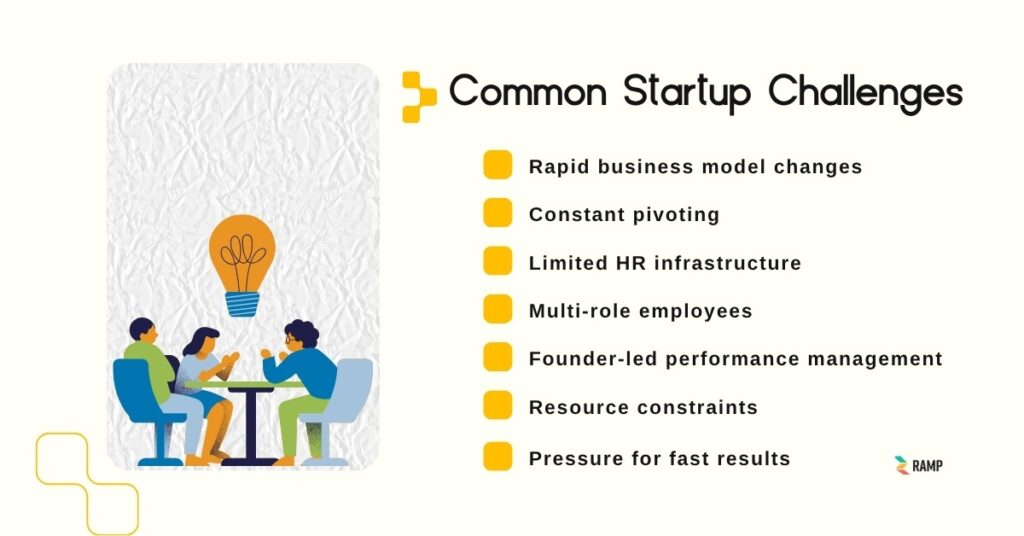
The diagram below highlights the common startup-specific challenges.
The details of the startup challenges include:
- Rapid business model changes: Goals may change as the startup learns from the market.
- Constant pivoting: Teams must adjust priorities quickly when products, customers, or funding conditions shift.
- Limited HR infrastructure: Early-stage startups may lack dedicated HR teams or formal review systems.
- Multi-role employees: One person may handle strategy, execution, customer support, and operations.
- Founder-led performance management: Founders often manage performance informally through direct conversations.
- Resource constraints: Startups must achieve more with fewer people, tools, and budgets.
- Pressure for fast results: Employees are expected to deliver quickly, often under uncertainty.
Because of these pressures, startups need a performance system that is structured enough to create accountability but flexible enough to support change.
Goal Setting in Startups
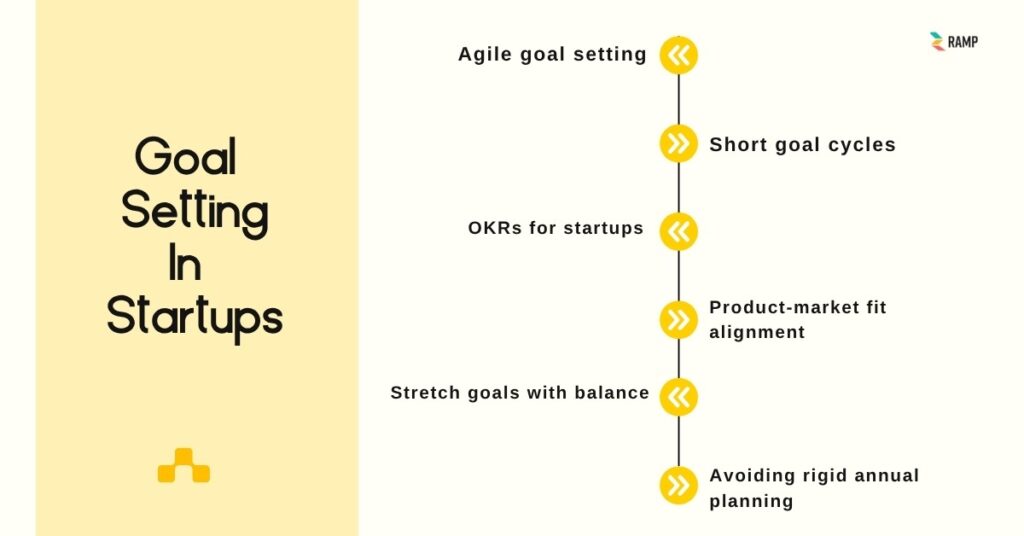
Goal setting is central to startup performance management. Startups cannot rely on rigid annual planning because market conditions, product direction, and funding priorities can change quickly. Instead, they need agile goal setting with short cycles. The diagram below lists effective startup goals.
Effective startup goal setting includes:
- Agile goal setting: Goals should be reviewed and adjusted frequently.
- Short goal cycles: Monthly or quarterly goals work better than annual goals.
- OKRs for startups: Objectives and Key Results help align teams around measurable outcomes.
- Product-market fit alignment: Goals should connect directly to learning, growth, retention, revenue, or product validation.
- Stretch goals with balance: Ambitious targets are useful, but unrealistic pressure can cause burnout.
- Avoiding rigid annual planning: Long-term vision matters, but execution goals must remain adaptable.
For example, instead of setting a yearly goal such as "increase revenue," a startup may set a quarterly OKR like: "Improve customer activation by increasing onboarding completion from 45% to 65% by the end of Q2."
Startup goals should answer three questions:
- What matters most right now?
- How will we measure progress?
- Who owns the outcome?
KPI Development
Startup KPIs differ from enterprise KPIs because startups are often focused on growth, validation, speed, and survival. A mature company may measure stability and efficiency, while a startup often measures traction, learning, revenue potential, and execution velocity.
The diagram below shows all the important startup KPIs.
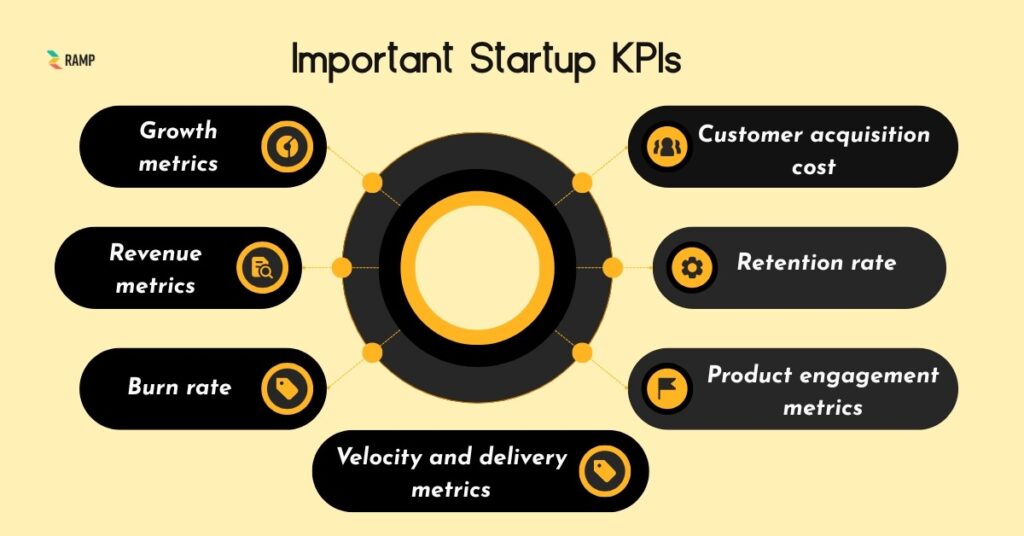
The details are given below.
- Growth metrics: User growth, sign-ups, activation rate, referral rate, or market expansion.
- Revenue metrics: Monthly recurring revenue, average revenue per customer, sales pipeline, and revenue growth rate.
- Burn rate: The amount of cash spent per month.
- Customer acquisition cost: CAC measures how much the company spends to acquire one customer.
- Retention rate: The percentage of customers or users who continue using the product over a defined period.
- Product engagement metrics: Active users, feature usage, session frequency, and onboarding completion.
- Velocity and delivery metrics: Sprint completion, cycle time, release frequency, and roadmap progress.
Role-Specific KPIs
This table outlines role-specific startup KPIs across Sales, Engineering, Marketing, and Product to show how performance metrics vary by function. It provides a simple view of the key measures startups can use to track contribution, execution, and business impact across teams.
| Function | Example Startup KPIs |
| Sales | Pipeline value, closed deals, conversion rate, sales cycle length, revenue generated |
| Engineering | Sprint velocity, deployment frequency, bug resolution time, system reliability, feature delivery |
| Marketing | Qualified leads, campaign conversion rate, CAC, website traffic, content performance |
| Product | Activation rate, retention, feature adoption, user feedback, roadmap delivery |
The best startup KPIs are practical and tied to the company's current priorities. Too many KPIs can create confusion, so startups should focus on a small set of metrics that directly reflect business progress.
Continuous Feedback Culture
Startups thrive on speed, so feedback must be frequent and direct. Annual reviews are usually ineffective in early-stage startups because they happen too late to improve performance or correct direction. The diagram shows the components of a strong, continuous feedback culture.
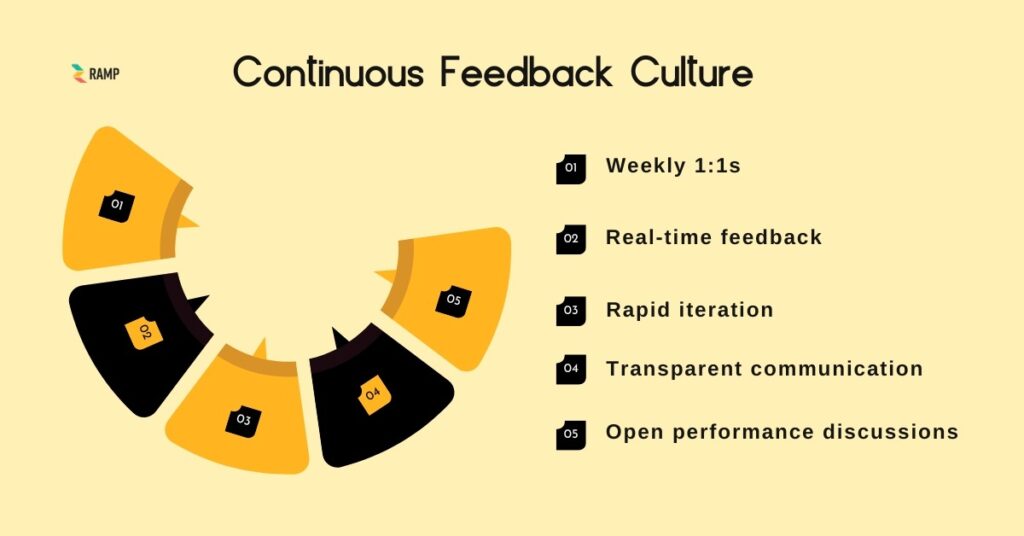
A strong, continuous feedback culture includes:
- Weekly 1:1s: Managers and employees discuss priorities, blockers, progress, and development.
- Real-time feedback: Feedback is given close to the moment when the behavior or result happens.
- Rapid iteration: Employees adapt quickly to new information.
- Transparent communication: Teams openly discuss what is working, what is not, and what needs to change.
- Open performance discussions: Performance should not be a hidden or uncomfortable topic.
In startups, feedback should be direct but respectful. The goal is not to criticize people; it is to improve execution quickly.
A healthy feedback culture helps startups avoid delayed decisions, unclear expectations, and silent frustration.
Role Clarity vs Role Flexibility
Startups need both role clarity and role flexibility. Employees must be flexible enough to work across functions, but they also need clear ownership so accountability does not disappear.
This is one of the biggest performance tensions in startups. If roles are too rigid, the company moves slowly. If roles are too vague, work gets duplicated, ignored, or delayed.
Startup performance management should include:
- Clear expectations in fluid roles: Employees should know their main responsibilities, even if they help outside their role.
- Defined ownership: Every major goal, project, or metric should have an owner.
- Cross-functional collaboration: Employees may work across product, sales, marketing, engineering, and customer success.
- Avoiding accountability gaps: Flexibility should not become an excuse for unclear responsibility.
For example, a product manager may help with customer calls, marketing messaging, and roadmap planning, but they should still have clear ownership of product priorities and user outcomes.
Founder and Leadership Influence
Startup performance systems are heavily shaped by founders and early leaders. In the early stages, employees often learn what matters by watching the founder's behavior, not by reading formal policies. The diagram below shows the criteria that the founder can influence.
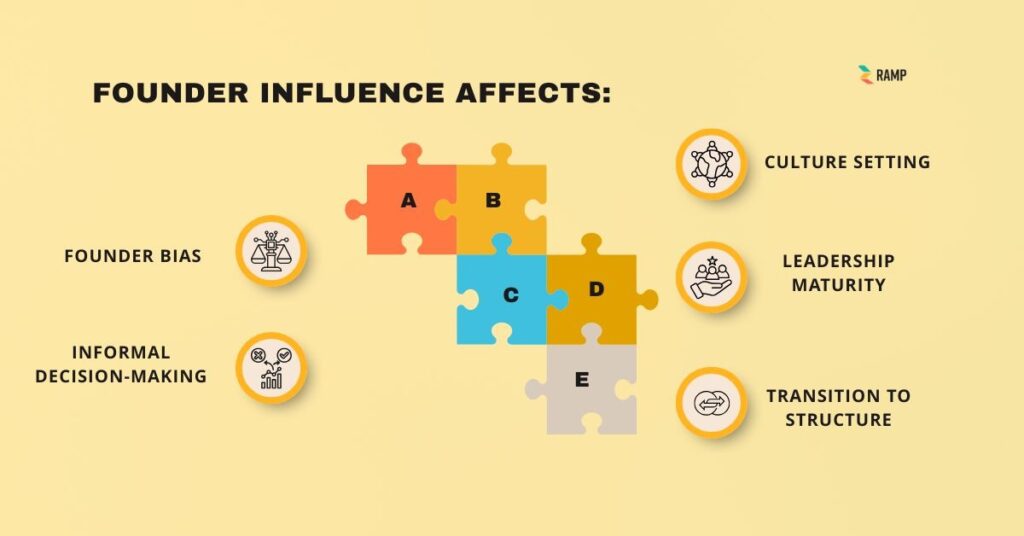
The details include:
- Founder bias: Founders may favor employees who think like them, work the same hours, or communicate in similar ways.
- Informal decision-making: Performance decisions may be made on instinct rather than on evidence.
- Culture setting: Founders define the company's standards for speed, quality, communication, and accountability.
- Leadership maturity: Inexperienced leaders may avoid difficult conversations or over-reliance on urgency.
- Transition to structure: As the company grows, informal feedback must become more consistent and documented.
Founder-led performance management can work in the early stage, but it becomes risky as the company scales. Startups eventually need clearer systems so performance decisions are not based only on personal judgment or proximity to leadership.
Performance Management by Growth Stage
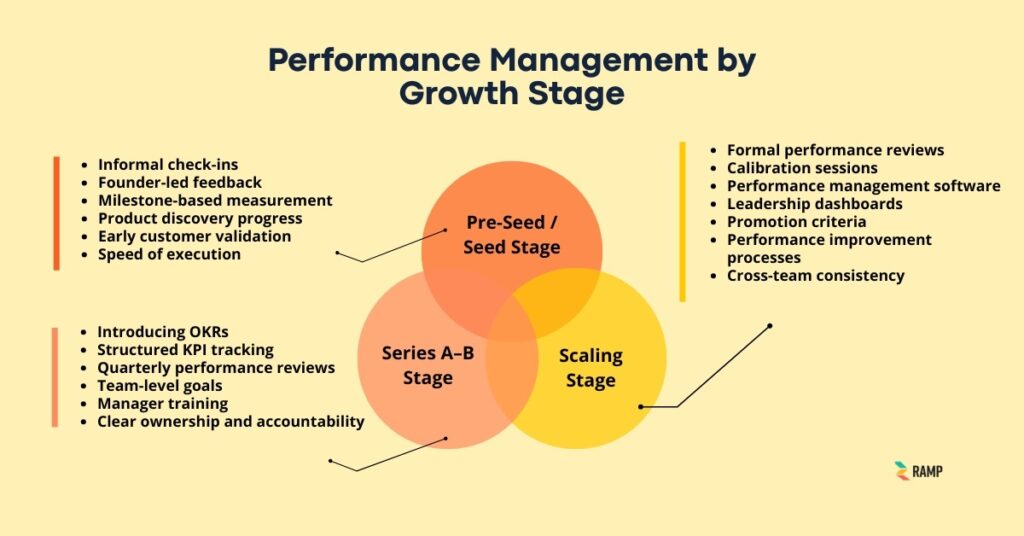
Startup performance management should evolve as the company grows. A pre-seed startup does not need the same system as a scaling organization with hundreds of employees.
Pre-Seed / Seed Stage
At this stage, performance management is usually informal and founder-driven.
Focus areas include:
- Informal check-ins
- Founder-led feedback
- Milestone-based measurement
- Product discovery progress
- Early customer validation
- Speed of execution
The goal is to keep people aligned without slowing the company down with heavy processes.
Series A–B Stage
At this stage, the company needs more structure because teams are larger and execution is more complex.
Focus areas include:
- Introducing OKRs
- Structured KPI tracking
- Quarterly performance reviews
- Team-level goals
- Manager training
- Clear ownership and accountability
The company should begin creating repeatable performance habits.
Scaling Stage
At the scaling stage, performance management must become more formal and consistent.
Focus areas include:
- Formal performance reviews
- Calibration sessions
- Performance management software
- Leadership dashboards
- Promotion criteria
- Performance improvement processes
- Cross-team consistency
The goal is to maintain startup speed while reducing chaos, bias, and inconsistent management. The diagram below summarizes the growth stage of startup performance management.
Performance Improvement in Startups
Startups need early intervention when performance problems appear. Because teams are small, one person's underperformance can quickly affect product delivery, customer experience, morale, or cash flow. So, it's crucial to know about effective performance improvement (PIPS).
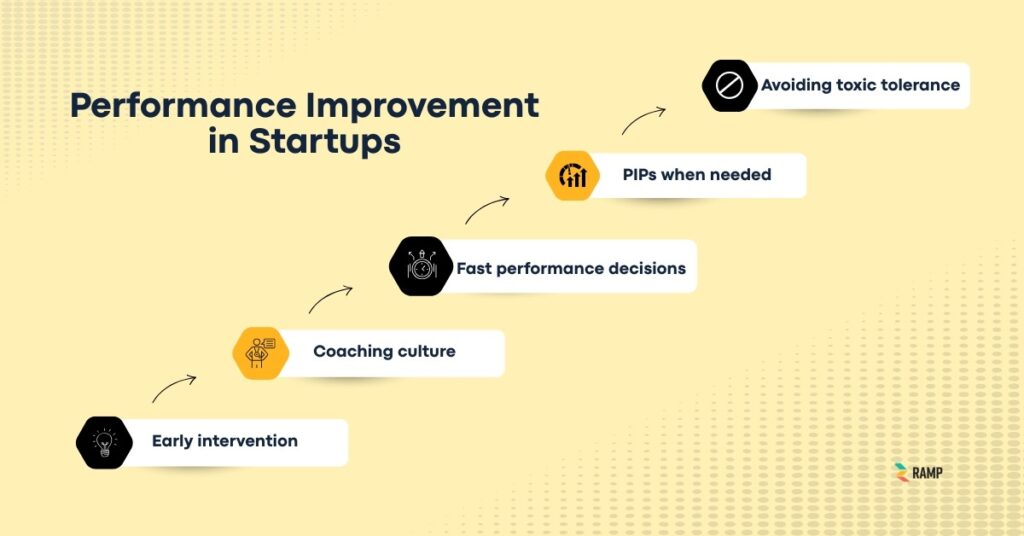
As shown in the diagram above, the effective performance improvement includes:
- Early intervention: Address issues as soon as patterns appear.
- Coaching culture: Managers should explain expectations, provide feedback, and help employees improve.
- Fast performance decisions: Startups cannot afford to ignore repeated underperformance for too long.
- PIPs when needed: A Performance Improvement Plan may be useful when an employee has ongoing performance issues but still has a realistic chance to improve.
- Avoiding toxic tolerance: Keeping underperformers too long can damage high performers, slow execution, and weaken accountability.
A startup PIP should be short, clear, and practical. It should define the performance issue, measurable goals, timeline, support, and consequences.
However, not every issue needs a PIP. Some problems can be solved through coaching, clearer goals, training, or role adjustment.
Culture and Psychological Safety
Startups are high-pressure environments. Employees often work under uncertainty, tight deadlines, and limited resources. Without a healthy culture, performance management can easily become stressful, reactive, or fear-driven.
The diagram below shows the factors startups should consider regarding culture and psychological safety.

Important cultural factors include:
- Psychological safety: Employees should feel safe raising concerns, admitting mistakes, and asking for help.
- Burnout prevention: Stretch goals should not become constant overwork.
- Transparency: Leaders should clearly communicate priorities, risks, and changes.
- Recognition: Employees need acknowledgment for effort, progress, and impact.
- Ownership mindset: People should feel responsible for outcomes, not just tasks.
A strong startup culture balances urgency with trust. It encourages speed, but not chaos. It drives performance without compromising employee health or long-term sustainability.
Tools and Technology
Startups should use lightweight performance tools that support speed and clarity. Overly complex HR systems can create an administrative burden before the company is ready for them. The diagram shows the tools startups use.
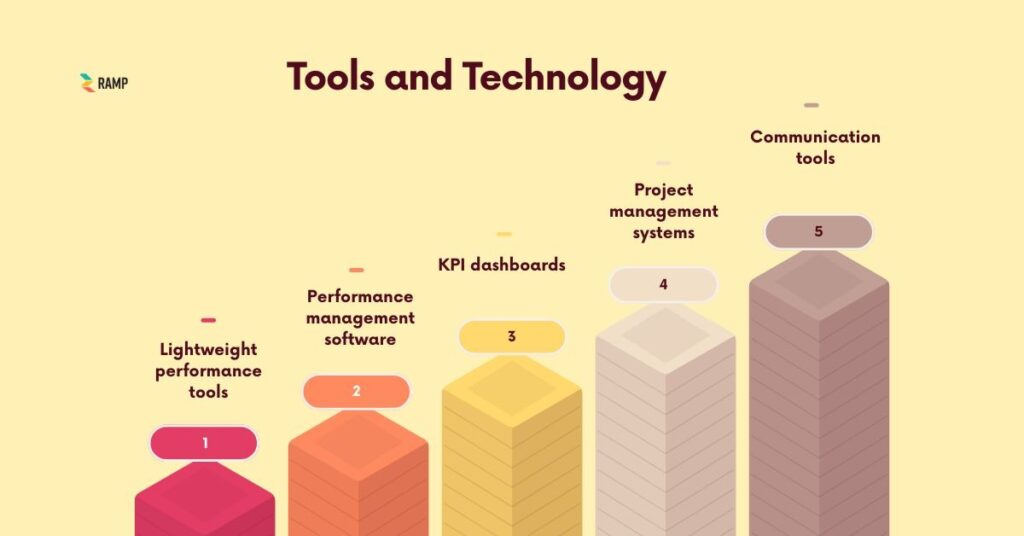
Useful tools include:
- Lightweight performance tools: Simple systems for goals, feedback, and reviews.
- Performance management software: Helpful as the team grows and needs consistency.
- KPI dashboards: Track company, team, and individual performance metrics.
- Project management systems: Tools for tasks, ownership, deadlines, and delivery tracking.
- Communication tools: Support async updates, feedback, and team alignment.
Startups should avoid overly complex HR systems that require excessive setup, training, or maintenance. The best tools are easy to adopt, flexible, and connected to daily work.
Technology should make performance more visible, not create surveillance or unnecessary bureaucracy.
Common Startup Performance Mistakes
Startups often make performance mistakes because they move quickly and delay structure until problems become painful. Thus, it's important to keep common performance management mistakes in mind as you move forward. The diagram below shows common startup performance mistakes.
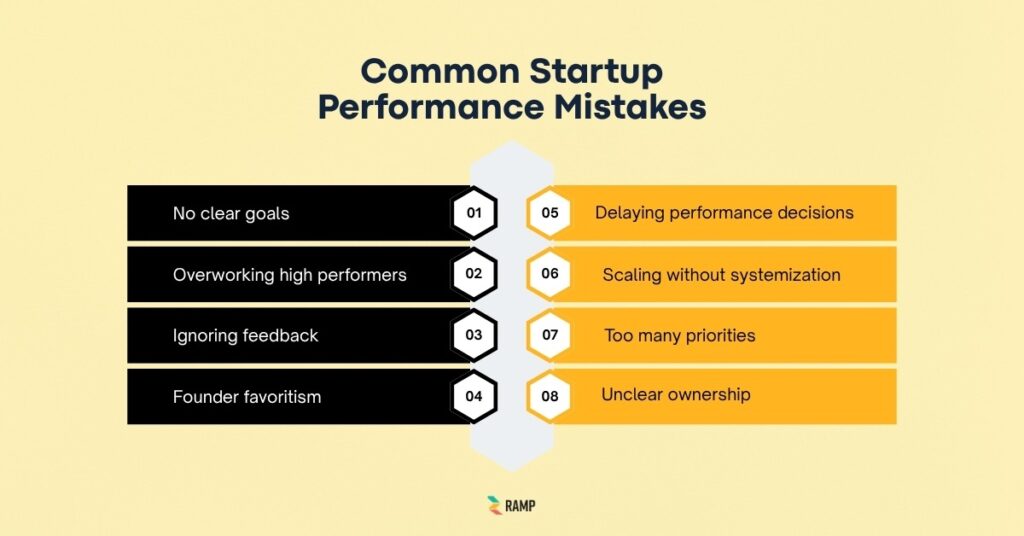
The details of the common mistakes include:
- No clear goals: Employees work hard, but not always on the right priorities.
- Overworking high performers: Strong employees become overloaded because leaders rely on them too much.
- Ignoring feedback: Managers avoid difficult conversations until issues become serious.
- Founder favoritism: Early employees or those trusted by the founder may receive unfair advantages.
- Delaying performance decisions: Underperformance continues because leaders hope it will fix itself.
- Scaling without systemization: What worked for 10 people breaks when the company reaches 50, 100, or more employees.
- Too many priorities: Teams lose focus because everything is treated as urgent.
- Unclear ownership: Work slips through gaps because no one is directly accountable.
These mistakes can slow growth, create frustration, and damage culture.
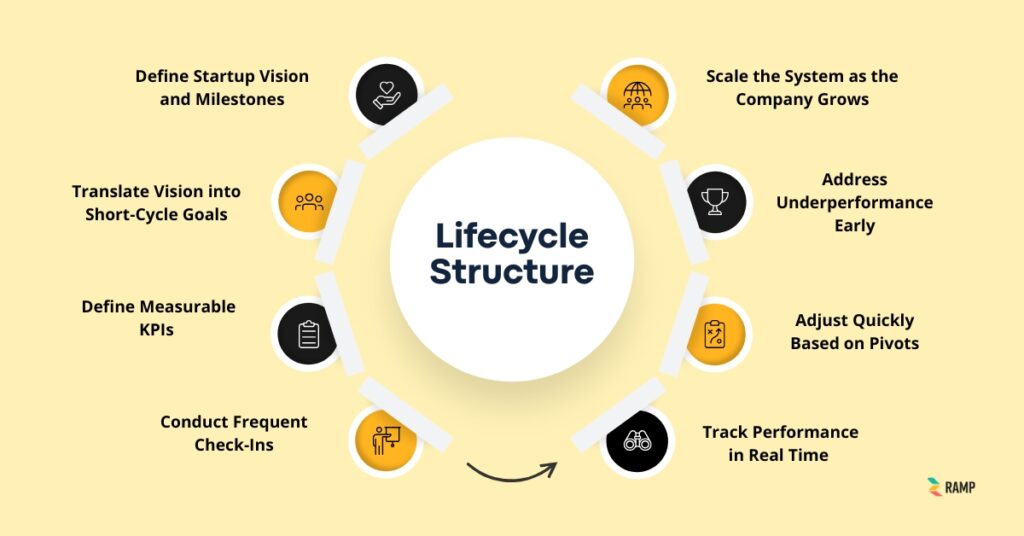
Lifecycle Structure: Building Performance Management as a Startup System
1. Define Startup Vision and Milestones
Start with the company's current vision, business model, funding stage, and key milestones. These may include launching a product, reaching revenue targets, improving retention, raising funding, or achieving product-market fit.
2. Translate Vision into Short-Cycle Goals
Convert the startup vision into monthly or quarterly goals. These goals should reflect current priorities, not outdated annual plans.
Example:
- Launch MVP by the end of the month
- Improve the activation rate this quarter
- Close the first 20 paying customers
- Reduce churn before the next funding round
3. Define Measurable KPIs
Select KPIs that show whether the team is making progress. Keep the list focused. Each KPI should have an owner, a timeframe, and a clear measurement method.
4. Conduct Frequent Check-Ins
Hold weekly 1:1s, team standups, and leadership reviews to discuss progress, blockers, priorities, and feedback. Frequent check-ins enable startups to move quickly while maintaining alignment.
5. Track Performance in Real Time
Utilize dashboards, project tools, and simple reporting to monitor progress. Real-time tracking enables teams to identify issues early, rather than waiting for periodic reviews.
6. Adjust Quickly Based on Pivots
When a startup pivots, its performance goals should change as well. Employees should not be evaluated against goals that are no longer relevant to the business direction.
7. Address Underperformance Early
Address missed expectations promptly. Begin with coaching, then implement formal improvement steps if necessary. Clear and early feedback supports both performance and culture.
8. Scale the System as the Company Grows
As the startup expands, introduce more structure: OKRs, quarterly reviews, calibration, promotion criteria, manager training, and performance management software. The system should mature with the company.
The diagram below summarizes the lifecycle and steps for building a performance management system as a startup.